Edward Deepak P, Alkatan Hind, Rafiq Qundeel, Eberhart Charles, Al Mesfer Saleh, Ghazi Nicola, Al Safieh Leen, Kondkar Altaf A, Abu Amero Khaled K
King Khaled Eye Specialist Hospital, Riyadh, Saudi Arabia; Wilmer Eye Institute, John Hopkins University School Of Medicine, Baltimore, MD, United States of America.
King Khaled Eye Specialist Hospital, Riyadh, Saudi Arabia.
PLoS One. 2015 Mar 25;10(3):e0121706. doi: 10.1371/journal.pone.0121706. eCollection 2015.
To study the differential expression of microRNA (miRNA) profiles between intraocular medulloepithelioma (ME) and normal control tissue (CT).
Total RNA was extracted from formalin fixed paraffin embedded (FFPE) intraocular ME (n=7) and from age matched ciliary body controls (n=8). The clinical history and phenotype was recorded. MiRNA profiles were determined using the Affymetrix GeneChip miRNA Arrays analyzed using expression console 1.3 software. Validation of significantly dysregulated miRNA was confirmed by quantitative real-time PCR. The web-based DNA Intelligent Analysis (DIANA)-miRPath v2.0 was used to perform enrichment analysis of differentially expressed (DE) miRNA gene targets in Kyoto Encyclopedia of Genes and Genomes (KEGG) pathway.
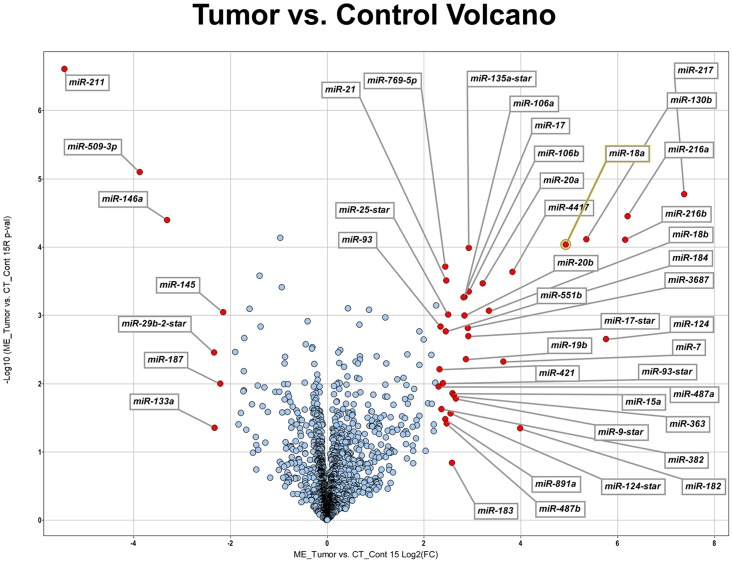
The pathologic evaluation revealed one benign (benign non-teratoid, n=1) and six malignant tumors (malignant teratoid, n=2; malignant non-teratoid, n = 4). A total of 88 miRNAs were upregulated and 43 miRNAs were downregulated significantly (P<0.05) in the tumor specimens. Many of these significantly dysregulated miRNAs were known to play various roles in carcinogenesis and tumor behavior. RT-PCR validated three significantly upregulated miRNAs and three significantly downregulated miRNAs namely miR-217, miR-216a, miR-216b, miR-146a, miR-509-3p and miR-211. Many DE miRNAs that were significant in ME tumors showed dysregulation in retinoblastoma, glioblastoma, and precursor, normal and reactive human cartilage. Enriched pathway analysis suggested a significant association of upregulated miRNAs with 15 pathways involved in prion disease and several types of cancer. The pathways involving significantly downregulated miRNAs included the toll-like receptor (TLR) (p<4.36E-16) and Nuclear Factor kappa B (NF-κB) signaling pathways (p<9.00E-06).
We report significantly dysregulated miRNAs in intraocular ME tumors, which exhibited abnormal profiles in other cancers as well such as retinoblastoma and glioblastoma. Pathway analysis of all dysregulated miRNAs shared commonalities with other cancer pathways.
研究眼内髓上皮瘤(ME)与正常对照组织(CT)之间微小RNA(miRNA)谱的差异表达。
从福尔马林固定石蜡包埋(FFPE)的眼内ME组织(n = 7)和年龄匹配的睫状体对照组织(n = 8)中提取总RNA。记录临床病史和表型。使用Affymetrix GeneChip miRNA阵列测定miRNA谱,并使用Expression Console 1.3软件进行分析。通过定量实时PCR确认显著失调的miRNA。基于网络的DNA智能分析(DIANA)-miRPath v2.0用于在京都基因与基因组百科全书(KEGG)途径中对差异表达(DE)的miRNA基因靶标进行富集分析。
病理评估显示1例良性肿瘤(良性非畸胎瘤,n = 1)和6例恶性肿瘤(恶性畸胎瘤,n = 2;恶性非畸胎瘤,n = 4)。在肿瘤标本中,共有88个miRNA上调,43个miRNA下调显著(P<0.05)。许多这些显著失调的miRNA在致癌作用和肿瘤行为中发挥各种作用。RT-PCR验证了3个显著上调的miRNA和3个显著下调的miRNA,即miR-217、miR-216a、miR-216b、miR-146a、miR-509-3p和miR-211。许多在ME肿瘤中显著的DE miRNA在视网膜母细胞瘤、胶质母细胞瘤以及人类软骨前体、正常和反应性组织中也显示失调。富集途径分析表明上调的miRNA与涉及朊病毒病和几种癌症的15条途径有显著关联。涉及显著下调miRNA的途径包括Toll样受体(TLR)(p<4.36E-16)和核因子κB(NF-κB)信号通路(p<9.00E-06)。
我们报告了眼内ME肿瘤中显著失调的miRNA,其在视网膜母细胞瘤和胶质母细胞瘤等其他癌症中也表现出异常谱。所有失调miRNA的途径分析与其他癌症途径有共同之处。