Castro-Magdonel Blanca Elena, Orjuela Manuela, Camacho Javier, García-Chéquer Adda Jeanette, Cabrera-Muñoz Lourdes, Sadowinski-Pine Stanislaw, Durán-Figueroa Noé, Orozco-Romero María de Jesús, Velázquez-Wong Ana Claudia, Hernández-Ángeles Adriana, Hernández-Galván Claudia, Lara-Molina Citlali, Ponce-Castañeda M Verónica
Medical Research Unit in Infectious Diseases, Hospital de Pediatría, CMN SXXI, Instituto Mexicano del Seguro Social, Av. Cuauhtémoc 330, 06720, Mexico City, Mexico.
Pharmacology Department, CINVESTAV, Mexico City, Mexico.
BMC Cancer. 2017 Jul 1;17(1):458. doi: 10.1186/s12885-017-3421-3.
miRNAs exert their effect through a negative regulatory mechanism silencing expression upon hybridizing to their target mRNA, and have a prominent position in the control of many cellular processes including carcinogenesis. Previous miRNA studies on retinoblastoma (Rb) have been limited to specific miRNAs reported in other tumors or to medium density arrays. Here we report expression analysis of the whole miRNome on 12 retinoblastoma tumor samples using a high throughput microarray platform including 2578 mature miRNAs.
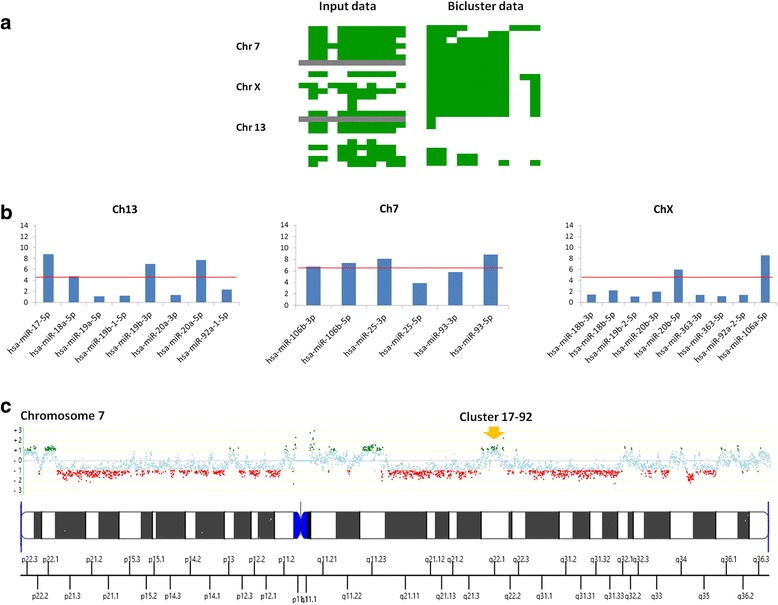
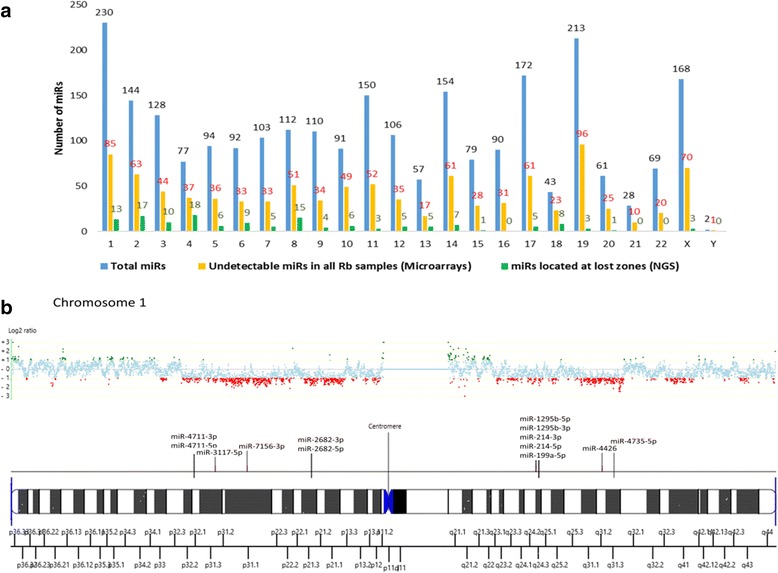
Twelve retinoblastoma tumor samples were analyzed using an Affymetrix platform including 2578 mature miRNAs. We applied RMA analysis to normalize raw data, obtained categorical data from detection call values, and also used signal intensity derived expression data. We used Diana-Tools-microT-CDS to find miRNA targets and ChromDraw to map miRNAs in chromosomes.
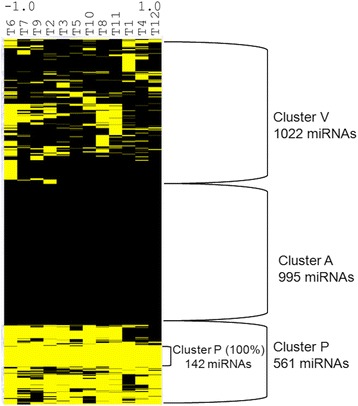
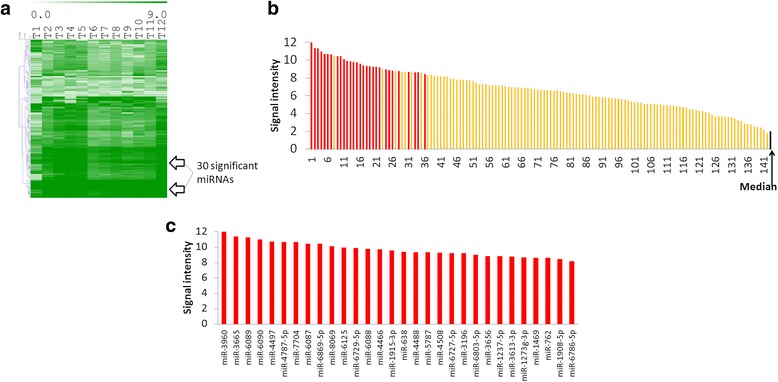
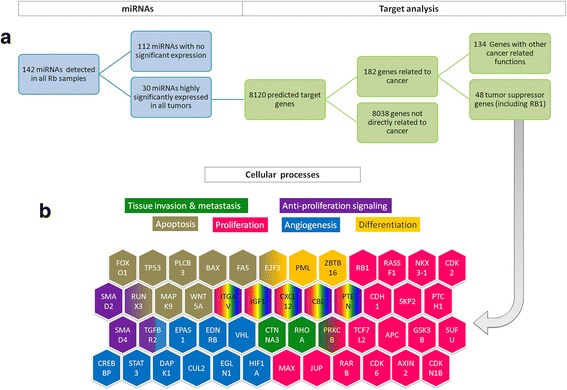
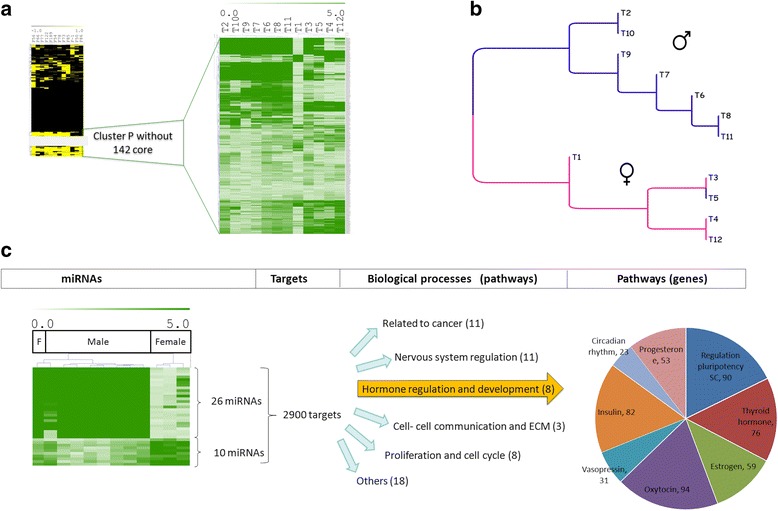
We discovered a core-cluster of 30 miRNAs that were highly expressed in all the cases and a cluster of 993 miRNAs that were uniformly absent in all cases. Another 1022 miRNA were variably present in the samples reflecting heterogeneity between tumors. We explored mRNA targets, pathways and biological processes affected by some of these miRNAs. We propose that the core-cluster of 30 miRs represent miRNA machinery common to all Rb, and affecting most pathways considered hallmarks of cancer. In this core, we identified miR-3613 as a potential and critical down regulatory hub, because it is highly expressed in all the samples and its potential mRNA targets include at least 36 tumor suppressor genes, including RB1. In the variably expressed miRNA, 36 were differentially expressed between males and females. Some of the potential pathways targeted by these 36 miRNAs were associated with hormonal production.
These findings indicate that Rb tumor samples share a common miRNA expression profile regardless of tumor heterogeneity, and shed light on potential novel therapeutic targets such as mir-3613 This is the first work to delineate the miRNA landscape in retinoblastoma tumor samples using an unbiased approach.
微小RNA(miRNA)通过与靶mRNA杂交沉默表达的负调控机制发挥作用,在包括致癌作用在内的许多细胞过程的调控中占据重要地位。先前关于视网膜母细胞瘤(Rb)的miRNA研究仅限于其他肿瘤中报道的特定miRNA或中密度阵列。在此,我们使用包含2578个成熟miRNA的高通量微阵列平台报告了12个视网膜母细胞瘤肿瘤样本的全miRNome表达分析。
使用包含2578个成熟miRNA的Affymetrix平台分析12个视网膜母细胞瘤肿瘤样本。我们应用RMA分析对原始数据进行归一化,从检测调用值获得分类数据,并使用信号强度衍生的表达数据。我们使用Diana-Tools-microT-CDS查找miRNA靶标,并使用ChromDraw在染色体上绘制miRNA。
我们发现了一个在所有病例中均高表达的30个miRNA的核心簇,以及一个在所有病例中均一致缺失的993个miRNA的簇。另外1022个miRNA在样本中可变存在,反映了肿瘤之间的异质性。我们探索了其中一些miRNA影响的mRNA靶标、途径和生物学过程。我们提出,30个miR的核心簇代表所有Rb共有的miRNA机制,并影响大多数被认为是癌症标志的途径。在这个核心中,我们将miR-3613鉴定为一个潜在的关键下调枢纽,因为它在所有样本中均高表达,其潜在的mRNA靶标包括至少36个肿瘤抑制基因,包括RB1。在可变表达的miRNA中,有36个在男性和女性之间差异表达。这36个miRNA靶向的一些潜在途径与激素产生有关。
这些发现表明,无论肿瘤异质性如何,Rb肿瘤样本都具有共同的miRNA表达谱,并揭示了潜在的新治疗靶点,如mir-3613。这是第一项使用无偏方法描绘视网膜母细胞瘤肿瘤样本中miRNA图谱的工作。