Gremmel Thomas, Perkmann Thomas, Kopp Christoph W, Seidinger Daniela, Eichelberger Beate, Koppensteiner Renate, Steiner Sabine, Panzer Simon
Division of Angiology, Department of Internal Medicine II, Medical University of Vienna, Vienna, Austria.
Department of Laboratory Medicine, Medical University of Vienna, Vienna, Austria.
PLoS One. 2015 Mar 25;10(3):e0122586. doi: 10.1371/journal.pone.0122586. eCollection 2015.
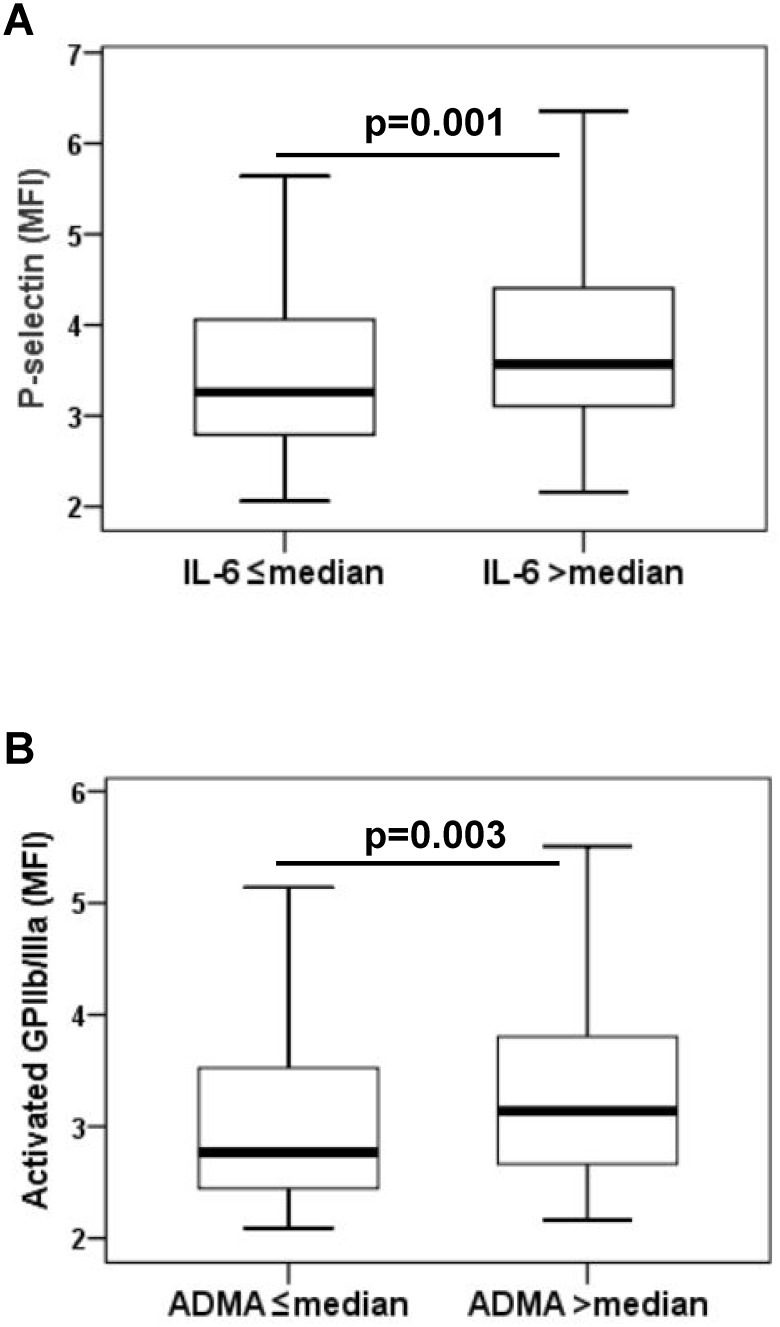
Data linking in vivo platelet activation with inflammation and cardiovascular risk factors are scarce. Moreover, the interrelation between endothelial dysfunction as early marker of atherosclerosis and platelet activation has not been studied, so far. We therefore sought to investigate the associations of inflammation, endothelial dysfunction and cardiovascular risk factors with platelet activation and monocyte-platelet aggregate (MPA) formation in 330 patients undergoing angioplasty with stent implantation for atherosclerotic cardiovascular disease. P-selectin expression, activation of glycoprotein IIb/IIIa and MPA formation were determined by flow cytometry. Interleukin (IL)-6, high sensitivity C-reactive protein and asymmetric dimethylarginine (ADMA) were measured by commercially available assays. IL-6 was the only parameter which was independently associated with platelet P-selectin expression and activated GPIIb/IIIa as well as with leukocyte-platelet interaction in multivariate regression analysis (all p<0.05). ADMA was independently associated with GPIIb/IIIa activation (p<0.05). Patients with high IL-6 exhibited a significantly higher expression of P-selectin than patients with low IL-6 (p=0.001), whereas patients with high ADMA levels showed a more pronounced activation of GPIIb/IIIa than patients with low ADMA (p=0.003). In conclusion, IL-6 and ADMA are associated with platelet activation after percutaneous angioplasty with stent implantation. It remains to be established whether they act prothrombotic and atherogenic themselves or are just surrogate markers for atherosclerosis with concomitant platelet activation.
关于体内血小板激活与炎症及心血管危险因素之间关联的数据很少。此外,迄今为止,作为动脉粥样硬化早期标志物的内皮功能障碍与血小板激活之间的相互关系尚未得到研究。因此,我们试图在330例因动脉粥样硬化性心血管疾病接受支架植入血管成形术的患者中,研究炎症、内皮功能障碍和心血管危险因素与血小板激活及单核细胞 - 血小板聚集体(MPA)形成之间的关联。通过流式细胞术测定P - 选择素表达、糖蛋白IIb/IIIa激活及MPA形成。通过市售检测方法测量白细胞介素(IL)-6、高敏C反应蛋白和不对称二甲基精氨酸(ADMA)。在多变量回归分析中,IL - 6是唯一与血小板P - 选择素表达、活化的GPIIb/IIIa以及白细胞 - 血小板相互作用独立相关的参数(所有p<0.05)。ADMA与GPIIb/IIIa激活独立相关(p<0.05)。高IL - 6患者的P - 选择素表达显著高于低IL - 6患者(p = 0.001),而高ADMA水平患者的GPIIb/IIIa活化比低ADMA患者更明显(p = 0.003)。总之,IL - 6和ADMA与支架植入后经皮血管成形术后的血小板激活有关。它们本身是否具有促血栓形成和致动脉粥样硬化作用,还是仅仅是伴随血小板激活的动脉粥样硬化的替代标志物,仍有待确定。