Rachiotis George, Stuckler David, McKee Martin, Hadjichristodoulou Christos
Department of Hygiene and Epidemiology, Medical Faculty, School of Health Science, University of Thessaly, Larissa, Greece.
Department of Sociology, University of Oxford, Oxford, UK European Centre on Health of Societies in Transition, London School of Hygiene and Tropical Medicine, London, UK.
BMJ Open. 2015 Mar 25;5(3):e007295. doi: 10.1136/bmjopen-2014-007295.
There is a controversy about the impact of economic crisis on suicide rates in Greece. We analysed recent suicide data to identify who has been most affected and the relationships to economic and labour market indicators.
Greece.
Age-specific and sex-specific suicide rates in Greece for the period 2003-2012 were calculated using data provided by the Hellenic Statistical Authority. We performed a join-point analysis to identify discontinuities in suicide trends between 2003 and 2010, prior to austerity, and in 2011-2012, during the period of austerity. Regression models were used to assess relationships between unemployment, Gross Domestic Product (GDP) and suicide rates for the entire period by age and sex.
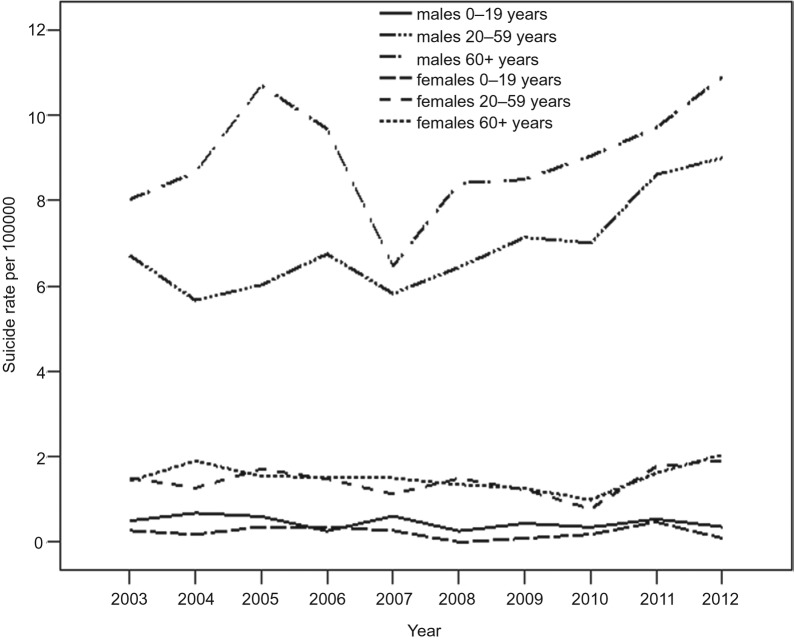
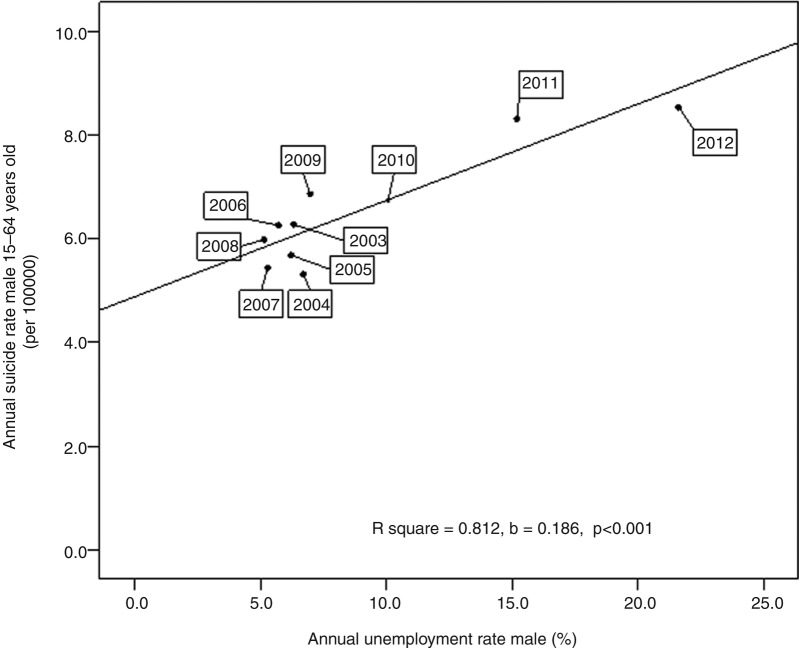
The mean suicide rate overall rose by 35% between 2010 and 2012, from 3.37 to 4.56/100,000 population. The suicide mortality rate for men increased from 5.75 (2003-2010) to 7.43/100,000 (2011-2012; p<0.01). Among women, the suicide rate also rose, albeit less markedly, from 1.17 to 1.55 (p=0.03). When differentiated by age group, suicide mortality increased among both sexes in the age groups 20-59 and >60 years. We found that each additional percentage point of unemployment was associated with a 0.19/100,000 population rise in suicides (95% CI 0.11 to 0.26) among working age men.
We found a clear increase in suicides among persons of working age, coinciding with austerity measures. These findings corroborate concerns that increased suicide risk in Greece is a health hazard associated with austerity measures.
经济危机对希腊自杀率的影响存在争议。我们分析了近期的自杀数据,以确定受影响最大的人群以及与经济和劳动力市场指标的关系。
希腊。
利用希腊统计局提供的数据,计算了2003 - 2012年期间希腊按年龄和性别划分的自杀率。我们进行了连接点分析,以确定2003年至2010年(紧缩政策实施前)以及2011 - 2012年(紧缩政策实施期间)自杀趋势的不连续性。使用回归模型评估整个时期按年龄和性别划分的失业率、国内生产总值(GDP)与自杀率之间的关系。
2010年至2012年期间,总体自杀率平均上升了35%,从每10万人3.37例升至4.56例。男性自杀死亡率从5.75(2003 - 2010年)升至7.43/10万(2011 - 2012年;p<0.01)。女性自杀率也有所上升,尽管幅度较小,从1.17升至1.55(p = 0.03)。按年龄组划分时,20 - 59岁和大于60岁年龄组的两性自杀死亡率均有所上升。我们发现,工作年龄男性的失业率每增加一个百分点,自杀率就会上升0.19/10万人口(95%可信区间0.11至0.26)。
我们发现工作年龄人群的自杀率明显上升,这与紧缩措施同时出现。这些发现证实了人们的担忧,即希腊自杀风险增加是与紧缩措施相关的健康危害。