Rhodin M, Roepstorff L, French A, Keegan K G, Pfau T, Egenvall A
Department of Clinical Sciences, Swedish University of Agricultural Sciences, Uppsala, Sweden.
Department of Anatomy, Physiology and Biochemistry, Swedish University of Agricultural Sciences, Uppsala, Sweden.
Equine Vet J. 2016 May;48(3):315-20. doi: 10.1111/evj.12446. Epub 2015 May 29.
Lungeing is commonly used as part of standard lameness examinations in horses. Knowledge of how lungeing influences motion symmetry in sound horses is needed.
The aim of this study was to objectively evaluate the symmetry of vertical head and pelvic motion during lungeing in a large number of horses with symmetric motion during straight line evaluation.
Cross-sectional prospective study.
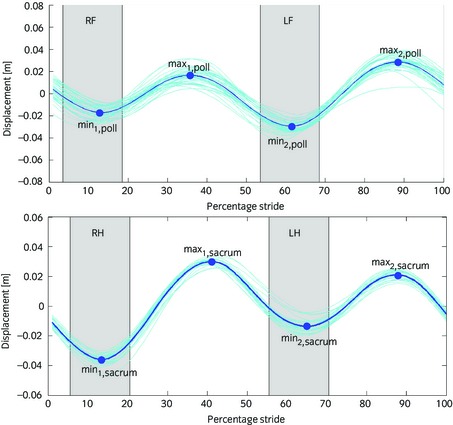
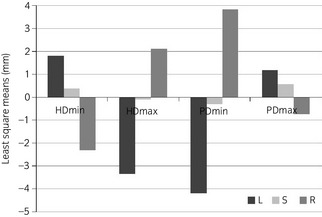
A pool of 201 riding horses, all functioning well and considered sound by their owners, were evaluated in trot on a straight line and during lungeing to the left and right. From this pool, horses with symmetric vertical head and pelvic movement during the straight line trot (n = 94) were retained for analysis. Vertical head and pelvic movements were measured with body mounted uniaxial accelerometers. Differences between vertical maximum and minimum head (HDmax, HDmin) and pelvic (PDmax, PDmin) heights between left and right forelimb and hindlimb stances were compared between straight line trot and lungeing in either direction.
Vertical head and pelvic movements during lungeing were more asymmetric than during trot on a straight line. Common asymmetric patterns seen in the head were more upward movement during push-off of the outside forelimb and less downward movement during impact of the inside limb. Common asymmetric patterns seen in the pelvis were less upward movement during push-off of the outside hindlimb and less downward movement of the pelvis during impact of the inside hindlimb. Asymmetric patterns in one lunge direction were frequently not the same as in the opposite direction.
Lungeing induces systematic asymmetries in vertical head and pelvic motion patterns in horses that may not be the same in both directions. These asymmetries may mask or mimic fore- or hindlimb lameness.
牵遛运动常用于马匹标准跛行检查。需要了解牵遛运动如何影响健康马匹的运动对称性。
本研究的目的是客观评估大量在直线评估中运动对称的马匹在牵遛时头部和骨盆垂直运动的对称性。
横断面前瞻性研究。
对201匹骑乘马进行评估,所有马匹功能良好且主人认为健康,在直线上以快步走进行评估,并分别向左和向右牵遛。从这些马匹中,保留在直线快步走时头部和骨盆垂直运动对称的马匹(n = 94)进行分析。使用安装在身体上的单轴加速度计测量头部和骨盆的垂直运动。比较直线快步走和向任一方向牵遛时,左右前肢和后肢站立时头部(HDmax、HDmin)和骨盆(PDmax、PDmin)高度的垂直最大和最小值之间的差异。
牵遛时头部和骨盆的垂直运动比直线快步走时更不对称。在头部常见的不对称模式是外侧前肢蹬地时向上运动更多,内侧肢体着地时向下运动更少。在骨盆常见的不对称模式是外侧后肢蹬地时向上运动更少,内侧后肢着地时骨盆向下运动更少。一个牵遛方向的不对称模式通常与相反方向不同。
牵遛会导致马匹头部和骨盆垂直运动模式出现系统性不对称,且两个方向可能不同。这些不对称可能掩盖或模拟前肢或后肢跛行。