Hanson Sonya M, Newstead Simon, Swartz Kenton J, Sansom Mark S P
Department of Biochemistry, University of Oxford, Oxford, United Kingdom; Computational Biology Program, Memorial Sloan-Kettering Cancer Center, New York, New York; Molecular Physiology and Biophysics Section, Porter Neuroscience Research Center, National Institute of Neurological Disorders and Stroke, National Institutes of Health, Bethesda, Maryland.
Department of Biochemistry, University of Oxford, Oxford, United Kingdom.
Biophys J. 2015 Mar 24;108(6):1425-1434. doi: 10.1016/j.bpj.2015.02.013.
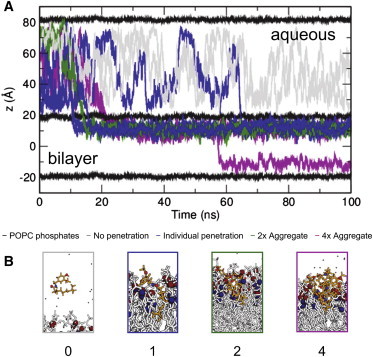
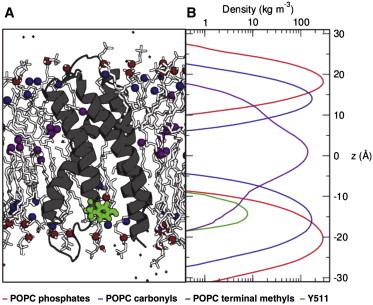
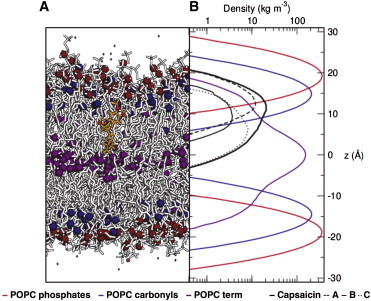
Transient receptor potential vanilloid subtype 1 (TRPV1) is a heat-sensitive ion channel also involved in pain sensation, and is the receptor for capsaicin, the active ingredient of hot chili peppers. The recent structures of TRPV1 revealed putative ligand density within the S1 to S4 voltage-sensor-like domain of the protein. However, questions remain regarding the dynamic role of the lipid bilayer in ligand binding to TRPV1. Molecular dynamics simulations were used to explore behavior of capsaicin in a 1-palmitoyl-2-oleoyl phosphatidylcholine bilayer and with the target S1-S4 transmembrane helices of TRPV1. Equilibrium simulations reveal a preferred interfacial localization for capsaicin. We also observed a capsaicin molecule flipping from the extracellular to the intracellular leaflet, and subsequently able to access the intracellular TRPV1 binding site. Calculation of the potential of mean force (i.e., free energy profile) of capsaicin along the bilayer normal confirms that it prefers an interfacial localization. The free energy profile indicates that there is a nontrivial but surmountable barrier to the flipping of capsaicin between opposing leaflets of the bilayer. Molecular dynamics of the S1-S4 transmembrane helices of the TRPV1 in a lipid bilayer confirm that Y511, known to be crucial to capsaicin binding, has a distribution along the bilayer normal similar to that of the aromatic group of capsaicin. Simulations were conducted of the TRPV1 S1-S4 transmembrane helices in the presence of capsaicin placed in the aqueous phase, in the lipid, or docked to the protein. No stable interaction between ligand and protein was seen for simulations initiated with capsaicin in the bilayer. However, interactions were seen between TRPV1 and capsaicin starting from the cytosolic aqueous phase, and capsaicin remained stable in the majority of simulations from the docked pose. We discuss the significance of capsaicin flipping from the extracellular to the intracellular leaflet and mechanisms of binding site access by capsaicin.
瞬时受体电位香草酸亚型1(TRPV1)是一种热敏离子通道,也参与痛觉感受,并且是辣椒素(即辣椒的活性成分)的受体。TRPV1的最新结构揭示了该蛋白S1至S4电压感受器样结构域内存在假定的配体密度。然而,关于脂质双层在配体与TRPV1结合中的动态作用仍存在问题。分子动力学模拟被用于探究辣椒素在1-棕榈酰-2-油酰磷脂酰胆碱双层以及与TRPV1的目标S1-S4跨膜螺旋中的行为。平衡模拟揭示了辣椒素的一个优先界面定位。我们还观察到一个辣椒素分子从细胞外小叶翻转到细胞内小叶,并随后能够进入细胞内TRPV1结合位点。计算辣椒素沿双层法线方向的平均力势(即自由能分布)证实它倾向于界面定位。自由能分布表明辣椒素在双层相对小叶之间翻转存在一个虽不简单但可克服的障碍。脂质双层中TRPV1的S1-S4跨膜螺旋的分子动力学证实,已知对辣椒素结合至关重要的Y511沿双层法线的分布与辣椒素芳香基团的分布相似。在辣椒素置于水相、脂质中或对接至蛋白质的情况下,对TRPV1 S1-S4跨膜螺旋进行了模拟。对于从双层中的辣椒素开始的模拟,未观察到配体与蛋白质之间的稳定相互作用。然而,从胞质水相开始,TRPV1与辣椒素之间观察到了相互作用,并且在大多数来自对接构象的模拟中辣椒素保持稳定。我们讨论了辣椒素从细胞外小叶翻转到细胞内小叶的意义以及辣椒素进入结合位点的机制。