Sauter Sharon L, Wells Susanne I, Zhang Xue, Hoskins Elizabeth E, Davies Stella M, Myers Kasiani C, Mueller Robin, Panicker Gitika, Unger Elizabeth R, Sivaprasad Umasundari, Brown Darron R, Mehta Parinda A, Butsch Kovacic Melinda
Cincinnati Children's Hospital Medical Center, Department of Pediatrics, University of Cincinnati, Cincinnati, Ohio.
Chronic Viral Diseases Branch, National Center for Emerging and Zoonotic Infectious Diseases, Centers for Disease Control and Prevention, Atlanta, Georgia.
Cancer Epidemiol Biomarkers Prev. 2015 May;24(5):864-72. doi: 10.1158/1055-9965.EPI-15-0097-T. Epub 2015 Mar 25.
Fanconi anemia is a rare genetic disorder resulting in a loss of function of the Fanconi anemia-related DNA repair pathway. Individuals with Fanconi anemia are predisposed to some cancers, including oropharyngeal and gynecologic cancers, with known associations with human papillomavirus (HPV) in the general population. As individuals with Fanconi anemia respond poorly to chemotherapy and radiation, prevention of cancer is critical.
To determine whether individuals with Fanconi anemia are particularly susceptible to oral HPV infection, we analyzed survey-based risk factor data and tested DNA isolated from oral rinses from 126 individuals with Fanconi anemia and 162 unaffected first-degree family members for 37 HPV types.
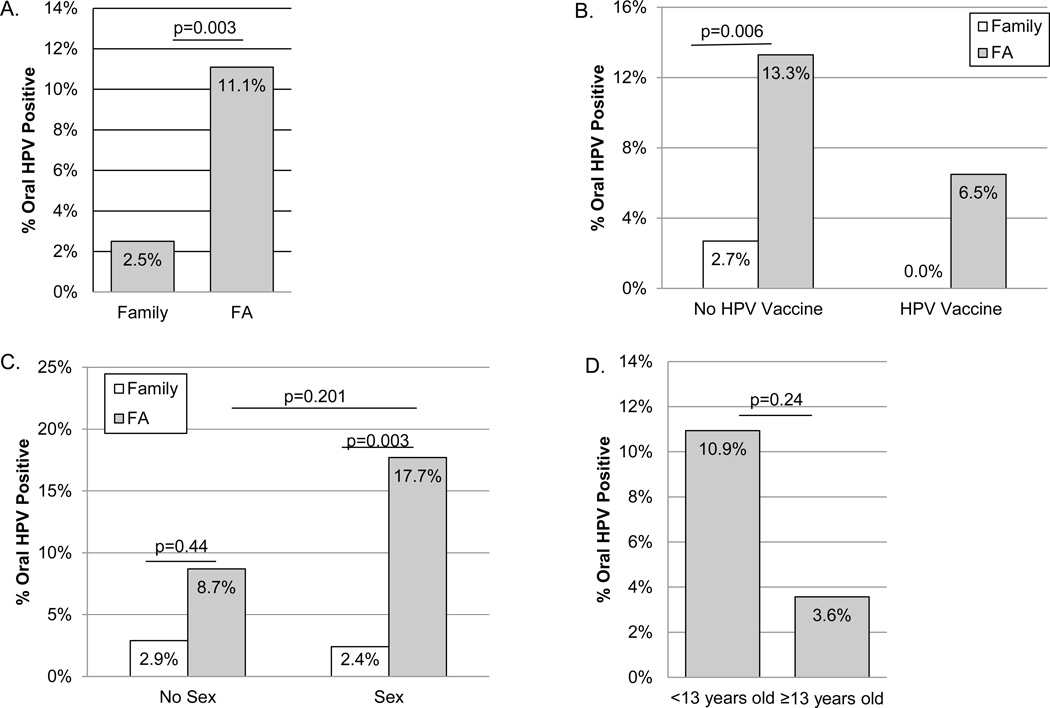
Fourteen individuals (11.1%) with Fanconi anemia tested positive, significantly more (P = 0.003) than family members (2.5%). While HPV prevalence was even higher for sexually active individuals with Fanconi anemia (17.7% vs. 2.4% in family; P = 0.003), HPV positivity also tended to be higher in the sexually inactive (8.7% in Fanconi anemia vs. 2.9% in siblings). Indeed, having Fanconi anemia increased HPV positivity 4.9-fold (95% CI, 1.6-15.4) considering age and sexual experience, but did not differ by other potential risk factors.
Our studies suggest that oral HPV is more common in individuals with Fanconi anemia. It will be essential to continue to explore associations between risk factors and immune dysfunction on HPV incidence and persistence over time.
HPV vaccination should be emphasized in those with Fanconi anemia as a first step to prevent oropharyngeal cancers, although additional studies are needed to determine whether the level of protection it offers in this population is adequate.
范可尼贫血是一种罕见的遗传性疾病,会导致范可尼贫血相关的DNA修复途径功能丧失。范可尼贫血患者易患某些癌症,包括口咽癌和妇科癌症,在普通人群中已知与人类乳头瘤病毒(HPV)有关联。由于范可尼贫血患者对化疗和放疗反应不佳,癌症预防至关重要。
为了确定范可尼贫血患者是否特别易患口腔HPV感染,我们分析了基于调查的风险因素数据,并对从126名范可尼贫血患者和162名未受影响的一级家庭成员的口腔冲洗液中分离的DNA进行了37种HPV类型的检测。
14名(11.1%)范可尼贫血患者检测呈阳性,显著多于家庭成员(2.5%,P = 0.003)。虽然有性活动的范可尼贫血患者HPV患病率更高(17.7% vs. 家庭成员中的2.4%;P = 0.003),但无性活动者中HPV阳性率也往往更高(范可尼贫血患者中为8.7%,而兄弟姐妹中为2.9%)。事实上,考虑到年龄和性经历,患有范可尼贫血使HPV阳性率增加了4.9倍(95% CI,1.6 - 15.4),但在其他潜在风险因素方面并无差异。
我们的研究表明,口腔HPV在范可尼贫血患者中更为常见。继续探索风险因素与免疫功能障碍之间关于HPV发病率和随时间持续存在情况的关联至关重要。
对于范可尼贫血患者应强调HPV疫苗接种,作为预防口咽癌的第一步,不过还需要进一步研究来确定其在该人群中提供的保护水平是否足够。