Department of Epidemiology, Harvard School of Public Health, Boston MA, USA Department of Environmental Health, Harvard School of Public Health, Boston MA, USA Department of Epidemiology, Johns Hopkins Bloomberg School of Public Health, Baltimore MD, USA
Department of Environmental Health, Harvard School of Public Health, Boston MA, USA.
BMJ. 2015 Mar 24;350:h1111. doi: 10.1136/bmj.h1111.
To determine whether higher past exposure to particulate air pollution is associated with prevalent high symptoms of anxiety.
Observational cohort study.
Nurses' Health Study.
71,271 women enrolled in the Nurses' Health Study residing throughout the contiguous United States who had valid estimates on exposure to particulate matter for at least one exposure period of interest and data on anxiety symptoms.
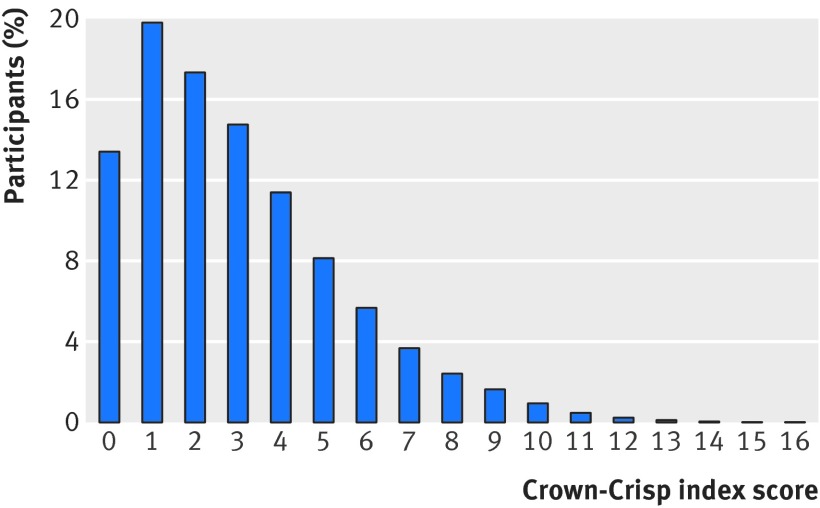
Meaningfully high symptoms of anxiety, defined as a score of 6 points or greater on the phobic anxiety subscale of the Crown-Crisp index, administered in 2004.
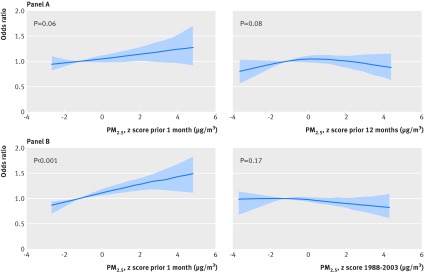
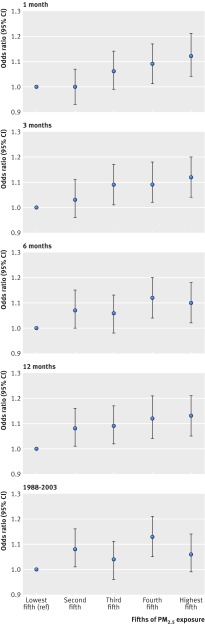
The 71,271 eligible women were aged between 57 and 85 years (mean 70 years) at the time of assessment of anxiety symptoms, with a prevalence of high anxiety symptoms of 15%. Exposure to particulate matter was characterized using estimated average exposure to particulate matter <2.5 μm in diameter (PM2.5) and 2.5 to 10 μm in diameter (PM2.5-10) in the one month, three months, six months, one year, and 15 years prior to assessment of anxiety symptoms, and residential distance to the nearest major road two years prior to assessment. Significantly increased odds of high anxiety symptoms were observed with higher exposure to PM2.5 for multiple averaging periods (for example, odds ratio per 10 µg/m(3) increase in prior one month average PM2.5: 1.12, 95% confidence interval 1.06 to 1.19; in prior 12 month average PM2.5: 1.15, 1.06 to 1.26). Models including multiple exposure windows suggested short term averaging periods were more relevant than long term averaging periods. There was no association between anxiety and exposure to PM2.5-10. Residential proximity to major roads was not related to anxiety symptoms in a dose dependent manner.
Exposure to fine particulate matter (PM2.5) was associated with high symptoms of anxiety, with more recent exposures potentially more relevant than more distant exposures. Research evaluating whether reductions in exposure to ambient PM2.5 would reduce the population level burden of clinically relevant symptoms of anxiety is warranted.
确定过去接触更高水平的颗粒物空气污染是否与普遍存在的高焦虑症状有关。
观察性队列研究。
护士健康研究。
居住在美国大陆各地的 71271 名参加护士健康研究的女性,她们对至少一个感兴趣的暴露期的颗粒物暴露有有效估计,并且有焦虑症状的数据。
明显的高焦虑症状,定义为使用 2004 年进行的 Crown-Crisp 指数的恐惧症焦虑子量表评定为 6 分或更高。
71271 名符合条件的女性在评估焦虑症状时年龄在 57 至 85 岁之间(平均年龄 70 岁),高焦虑症状的患病率为 15%。使用估计的平均暴露于直径小于 2.5μm(PM2.5)和 2.5 至 10μm(PM2.5-10)的颗粒物在评估焦虑症状前一个月、三个月、六个月、一年和 15 年的暴露情况,以及评估焦虑症状前两年距离最近主要道路的居住距离来描述颗粒物的暴露情况。在多个平均期内,观察到较高的 PM2.5 暴露与较高的高焦虑症状发生几率显著相关(例如,前一个月平均 PM2.5每增加 10μg/m3的比值比:1.12,95%置信区间为 1.06 至 1.19;前 12 个月平均 PM2.5:1.15,1.06 至 1.26)。包括多个暴露窗口的模型表明,短期平均期比长期平均期更相关。PM2.5-10 与焦虑之间没有关联。与主要道路的居住接近程度与焦虑症状无关,不存在剂量依赖性关系。
接触细颗粒物(PM2.5)与高焦虑症状有关,近期暴露的相关性可能比遥远的暴露更相关。有必要进行研究评估减少环境 PM2.5 暴露是否会降低具有临床意义的焦虑症状的人群负担。