Nephrology Section, 0K12 , University Hospital , Ghent B9000 , Belgium.
Clin Kidney J. 2015 Apr;8(2):168-79. doi: 10.1093/ckj/sfv004. Epub 2015 Feb 10.
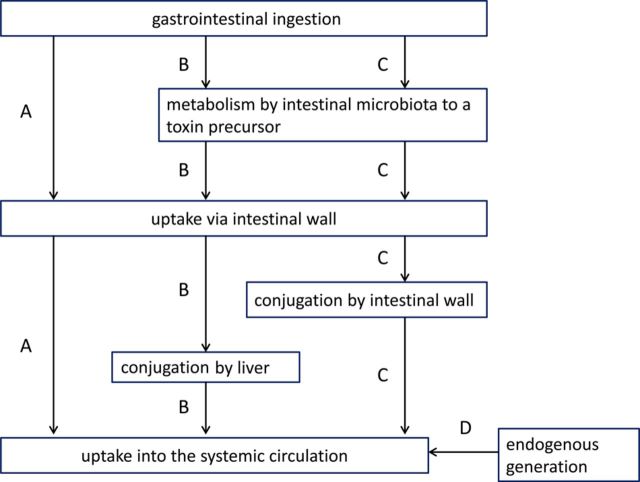
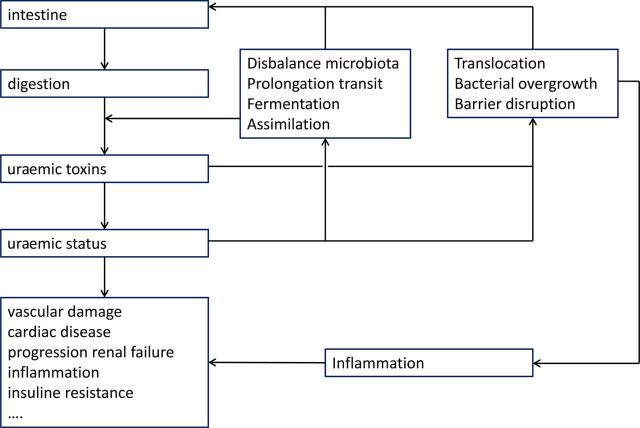
The concept that the intestine and chronic kidney disease influence each other, emerged only recently. The problem is multifaceted and bidirectional. On one hand, the composition of the intestinal microbiota impacts uraemic retention solute production, resulting in the generation of essentially protein-bound uraemic toxins with strong biological impact such as vascular damage and progression of kidney failure. On the other hand, the uraemic status affects the composition of intestinal microbiota, the generation of uraemic retention solutes and their precursors and causes disturbances in the protective epithelial barrier of the intestine and the translocation of intestinal microbiota into the body. All these elements together contribute to the disruption of the metabolic equilibrium and homeostasis typical to uraemia. Several measures with putative impact on intestinal status have recently been tested for their influence on the generation or concentration of uraemic toxins. These include dietary measures, prebiotics, probiotics, synbiotics and intestinal sorbents. Unfortunately, the quality and the evidence base of many of these studies are debatable, especially in uraemia, and often results within one study or among studies are contradictory. Nevertheless, intestinal uraemic metabolite generation remains an interesting target to obtain in the future as an alternative or additive to dialysis to decrease uraemic toxin generation. In the present review, we aim to summarize (i) the role of the intestine in uraemia by producing uraemic toxins and by generating pathophysiologically relevant changes, (ii) the role of uraemia in modifying intestinal physiology and (iii) the therapeutic options that could help to modify these effects and the studies that have assessed the impact of these therapies.
肠道和慢性肾脏病相互影响的概念直到最近才出现。这个问题是多方面和双向的。一方面,肠道微生物群落的组成影响尿毒症溶质的产生,导致基本上与蛋白质结合的尿毒症毒素的生成,这些毒素具有很强的生物学影响,如血管损伤和肾功能衰竭的进展。另一方面,尿毒症状态会影响肠道微生物群落的组成、尿毒症溶质的产生及其前体,并导致肠道保护性上皮屏障的紊乱和肠道微生物群落向体内的易位。所有这些因素共同导致了尿毒症特有的代谢平衡和内稳态的破坏。最近,人们测试了几种可能对肠道状态有影响的措施,以研究它们对尿毒症毒素产生或浓度的影响。这些措施包括饮食措施、益生元、益生菌、合生菌和肠道吸附剂。不幸的是,许多这些研究的质量和证据基础存在争议,尤其是在尿毒症中,而且一项研究或多项研究中的结果往往相互矛盾。然而,肠道尿毒症代谢物的产生仍然是一个有趣的目标,将来可以作为透析的替代或附加方法,以减少尿毒症毒素的产生。在本综述中,我们旨在总结(i)肠道通过产生尿毒症毒素和产生与病理生理相关的变化在尿毒症中的作用,(ii)尿毒症在改变肠道生理学中的作用,以及(iii)可以帮助改变这些作用的治疗选择,以及评估这些治疗方法影响的研究。