Echigoya Yusuke, Mouly Vincent, Garcia Luis, Yokota Toshifumi, Duddy William
University of Alberta, Faculty of Medicine and Dentistry, Department of Medical Genetics, Edmonton, Alberta, Canada.
UPMC-Sorbonne Universités-Univ. Paris 6, UPMC/INSERM UMRS974, CNRS FRE 3617, Center of Research in Myology, Paris, 75651 cedex 13, France.
PLoS One. 2015 Mar 27;10(3):e0120058. doi: 10.1371/journal.pone.0120058. eCollection 2015.
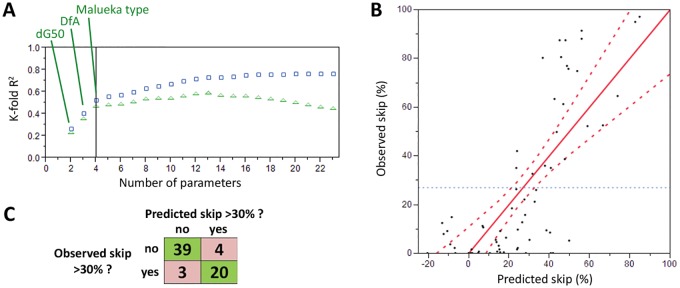
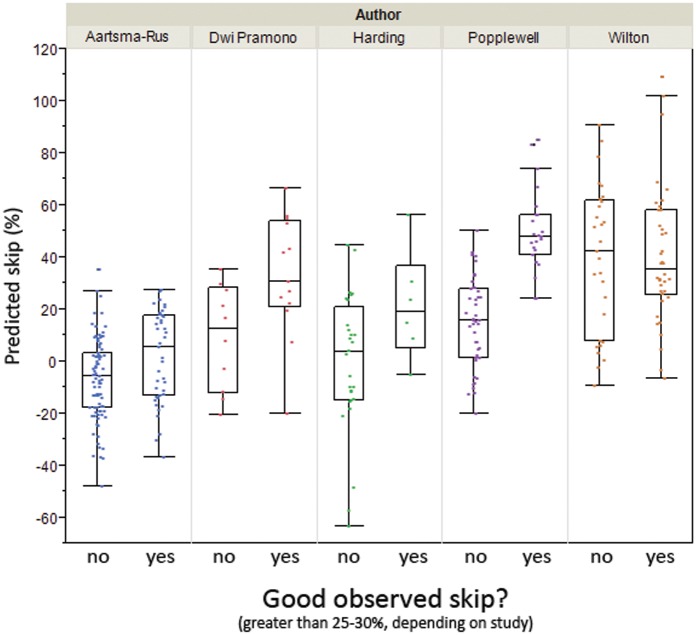
The use of antisense 'splice-switching' oligonucleotides to induce exon skipping represents a potential therapeutic approach to various human genetic diseases. It has achieved greatest maturity in exon skipping of the dystrophin transcript in Duchenne muscular dystrophy (DMD), for which several clinical trials are completed or ongoing, and a large body of data exists describing tested oligonucleotides and their efficacy. The rational design of an exon skipping oligonucleotide involves the choice of an antisense sequence, usually between 15 and 32 nucleotides, targeting the exon that is to be skipped. Although parameters describing the target site can be computationally estimated and several have been identified to correlate with efficacy, methods to predict efficacy are limited. Here, an in silico pre-screening approach is proposed, based on predictive statistical modelling. Previous DMD data were compiled together and, for each oligonucleotide, some 60 descriptors were considered. Statistical modelling approaches were applied to derive algorithms that predict exon skipping for a given target site. We confirmed (1) the binding energetics of the oligonucleotide to the RNA, and (2) the distance in bases of the target site from the splice acceptor site, as the two most predictive parameters, and we included these and several other parameters (while discounting many) into an in silico screening process, based on their capacity to predict high or low efficacy in either phosphorodiamidate morpholino oligomers (89% correctly predicted) and/or 2'O Methyl RNA oligonucleotides (76% correctly predicted). Predictions correlated strongly with in vitro testing for sixteen de novo PMO sequences targeting various positions on DMD exons 44 (R² 0.89) and 53 (R² 0.89), one of which represents a potential novel candidate for clinical trials. We provide these algorithms together with a computational tool that facilitates screening to predict exon skipping efficacy at each position of a target exon.
使用反义“剪接转换”寡核苷酸诱导外显子跳跃是治疗多种人类遗传疾病的一种潜在方法。它在杜氏肌营养不良症(DMD)中肌营养不良蛋白转录本的外显子跳跃方面已达到最高成熟度,针对该疾病的多项临床试验已经完成或正在进行,并且存在大量描述经过测试的寡核苷酸及其疗效的数据。外显子跳跃寡核苷酸的合理设计涉及选择一个反义序列,通常为15至32个核苷酸,靶向要跳跃的外显子。尽管描述靶位点的参数可以通过计算估计,并且已经确定了几个与疗效相关的参数,但预测疗效的方法仍然有限。在此,基于预测统计模型提出了一种计算机预筛选方法。将先前的DMD数据汇总在一起,对于每个寡核苷酸,考虑了约60个描述符。应用统计建模方法得出预测给定靶位点外显子跳跃的算法。我们确认(1)寡核苷酸与RNA的结合能,以及(2)靶位点与剪接受体位点的碱基距离,是两个最具预测性的参数,并且我们将这些参数和其他几个参数(同时排除许多参数)纳入计算机筛选过程,基于它们预测磷二酰胺吗啉代寡聚物(89%正确预测)和/或2'-O-甲基RNA寡核苷酸(76%正确预测)高或低疗效的能力。对于针对DMD外显子44(R² 0.89)和53(R² 0.89)上不同位置的16个从头设计的PMO序列,预测结果与体外测试结果高度相关,其中一个代表了潜在的临床试验新候选物。我们提供这些算法以及一个计算工具,该工具便于筛选以预测靶外显子每个位置的外显子跳跃疗效。