Zhang Jun, Ma Jingxue, Zhou Nalei, Zhang Bin, An Jianbin
Department of Ophthalmology, Second Hospital of Hebei Medical University, Shijiazhuang, Hebei, China (mainland).
Med Sci Monit. 2015 Mar 30;21:929-36. doi: 10.12659/MSM.892056.
Diabetes mellitus is a common and serious disorder. A search of the literature reveals no comprehensive quantitative assessment of the association between insulin use and incidence of diabetic macular edema. Therefore, we performed a meta-analysis of observational studies to evaluate the effect of insulin use on the risk of developing macular edema.
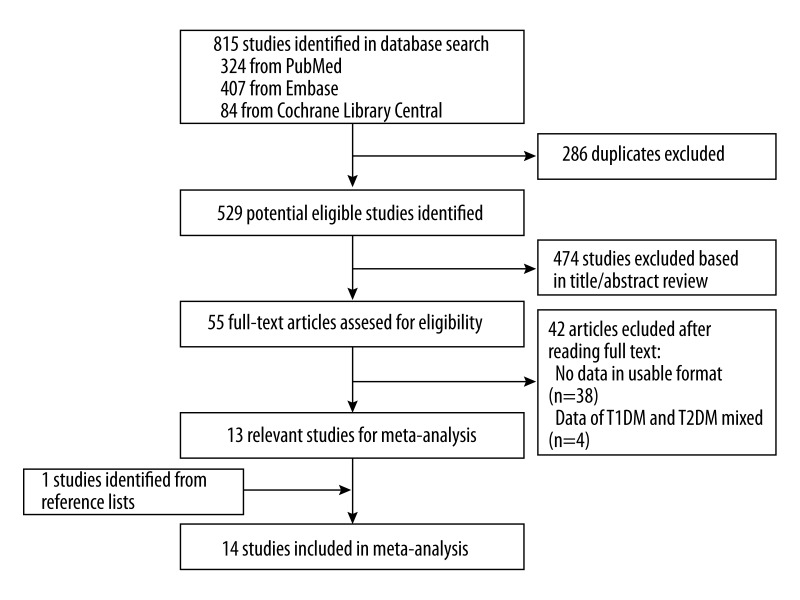
MATERIAL/METHODS: Comparative studies published until May 2014 were searched through a comprehensive search of the Medline, Embase, and the Cochrane Library electronic databases. A systematic review and quantitative analysis of comparative studies reporting the effect of insulin use on the incidence of macular edema was performed. All analyses were performed using the Review Manager (RevMan) v.5 (Nordic Cochrane Centre, Copenhagen, Denmark).
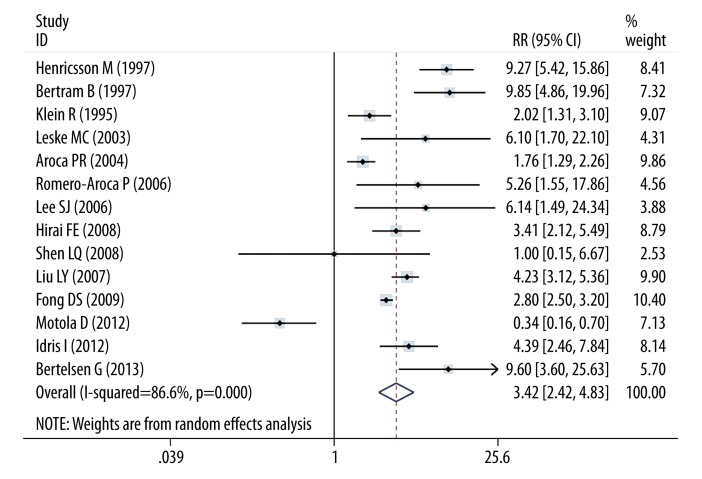
A total of 202 905 individuals were included in the present meta-analysis. In a random-effects meta-analysis, the use of insulin was found to be associated with increased risk of macular edema (RR, 3.416; 95% CI, 2.417-4.829; I2, 86.6%). Analysis that just included high-quality studies showed that insulin use increased the risk of macular edema (RR, 2.728; 95% CI, 1.881-3.955; I2=77.7%). In cohort studies (RR, 4.509; 95% CI, 3.100-6.559; I2, 77.7%) but not in case-control studies (RR, 1.455; 95% CI, 0.520 to 4.066; I2, 95.9%), increased incidence of macular edema was observed.
The results of this meta-analysis of observational studies demonstrate that insulin use is a risk factor for diabetic macular edema. However, available data are still sparse, and in-depth analyses of the assessed associations in the context of additional longitudinal studies are highly desirable to enable more precise estimates and a better understanding of the role of insulin use in incidence of diabetic macular edema.
糖尿病是一种常见且严重的疾病。对文献的检索显示,尚无关于胰岛素使用与糖尿病性黄斑水肿发生率之间关联的全面定量评估。因此,我们进行了一项观察性研究的荟萃分析,以评估胰岛素使用对发生黄斑水肿风险的影响。
材料/方法:通过全面检索Medline、Embase和Cochrane图书馆电子数据库,查找截至2014年5月发表的比较研究。对报告胰岛素使用对黄斑水肿发生率影响的比较研究进行系统评价和定量分析。所有分析均使用Review Manager(RevMan)v.5(丹麦哥本哈根北欧Cochrane中心)进行。
本荟萃分析共纳入202905名个体。在随机效应荟萃分析中,发现使用胰岛素与黄斑水肿风险增加相关(相对风险[RR],3.416;95%置信区间[CI],2.417 - 4.829;I²,86.6%)。仅纳入高质量研究的分析表明,使用胰岛素会增加黄斑水肿风险(RR,2.728;95% CI,1.881 - 3.955;I² = 77.7%)。在队列研究中(RR,4.509;95% CI,3.100 - 6.559;I²,77.7%)观察到黄斑水肿发生率增加,但在病例对照研究中未观察到(RR,1.455;95% CI,0.520至4.066;I²,95.9%)。
这项观察性研究的荟萃分析结果表明,使用胰岛素是糖尿病性黄斑水肿的一个危险因素。然而,现有数据仍然稀少,非常需要在更多纵向研究的背景下对评估的关联进行深入分析,以便能够进行更精确的估计,并更好地理解胰岛素使用在糖尿病性黄斑水肿发生率中的作用。