Meena Jitendra K, Cerutti Aurora, Beichler Christine, Morita Yohei, Bruhn Christopher, Kumar Mukesh, Kraus Johann M, Speicher Michael R, Wang Zhao-Qi, Kestler Hans A, d'Adda di Fagagna Fabrizio, Günes Cagatay, Rudolph Karl Lenhard
Leibniz Institute of Age Research, Fritz Lipmann Institute e.V., Jena, Germany.
IFOM Foundation-FIRC Institute of Molecular Oncology Foundation, Milan, Italy.
EMBO J. 2015 May 12;34(10):1371-84. doi: 10.15252/embj.201490070. Epub 2015 Mar 27.
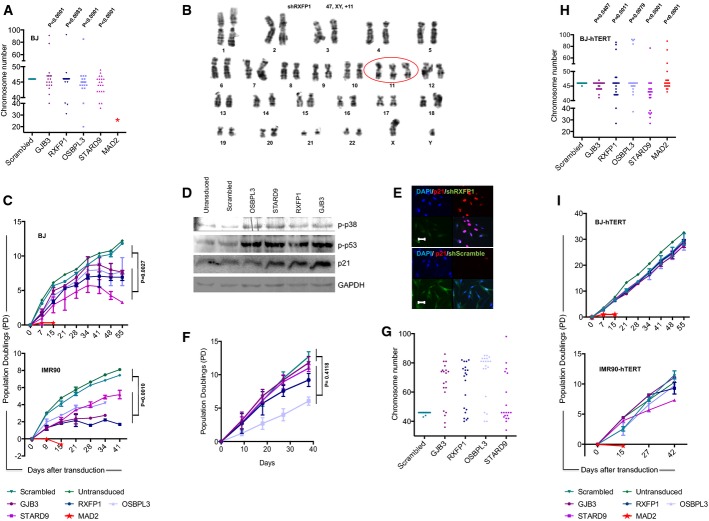
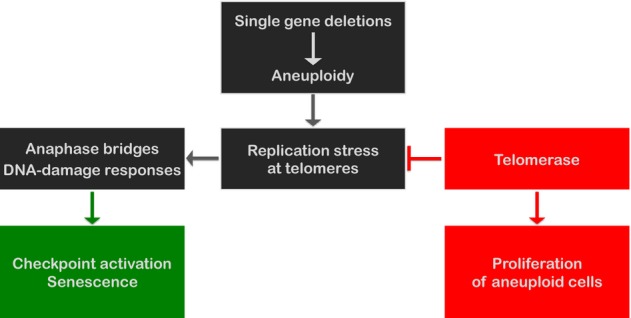
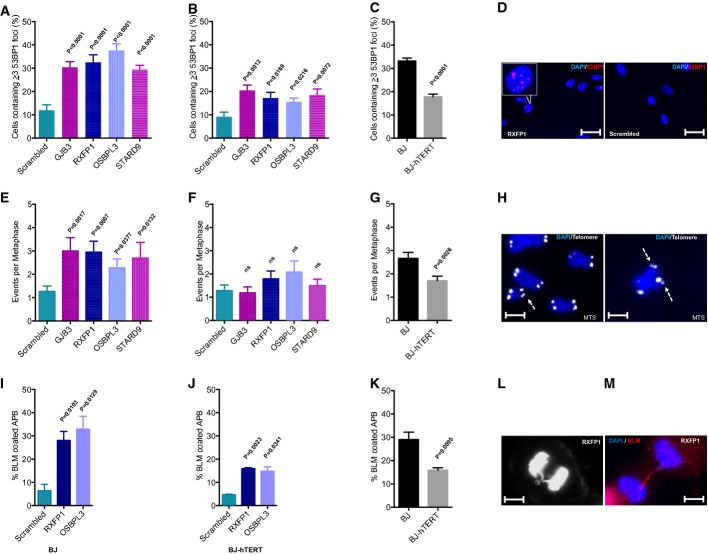
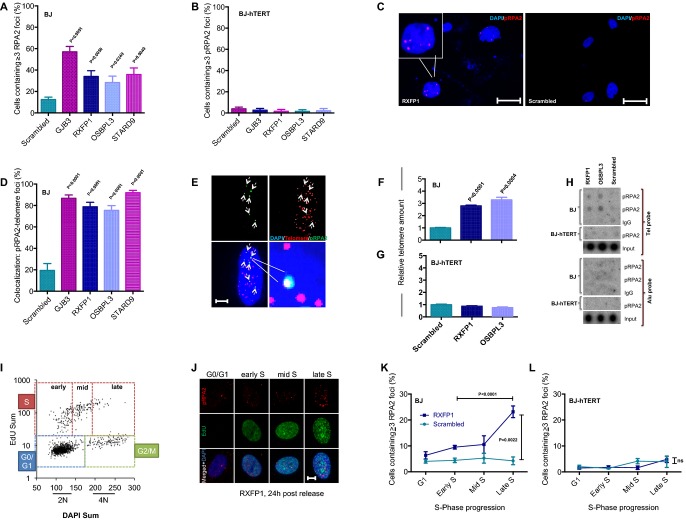
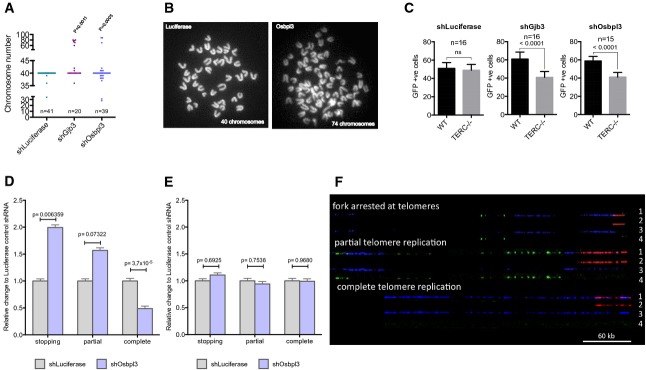
The causal role of aneuploidy in cancer initiation remains under debate since mutations of euploidy-controlling genes reduce cell fitness but aneuploidy strongly associates with human cancers. Telomerase activation allows immortal growth by stabilizing telomere length, but its role in aneuploidy survival has not been characterized. Here, we analyze the response of primary human cells and murine hematopoietic stem cells (HSCs) to aneuploidy induction and the role of telomeres and the telomerase in this process. The study shows that aneuploidy induces replication stress at telomeres leading to telomeric DNA damage and p53 activation. This results in p53/Rb-dependent, premature senescence of human fibroblast, and in the depletion of hematopoietic cells in telomerase-deficient mice. Endogenous telomerase expression in HSCs and enforced expression of telomerase in human fibroblasts are sufficient to abrogate aneuploidy-induced replication stress at telomeres and the consequent induction of premature senescence and hematopoietic cell depletion. Together, these results identify telomerase as an aneuploidy survival factor in mammalian cells based on its capacity to alleviate telomere replication stress in response to aneuploidy induction.
由于整倍体控制基因的突变会降低细胞适应性,但非整倍体却与人类癌症密切相关,因此非整倍体在癌症起始中的因果作用仍存在争议。端粒酶激活通过稳定端粒长度实现永生生长,但其在非整倍体存活中的作用尚未明确。在此,我们分析了原代人类细胞和小鼠造血干细胞(HSC)对非整倍体诱导的反应以及端粒和端粒酶在此过程中的作用。研究表明,非整倍体在端粒处诱导复制应激,导致端粒DNA损伤和p53激活。这导致人成纤维细胞出现p53/Rb依赖的过早衰老,并导致端粒酶缺陷小鼠中的造血细胞耗竭。HSC中的内源性端粒酶表达以及人成纤维细胞中端粒酶的强制表达足以消除非整倍体诱导的端粒复制应激以及随之而来的过早衰老诱导和造血细胞耗竭。总之,这些结果基于端粒酶在响应非整倍体诱导时减轻端粒复制应激的能力,确定其为哺乳动物细胞中的非整倍体存活因子。