
颈椎全椎间盘置换术优于颈椎前路减压融合术:前瞻性随机对照试验的荟萃分析。
Cervical total disc replacement is superior to anterior cervical decompression and fusion: a meta-analysis of prospective randomized controlled trials.
作者信息
Zhang Yujie, Liang Chengzhen, Tao Yiqing, Zhou Xiaopeng, Li Hao, Li Fangcai, Chen Qixin
机构信息
Department of Orthopedic Surgery, 2nd Affiliated Hospital, School of Medicine, Zhejiang University, 88 Jie Fang Road, Hangzhou, 310009, Zhejiang, People's Republic of China.
出版信息
PLoS One. 2015 Mar 30;10(3):e0117826. doi: 10.1371/journal.pone.0117826. eCollection 2015.
BACKGROUND
Despite being considered the standard surgical procedure for symptomatic cervical disc disease, anterior cervical decompression and fusion invariably accelerates adjacent segment degeneration. Cervical total disc replacement is a motion-preserving procedure developed as a substitute to fusion. Whether cervical total disc replacement is superior to fusion remains unclear.
METHODS
We comprehensively searched PubMed, EMBASE, Medline, and the Cochrane Library in accordance with the inclusion criteria to identify possible studies. The retrieved results were last updated on December 12, 2014. We classified the studies as short-term and midterm follow-up.
RESULTS
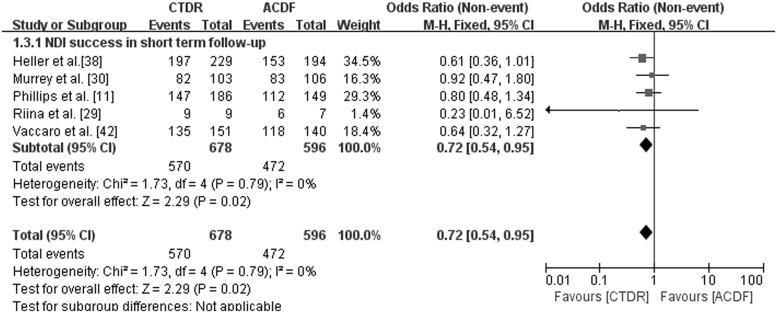
Nineteen randomized controlled trials involving 4516 cases were identified. Compared with anterior cervical decompression and fusion, cervical total disc replacement had better functional outcomes (neck disability index [NDI], NDI success, neurological success, neck pain scores reported on a numerical rating scale [NRS], visual analog scales scores and overall success), greater segmental motion at the index level, fewer adverse events and fewer secondary surgical procedures at the index and adjacent levels in short-term follow-up (P < 0.05). With midterm follow-up, the cervical total disc replacement group indicated superiority in the NDI, neurological success, pain assessment (NRS), and secondary surgical procedures at the index level (P < 0.05). The Short Form 36 (SF-36) and segmental motion at the adjacent level in the short-term follow-up showed no significant difference between the two procedures, as did the secondary surgical procedure rates at the adjacent level with midterm follow-up (P > 0.05).
CONCLUSIONS
Cervical total disc replacement presented favorable functional outcomes, fewer adverse events, and fewer secondary surgical procedures. The efficacy and safety of cervical total disc replacement are superior to those of fusion. Longer-term, multicenter studies are required for a better evaluation of the long-term efficacy and safety of the two procedures.
背景
尽管颈椎前路减压融合术被视为有症状的颈椎间盘疾病的标准外科手术,但它总是会加速相邻节段退变。颈椎全椎间盘置换术是一种作为融合术替代方案而开发的保留运动功能的手术。颈椎全椎间盘置换术是否优于融合术仍不清楚。
方法
我们根据纳入标准全面检索了PubMed、EMBASE、Medline和Cochrane图书馆,以确定可能的研究。检索结果于2014年12月12日进行了最后更新。我们将研究分为短期和中期随访。
结果
共确定了19项涉及4516例患者的随机对照试验。与颈椎前路减压融合术相比,颈椎全椎间盘置换术在短期随访中具有更好的功能结局(颈部残疾指数[NDI]、NDI成功率、神经功能成功率、数字评定量表[NRS]报告的颈部疼痛评分、视觉模拟量表评分和总体成功率)、手术节段更大的活动度、更少的不良事件以及手术节段和相邻节段更少的二次手术(P<0.05)。在中期随访中,颈椎全椎间盘置换术组在NDI、神经功能成功率、疼痛评估(NRS)和手术节段的二次手术方面表现更优(P<0.05)。短期随访中的简明健康状况调查简表(SF-36)和相邻节段的活动度在两种手术之间无显著差异,中期随访中相邻节段的二次手术率也是如此(P>0.05)。
结论
颈椎全椎间盘置换术具有良好的功能结局、更少的不良事件和更少的二次手术。颈椎全椎间盘置换术的疗效和安全性优于融合术。需要进行更长期的多中心研究,以更好地评估这两种手术的长期疗效和安全性。




 Zotero 插件