Lusi Elena Angela, Di Ciommo Vincenzo Maria, Patrissi Tommaso, Guarascio Paolo
St Vincent Private Hospital, Dublin, Ireland.
Ospedale Pediatrico Bambino Gesu', Epidemiology and Biostatistics Unit, Rome, Italy.
PLoS One. 2015 Mar 30;10(3):e0123265. doi: 10.1371/journal.pone.0123265. eCollection 2015.
In our Allergy Unit, we incidentally observed that a low Nickel diet, prescribed for delayed allergy to Nickel sulfate, reduced body mass index (BMI) and waist circumference in overweight patients.
This pilot cross-sectional analysis was undertaken to compare the prevalence of Nickel allergy of overweight individuals versus the general population. We also had the chance to report the efficacy of a low Nickel diet on BMI and waist circumference in Nickel-sensitive overweight subjects.
Eighty-seven overweight subjects, with a BMI > 26 Kg/m2, were consecutively enrolled in a health prevention program, and screened for the presence of Nickel allergy. The enrolled population was mostly females (72/87) (82.8%). Forty-three overweight women and two men showed a Nickel allergy and started a low Nickel diet. After 6-months of dieting, 24 overweight allergic women could be traced and changes in BMI and waist circumference were calculated.
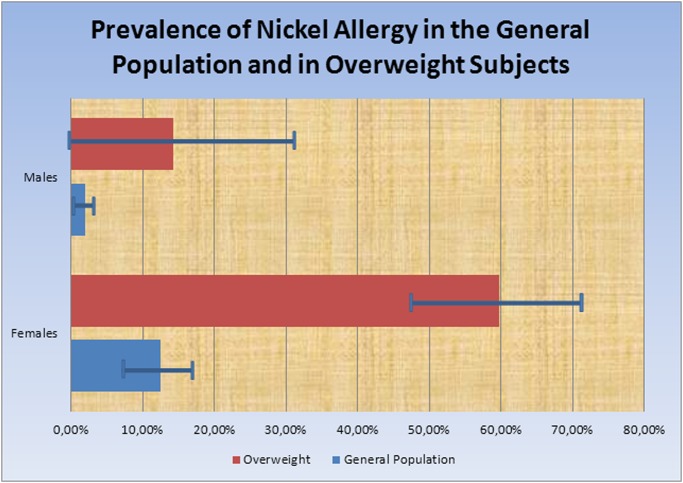
Prevalence of Nickel allergy in overweight.
Prevalence of Nickel allergy in overweight female was 59.7%, compared with a prevalence rate of 12.5% in the general population. A significant reduction in BMI was observed in 24 out of 43 overweight females with Nickel allergy after 24 weeks of a low Nickel diet. Relative to baseline, mean BMI decrease was 4.2 ± 0.5 (P < 0.001) and the mean decline in waist circumference was 11.7 ± 0.6 cm (P < 0.001).
This pilot observational analysis showed a substantially higher prevalence of Nickel allergy among overweight females, especially those with metabolic syndrome and fatty liver disease. A normocaloric low Nickel diet was effective in reducing BMI in this population. Further research is strongly needed to confirm these preliminary findings.
在我们的过敏科,我们偶然观察到,因对硫酸镍过敏反应延迟而规定的低镍饮食,降低了超重患者的体重指数(BMI)和腰围。
进行这项初步横断面分析,以比较超重个体与普通人群中镍过敏的患病率。我们还有机会报告低镍饮食对镍敏感超重受试者的BMI和腰围的疗效。
87名BMI>26kg/m²的超重受试者连续参加了一项健康预防计划,并接受了镍过敏筛查。纳入人群以女性为主(72/87)(82.8%)。43名超重女性和2名男性表现出镍过敏,并开始了低镍饮食。节食6个月后,可追踪到24名超重过敏女性,并计算其BMI和腰围的变化。
超重人群中镍过敏的患病率。
超重女性中镍过敏的患病率为59.7%,而普通人群中的患病率为12.5%。43名对镍过敏的超重女性中,有24名在低镍饮食24周后BMI显著降低。相对于基线,平均BMI下降4.2±0.5(P<0.001),腰围平均下降11.7±0.6cm(P<0.001)。
这项初步观察分析表明,超重女性中镍过敏的患病率显著更高,尤其是那些患有代谢综合征和脂肪肝病的女性。正常热量的低镍饮食对降低该人群的BMI有效。强烈需要进一步研究来证实这些初步发现。