Izumi Masanari, Zheng Lu, Sakai Yusuke, Goto Hidenori, Sakata Masafumi, Nakamoto Yuki, Nguyen Huyen L T, Kagayama Tomoko, Shimizu Katsuya, Araki Shingo, Kobayashi Tatsuo C, Kambe Takashi, Gu Dachun, Guo Jing, Liu Jing, Li Yanchun, Sun Liling, Prassides Kosmas, Kubozono Yoshihiro
Research Laboratory for Surface Science, Okayama University, Okayama 700-8530, Japan.
Research Centre of New Functional Materials for Energy Production, Storage and Transport, Okayama University, Okayama 700-8530, Japan.
Sci Rep. 2015 Apr 1;5:9477. doi: 10.1038/srep09477.
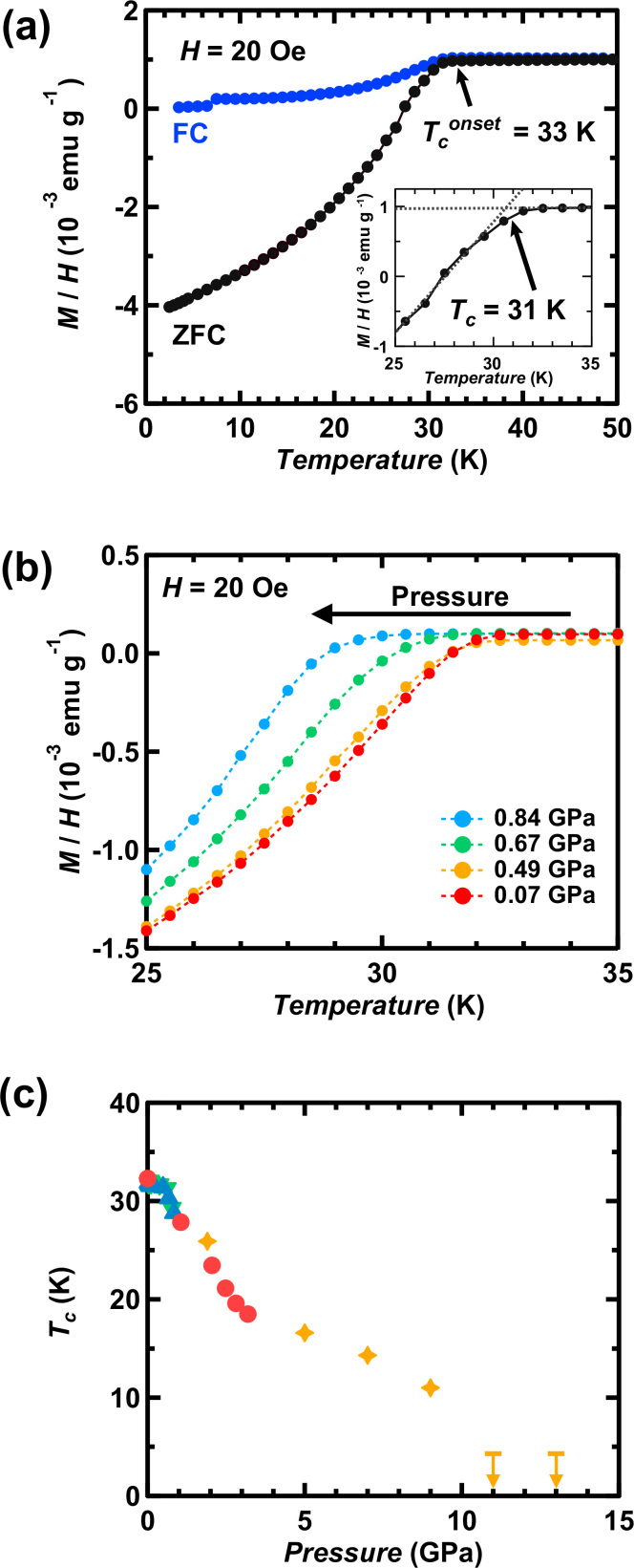
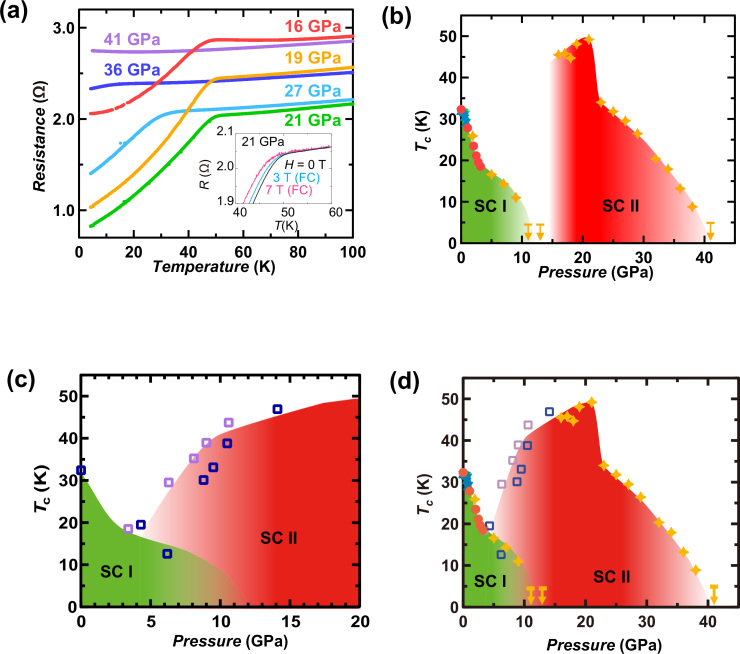
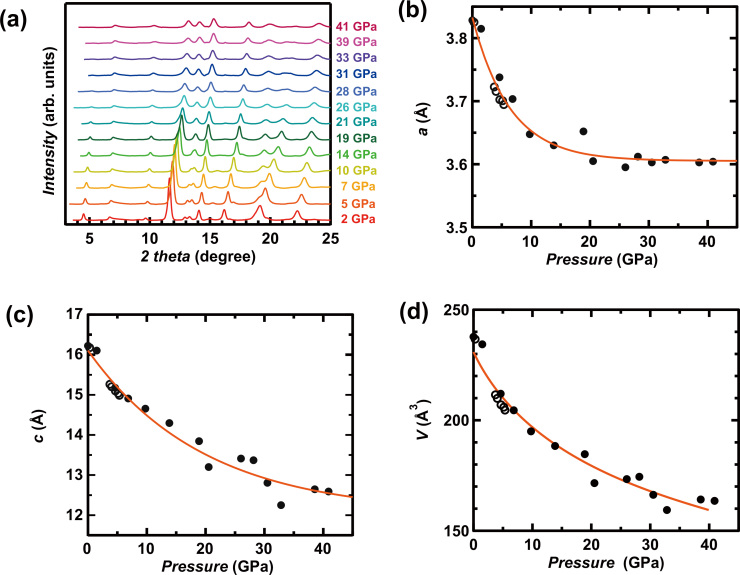
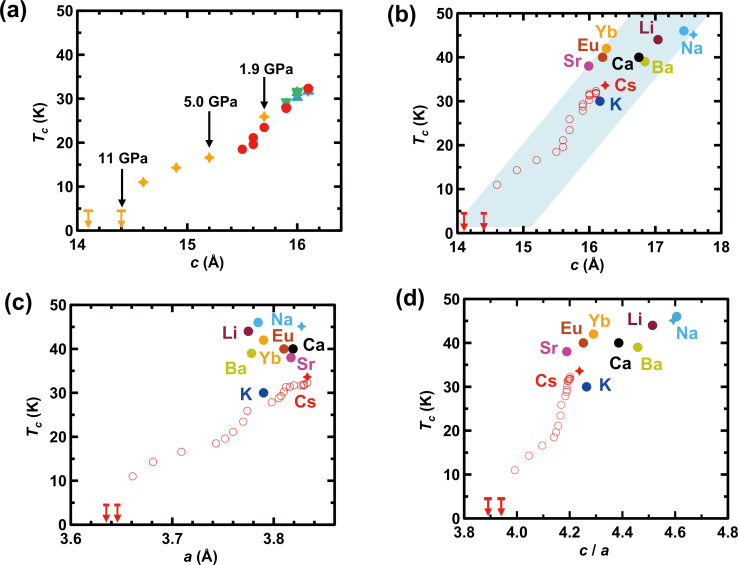
The pressure dependence of the superconducting transition temperature (Tc) and unit cell metrics of tetragonal (NH3)yCs0.4FeSe were investigated in high pressures up to 41 GPa. The Tc decreases with increasing pressure up to 13 GPa, which can be clearly correlated with the pressure dependence of c (or FeSe layer spacing). The Tc vs. c plot is compared with those of various (NH3)yMxFeSe (M: metal atoms) materials exhibiting different Tc and c, showing that the Tc is universally related to c. This behaviour means that a decrease in two-dimensionality lowers the Tc. No superconductivity was observed down to 4.3 K in (NH3)yCs0.4FeSe at 11 and 13 GPa. Surprisingly, superconductivity re-appeared rapidly above 13 GPa, with the Tc reaching 49 K at 21 GPa. The appearance of a new superconducting phase is not accompanied by a structural transition, as evidenced by pressure-dependent XRD. Furthermore, Tc slowly decreased with increasing pressure above 21 GPa, and at 41 GPa superconductivity disappeared entirely at temperatures above 4.9 K. The observation of a double-dome superconducting phase may provide a hint for pursuing the superconducting coupling-mechanism of ammoniated/non-ammoniated metal-doped FeSe.
研究了四方结构(NH3)yCs0.4FeSe在高达41 GPa的高压下超导转变温度(Tc)和晶胞参数对压力的依赖性。在高达13 GPa的压力下,Tc随压力增加而降低,这与c轴(或FeSe层间距)对压力的依赖性明显相关。将Tc与c的关系图与各种具有不同Tc和c的(NH3)yMxFeSe(M:金属原子)材料的关系图进行比较,结果表明Tc与c普遍相关。这种行为意味着二维性的降低会降低Tc。在11 GPa和13 GPa下,(NH3)yCs0.4FeSe在4.3 K以下未观察到超导性。令人惊讶的是,在13 GPa以上超导性迅速重新出现,在21 GPa时Tc达到49 K。如压力依赖XRD所示,新超导相的出现并未伴随结构转变。此外,在21 GPa以上,Tc随压力增加而缓慢降低,在41 GPa时,在4.9 K以上超导性完全消失。双穹顶超导相的观测可能为探索氨化/非氨化金属掺杂FeSe的超导耦合机制提供线索。