Dubowitz Tamara, Ncube Collette, Leuschner Kristin, Tharp-Gilliam Shannah
RAND Corporation, Pittsburgh, PA, USA
University of Pittsburgh Graduate School of Public Health, Pittsburgh, PA, USA.
Health Educ Behav. 2015 Apr;42(1 Suppl):87S-96S. doi: 10.1177/1090198115570048.
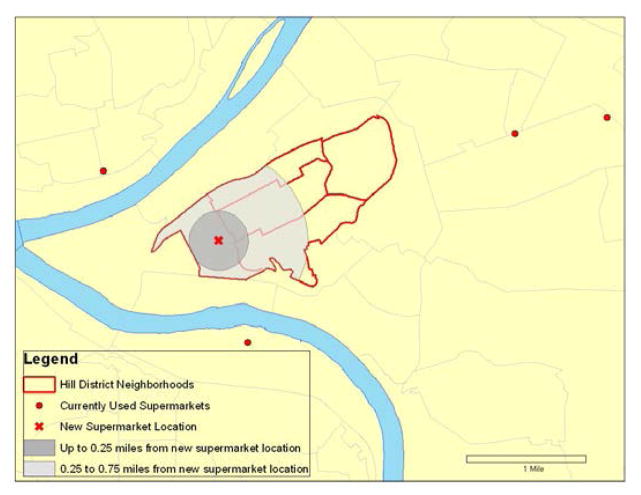
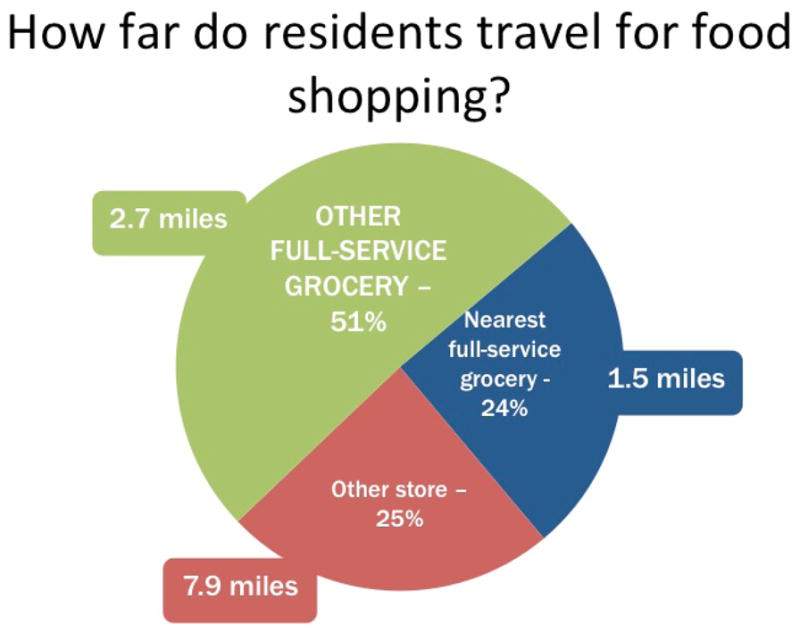
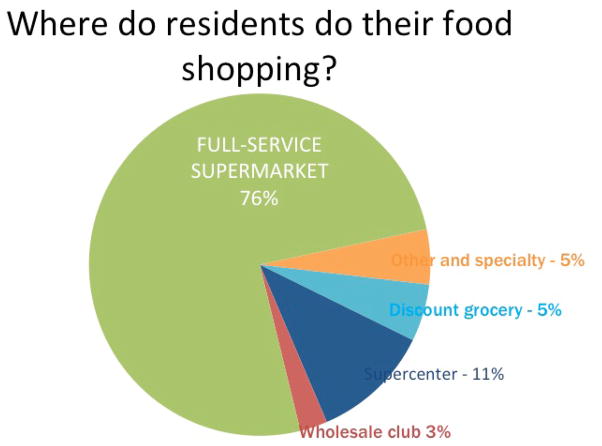
A growing body of evidence has highlighted an association between a lack of access to nutritious, affordable food (e.g., through full-service grocery stores [FSGs]), poor diet, and increased risk for obesity. In response, there has been growing interest among policy makers in encouraging the siting of supermarkets in "food deserts," that is, low-income geographic areas with low access to healthy food options. However, there is limited research to evaluate the impact of such efforts, and most studies to date have been cross-sectional. The Pittsburgh Hill/Homewood Research on Eating, Shopping, and Health (PHRESH) is a longitudinal quasi-experimental study of a dramatic change (i.e., a new FSG) in the food landscape of a low-income, predominantly Black neighborhood. The study is following a stratified random sample of households (n = 1,372), and all food venues (n = 60) in both intervention and control neighborhoods, and the most frequently reported food shopping venues outside both neighborhoods. This article describes the study design and community-based methodology, which focused simultaneously on the conduct of scientifically rigorous research and the development and maintenance of trust and buy-in from the involved neighborhoods. Early results have begun to define markers for success in creating a natural experiment, including strong community engagement. Baseline data show that the vast majority of residents already shop at a FSG and do not shop at the nearest one. Follow-up data collection will help determine whether and how a new FSG may change behaviors and may point to the need for additional interventions beyond new FSGs alone.
越来越多的证据表明,难以获得营养丰富且价格合理的食物(例如通过提供全方位服务的杂货店[FSG])、不良饮食与肥胖风险增加之间存在关联。对此,政策制定者越来越有兴趣鼓励在“食物荒漠”地区开设超市,即健康食品选择匮乏的低收入地理区域。然而,评估此类举措影响的研究有限,而且迄今为止大多数研究都是横断面研究。匹兹堡希尔/霍姆伍德饮食、购物与健康研究(PHRESH)是一项针对低收入、主要为黑人社区食物格局的巨大变化(即一家新的FSG)的纵向准实验研究。该研究跟踪了分层随机抽样的家庭(n = 1372),以及干预社区和对照社区内的所有食品场所(n = 60),还有两个社区之外最常被提及的食品购物场所。本文描述了该研究设计和基于社区的方法,该方法同时侧重于开展科学严谨的研究以及与相关社区建立并维持信任和支持。早期结果已开始确定成功创建自然实验的标志,包括强大的社区参与度。基线数据显示,绝大多数居民已经在一家FSG购物,而不是在最近的那家购物。后续的数据收集将有助于确定一家新的FSG是否以及如何改变行为,并且可能表明除了新的FSG之外还需要其他干预措施。