Molenaar R J, Thota S, Nagata Y, Patel B, Clemente M, Przychodzen B, Hirsh C, Viny A D, Hosano N, Bleeker F E, Meggendorfer M, Alpermann T, Shiraishi Y, Chiba K, Tanaka H, van Noorden C J F, Radivoyevitch T, Carraway H E, Makishima H, Miyano S, Sekeres M A, Ogawa S, Haferlach T, Maciejewski J P
Department of Translational Hematology and Oncology Research, Taussig Cancer Institute, Cleveland Clinic, 9500 Euclid Avenue, Cleveland, OH, USA.
Department of Cell Biology & Histology, Academic Medical Center, University of Amsterdam, Amsterdam, The Netherlands.
Leukemia. 2015 Nov;29(11):2134-42. doi: 10.1038/leu.2015.91. Epub 2015 Apr 3.
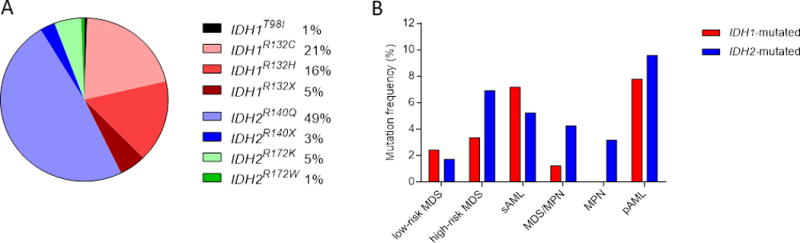
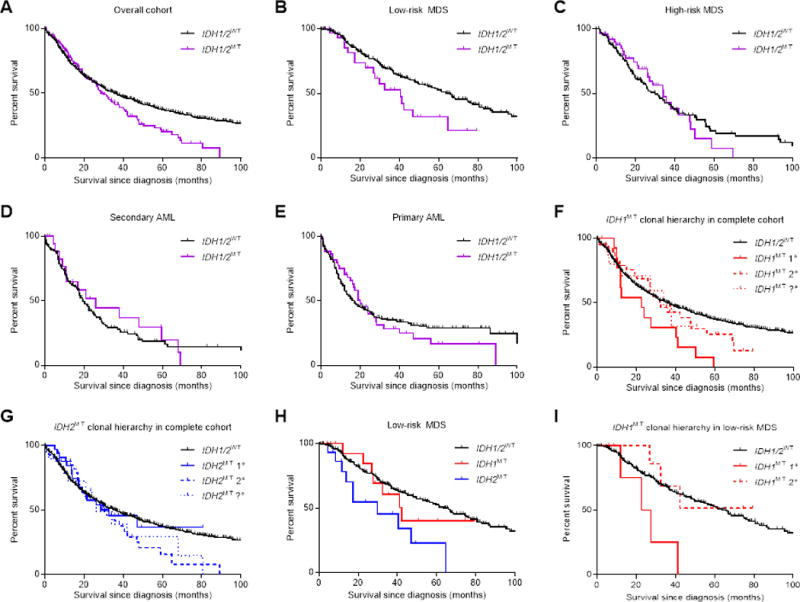
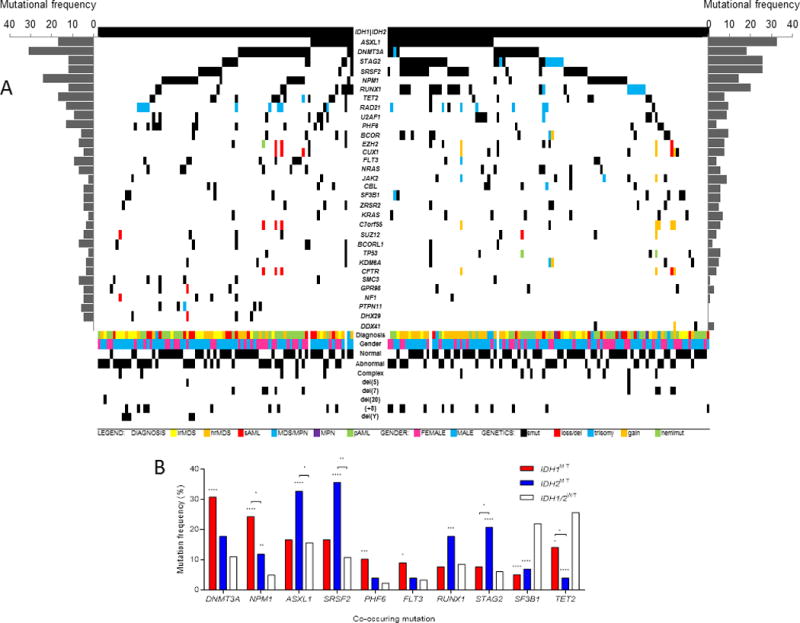
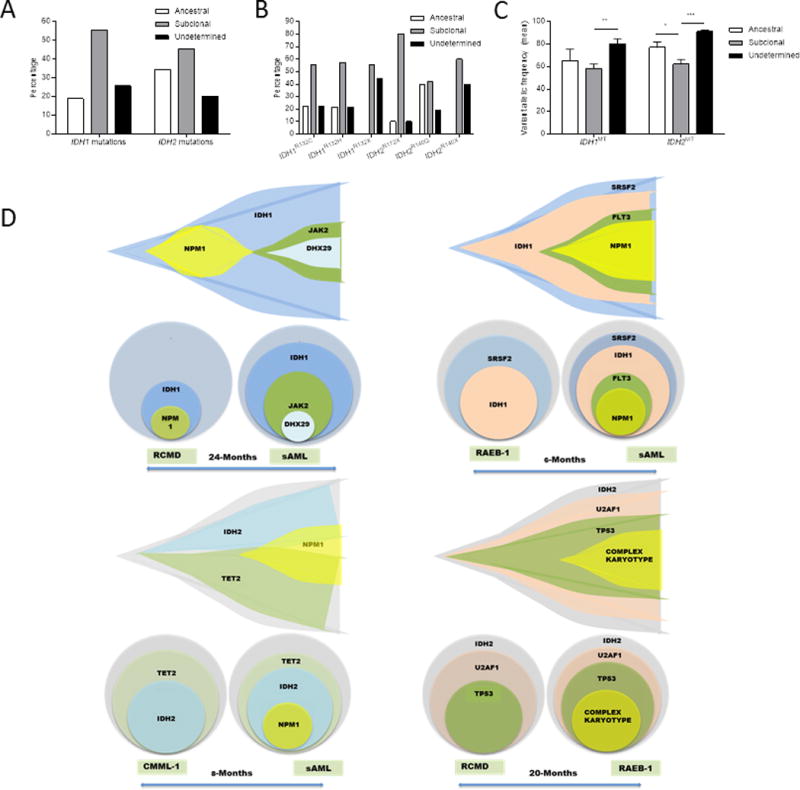
Mutations in isocitrate dehydrogenase 1/2 (IDH1/2(MT)) are drivers of a variety of myeloid neoplasms. As they yield the same oncometabolite, D-2-hydroxyglutarate, they are often treated as equivalent, and pooled. We studied the validity of this approach and found IDH1/2 mutations in 179 of 2119 myeloid neoplasms (8%). Cross-sectionally, the frequencies of these mutations increased from lower- to higher risk disease, thus suggesting a role in clinical progression. Variant allelic frequencies indicated that IDH1(MT) and IDH2(MT) are ancestral in up to 14/74 (19%) vs 34/99 (34%; P=0.027) of cases, respectively, illustrating the pathogenic role of these lesions in myeloid neoplasms. IDH1/2(MT) was associated with poor overall survival, particularly in lower risk myelodysplastic syndromes. Ancestral IDH1(MT) cases were associated with a worse prognosis than subclonal IDH1(MT) cases, whereas the position of IDH2(MT) within clonal hierarchy did not impact survival. This may relate to distinct mutational spectra with more DNMT3A and NPM1 mutations associated with IDH1(MT) cases, and more ASXL1, SRSF2, RUNX1, STAG2 mutations associated with IDH2(MT) cases. Our data demonstrate important clinical and biological differences between IDH1(MT) and IDH2(MT) myeloid neoplasms. These mutations should be considered separately as their differences could have implications for diagnosis, prognosis and treatment with IDH1/2(MT) inhibitors of IDH1/2(MT) patients.
异柠檬酸脱氢酶1/2(IDH1/2)突变是多种髓系肿瘤的驱动因素。由于它们产生相同的致癌代谢物D-2-羟基戊二酸,因此通常被视为等效并合并处理。我们研究了这种方法的有效性,在2119例髓系肿瘤中发现了179例IDH1/2突变(8%)。从横断面来看,这些突变的频率从低风险疾病到高风险疾病逐渐增加,因此提示其在临床进展中发挥作用。变异等位基因频率表明,IDH1突变(IDH1(MT))和IDH2突变(IDH2(MT))在高达14/74(19%)和34/99(34%;P=0.027)的病例中分别为祖先型,这说明了这些病变在髓系肿瘤中的致病作用。IDH1/2(MT)与总体生存率低相关,尤其是在低风险骨髓增生异常综合征中。祖先型IDH1(MT)病例的预后比亚克隆IDH1(MT)病例更差,而IDH2(MT)在克隆层次结构中的位置不影响生存率。这可能与不同的突变谱有关,IDH1(MT)病例中更多地与DNMT3A和NPM1突变相关,而IDH2(MT)病例中更多地与ASXL1、SRSF2、RUNX1、STAG2突变相关。我们的数据表明IDH1(MT)和IDH2(MT)髓系肿瘤之间存在重要的临床和生物学差异。这些突变应分别考虑,因为它们的差异可能对IDH1/2(MT)患者的诊断、预后和使用IDH1/2(MT)抑制剂治疗有影响。