Division of Neurological Sciences, Vetsuisse Faculty, University of Bern, 3012 Bern, Switzerland.
Viruses. 2021 Jun 23;13(7):1201. doi: 10.3390/v13071201.
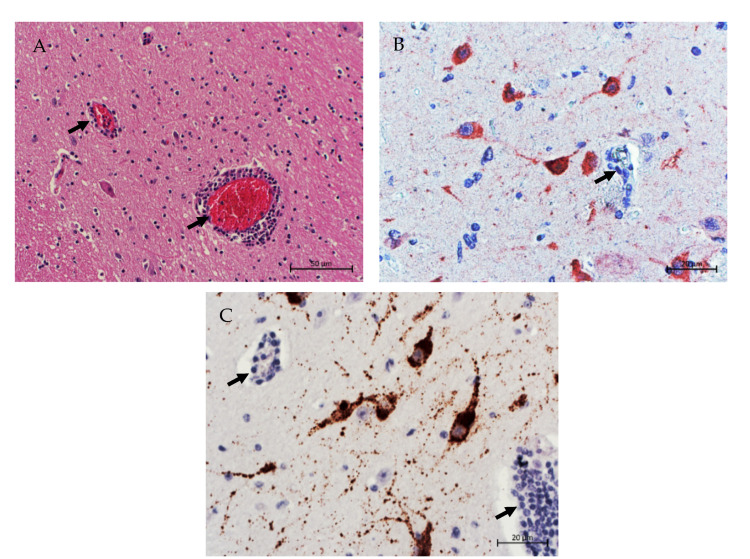
Astrovirus infections are among the main causes of diarrhea in children, but their significance for animal health has remained underestimated and largely unknown. This is changing due to the increasing amount of newly identified neurotropic astroviruses in cases of nonsuppurative encephalitis and neurological disease in humans, pigs, ruminant species and minks. Neurological cases in ruminants and humans usually occur sporadically and as isolated cases. This contrasts with the situation in pigs and minks, in which diseases associated with neurotropic astroviruses are endemic and occur on the herd level. Affected animals show neurological signs such as mild ataxia to tetraplegia, loss of orientation or trembling, and the outcome is often fatal. Non-suppurative inflammation with perivascular cuffing, gliosis and neuronal necrosis are typical histological lesions of astrovirus encephalitis. Since astroviruses primarily target the gastrointestinal tract, it is assumed that they infect the brain through the circulatory system or retrograde following the nerves. The phylogenetic analysis of neurotropic astroviruses has revealed that they are genetically closely related, suggesting the presence of viral determinants for tissue tropism and neuroinvasion. In this review, we summarize the current knowledge on neurotropic astrovirus infections in animals and propose future research activities.
星状病毒感染是儿童腹泻的主要原因之一,但它们对动物健康的重要性一直被低估且知之甚少。这种情况正在发生变化,因为越来越多的新鉴定的神经亲和性星状病毒在人类、猪、反刍动物物种和水貂的非化脓性脑炎和神经疾病病例中被发现。反刍动物和人类的神经病例通常是零星发生的,而且是孤立的病例。这与猪和水貂的情况形成对比,在猪和水貂中,与神经亲和性星状病毒相关的疾病是地方性的,发生在畜群水平。受感染的动物表现出神经症状,如轻度共济失调至四肢瘫痪、定向力丧失或颤抖,结果通常是致命的。非化脓性炎症伴血管周围套袖、胶质增生和神经元坏死是星状病毒脑炎的典型组织学病变。由于星状病毒主要靶向胃肠道,因此人们认为它们通过循环系统或逆行神经感染大脑。神经亲和性星状病毒的系统发育分析表明,它们在遗传上密切相关,这表明存在病毒决定组织嗜性和神经入侵的因素。在这篇综述中,我们总结了动物中神经亲和性星状病毒感染的现有知识,并提出了未来的研究活动。