Ruengphayak Siriphat, Chaichumpoo Ekawat, Phromphan Supaporn, Kamolsukyunyong Wintai, Sukhaket Wissarut, Phuvanartnarubal Ekapol, Korinsak Siripar, Korinsak Siriporn, Vanavichit Apichart
Rice Science Center, Kasetsart University, Kamphaeng Saen, Nakhon Pathom 73140 Thailand ; Interdisciplinary Graduate Program in Genetic Engineering, Kasetsart University, Chatuchak, Bangkok 10900 Thailand.
Rice Science Center, Kasetsart University, Kamphaeng Saen, Nakhon Pathom 73140 Thailand.
Rice (N Y). 2015 Feb 5;8:7. doi: 10.1186/s12284-014-0035-0. eCollection 2015.
Pyramiding multiple genes into a desirable genetic background can take years to accomplish. In this paper, a pseudo-backcrossing scheme was designed to shorten the backcrossing cycle needed. PinK3, an aromatic and potentially high-yielding rice variety-although one that is intolerant to flash flooding (Sub) and susceptible to bacterial leaf blight (BB), leaf-neck blast (BL) and the brown planthopper (BPH)-was used as a genetic basis for significant improvements through gene pyramiding.
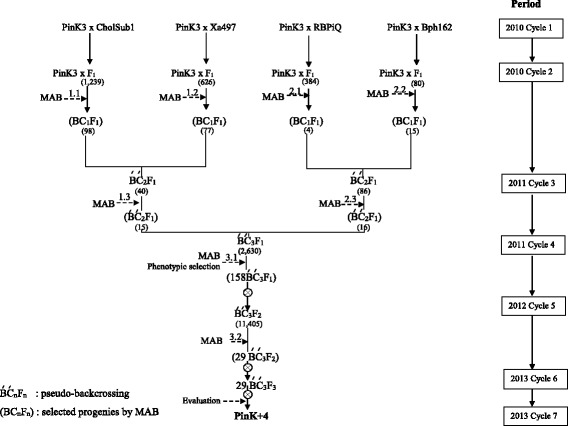
Four resistance donors with five target genes (Sub1A-C, xa5, Xa21, TPS and SSIIa) and three QTLs (qBph3, qBL1 and qBL11) were backcrossed individually using markers into the pseudo-recurrent parent 'PinK3' via one cycle of backcrossing followed by two cycles of pseudo-backcrossing and three selfings with rigorous foreground marker-assisted selection. In total, 29 pseudo-backcross inbred lines (BILs) were developed. Genome composition was surveyed using 61 simple sequence repeats (SSRs), 35 of which were located on six carrier chromosomes, with the remainder located on six non-carrier chromosomes. The recurrent genome content (%RGC) and donor genome content (%DGC), which were based on the physical positions of BC1F2, ranged from 69.99 to 88.98% and 11.02 to 30.01%, respectively. For the pseudo-BC3F3BILs, the %RGC and %DGC ranged from 74.50 to 81.30% and 18.70 to 25.50%, respectively. These results indicated that without direct background selection, no further increases in %RGC were obtained during pseudo-backcrossing, whereas rigorous foreground marker-assisted selection tended to reduce linkage drag during pseudo-backcrossing. The evaluation of new traits in selected pseudo-BC3F3BILs indicated significant improvements in resistance to BB, BL, BPH and Sub compared with PinK3, as well as significant improvements in grain yield (21-68%) over the donors, although yield was 7-26% lower than in 'PinK3'. All pyramided lines were aromatic and exhibited improved starch profiles, rendering them suitable for industrial food applications.
Results show that our new pyramiding platform, which is based on marker-assisted pseudo-backcrossing, can fix five target genes and three QTLs into a high-yielding pseudo-recurrent background within seven breeding cycles in four years. This multiple pseudo-backcrossing platform decreases the time required to generate new rice varieties exhibiting complex, durable resistance to biotic and abiotic stresses in backgrounds with desirable qualities.
将多个基因导入理想的遗传背景可能需要数年时间才能完成。本文设计了一种假回交方案,以缩短所需的回交周期。粉红3号是一种香型且可能高产的水稻品种,尽管它不耐骤发洪水(Sub),且易感染白叶枯病(BB)、叶颈瘟(BL)和褐飞虱(BPH),但被用作通过基因聚合进行显著改良的遗传基础。
利用标记将四个带有五个目标基因(Sub1A - C、xa5、Xa21、TPS和SSIIa)以及三个数量性状基因座(qBph3、qBL1和qBL11)的抗性供体,通过一个回交周期、随后两个假回交周期以及三次自交,并进行严格的前景标记辅助选择,分别回交至假轮回亲本“粉红3号”。总共培育出了29个假回交自交系(BILs)。使用61个简单序列重复(SSR)标记对基因组组成进行了检测,其中35个位于六条携带染色体上,其余位于六条非携带染色体上。基于BC1F2的物理位置计算的轮回基因组含量(%RGC)和供体基因组含量(%DGC)分别为69.99%至88.98%和11.02%至30.01%。对于假BC3F3 BILs,%RGC和%DGC分别为74.50%至81.30%和18.70%至25.50%。这些结果表明,在没有直接背景选择的情况下,假回交过程中%RGC没有进一步增加,而严格的前景标记辅助选择倾向于减少假回交过程中的连锁累赘。对所选假BC3F3 BILs新性状的评估表明,与粉红3号相比,其对白叶枯病、叶颈瘟、褐飞虱和骤发洪水的抗性有显著提高,并且产量比供体提高了21 - 68%,尽管产量比“粉红3号”低7 - 26%。所有聚合系均为香型,且淀粉特性得到改善,适合用于工业食品应用。
结果表明,我们基于标记辅助假回交的新聚合平台能够在四年内通过七个育种周期将五个目标基因和三个数量性状基因座固定到高产假轮回背景中。这个多重假回交平台减少了在具有理想品质的背景下培育对生物和非生物胁迫具有复杂、持久抗性的新型水稻品种所需的时间。