Gao Peng Ji, Gao Jie, Li Zhao, Hu Zhi Ping, Zhu Ji Ye
Department of Hepatobiliary Surgery, Peking University People's Hospital, Beijing, China.
Ann Surg Treat Res. 2015 Apr;88(4):222-8. doi: 10.4174/astr.2015.88.4.222. Epub 2015 Mar 26.
The aim of this study is to evaluate the incidence of de novo malignancy after liver transplantation (LT) and compare with those among the general Chinese population.
A total of 466 patients who had a minimum follow-up time of 6 months were enrolled in the study. All data of medical records and follow up were retrospectively reviewed.
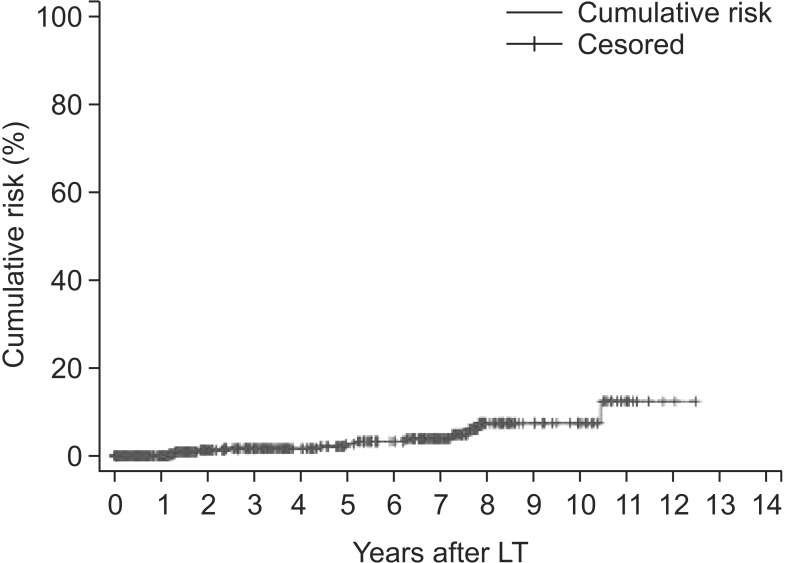
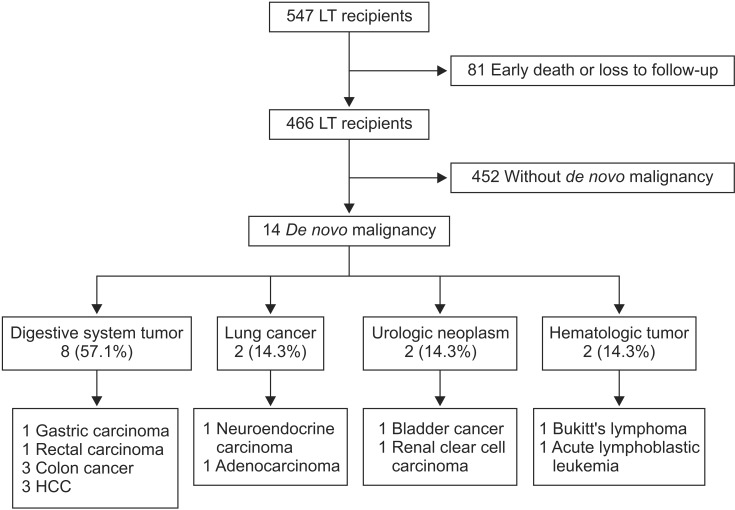
The incidence rate of de novo malignancy was 3.0% (14 in 466 patients). The median elapsed time from transplant to the diagnosis of de novo malignancy was 42 months (range, 6 to 106 months). The cumulative risk for development of de novo malignancy was 1.6%, 2.7%, and 8.2% at 3, 5 and 10 years after LT, respectively. The patients were all male. The types of de novo tumors included digestive system tumor (8 in 14), lung cancer (2 in 14), urologic neoplasm (2 in 14), and hematologic malignant tumor (2 in 14). Over a mean follow-up of 24 months after diagnosis of de novo malignancy, 7 patients (50.0%) died; the overall 5-year patient survival rate was 54.5%. The relative risk of malignancy following LT was 9.5 folds higher than the general Chinese population.
The relative risk of malignancy following LT was much higher than the general Chinese population. Digestive system tumor is the most common type of de novo malignancy after LT in China.
本研究旨在评估肝移植(LT)后新发恶性肿瘤的发生率,并与中国普通人群的发生率进行比较。
共有466例随访时间至少6个月的患者纳入本研究。对所有病历和随访数据进行回顾性分析。
新发恶性肿瘤的发生率为3.0%(466例患者中有14例)。从移植到新发恶性肿瘤诊断的中位时间为42个月(范围6至106个月)。肝移植后3年、5年和10年新发恶性肿瘤的累积风险分别为1.6%、2.7%和8.2%。患者均为男性。新发肿瘤类型包括消化系统肿瘤(14例中有8例)、肺癌(14例中有2例)、泌尿系统肿瘤(14例中有2例)和血液系统恶性肿瘤(14例中有2例)。新发恶性肿瘤诊断后平均随访24个月,7例患者(50.0%)死亡;总体5年患者生存率为54.5%。肝移植后发生恶性肿瘤的相对风险比中国普通人群高9.5倍。
肝移植后发生恶性肿瘤的相对风险远高于中国普通人群。消化系统肿瘤是中国肝移植后最常见的新发恶性肿瘤类型。