Kharaziha Pedram, Chioureas Dimitris, Rutishauser Dorothea, Baltatzis George, Lennartsson Lena, Fonseca Pedro, Azimi Alireza, Hultenby Kjell, Zubarev Roman, Ullén Anders, Yachnin Jeffrey, Nilsson Sten, Panaretakis Theocharis
Department of Oncology-Pathology, Karolinska Institutet and University Hospital, Stockholm, Sweden.
Department of Medical Biochemistry and Biophysics, Karolinska Institutet and University Hospital, Stockholm, Sweden.
Oncotarget. 2015 Aug 28;6(25):21740-54. doi: 10.18632/oncotarget.3226.
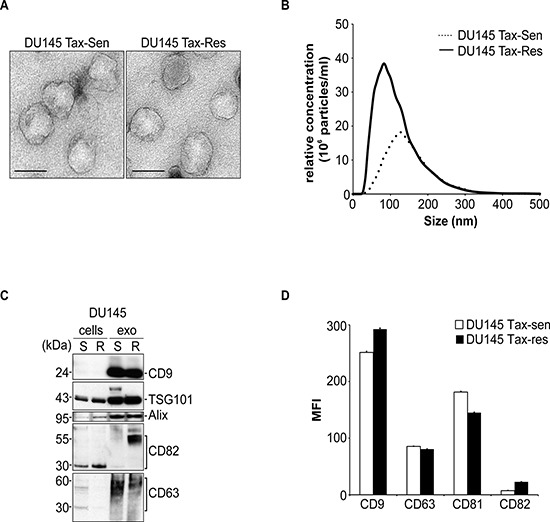
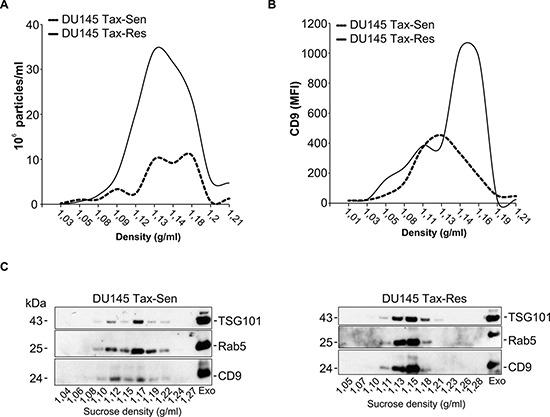
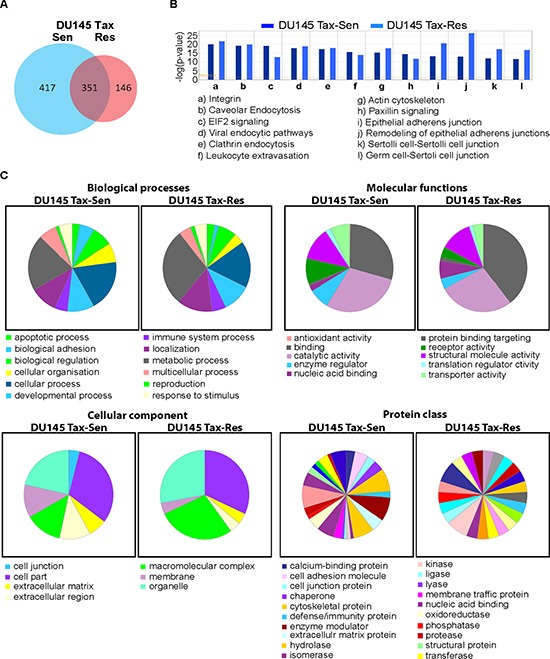
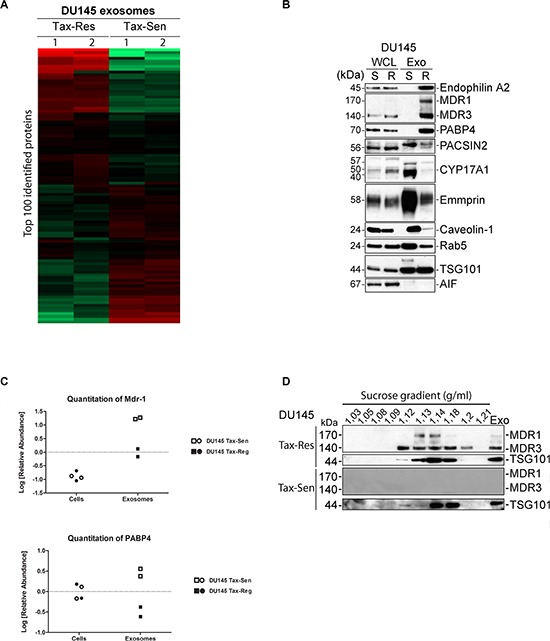
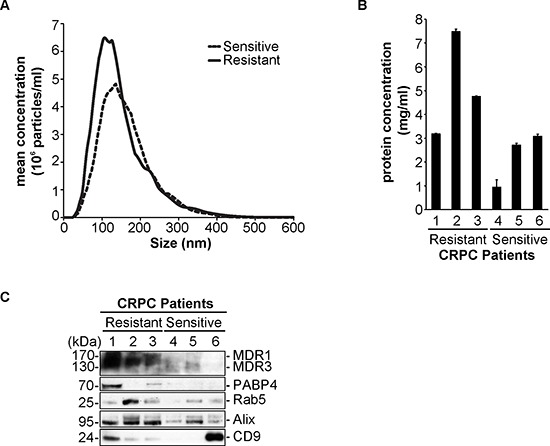
Docetaxel is a cornerstone treatment for metastatic, castration resistant prostate cancer (CRPC) which remains a leading cause of cancer-related deaths, worldwide. The clinical usage of docetaxel has resulted in modest gains in survival, primarily due to the development of resistance. There are currently no clinical biomarkers available that predict whether a CRPC patient will respond or acquire resistance to this therapy. Comparative proteomics analysis of exosomes secreted from DU145 prostate cancer cells that are sensitive (DU145 Tax-Sen) or have acquired resistance (DU145 Tax-Res) to docetaxel, demonstrated significant differences in the amount of exosomes secreted and in their molecular composition. A panel of proteins was identified by proteomics to be differentially enriched in DU145 Tax-Res compared to DU145 Tax-Sen exosomes and was validated by western blotting. Importantly, we identified MDR-1, MDR-3, Endophilin-A2 and PABP4 that were enriched only in DU145 Tax-Res exosomes. We validated the presence of these proteins in the serum of a small cohort of patients. DU145 cells that have uptaken DU145 Tax-Res exosomes show properties of increased matrix degradation. In summary, exosomes derived from DU145 Tax-Res cells may be a valuable source of biomarkers for response to therapy.
多西他赛是转移性去势抵抗性前列腺癌(CRPC)的基石治疗药物,而CRPC仍是全球癌症相关死亡的主要原因。多西他赛的临床应用使患者生存期略有延长,主要是由于耐药性的产生。目前尚无临床生物标志物可预测CRPC患者对该疗法是否有反应或是否会产生耐药性。对多西他赛敏感(DU145 Tax-Sen)或已产生耐药性(DU145 Tax-Res)的DU145前列腺癌细胞分泌的外泌体进行比较蛋白质组学分析,结果显示外泌体分泌量及其分子组成存在显著差异。通过蛋白质组学鉴定出一组蛋白质,与DU145 Tax-Sen外泌体相比,这些蛋白质在DU145 Tax-Res外泌体中差异富集,并通过蛋白质印迹法进行了验证。重要的是,我们鉴定出仅在DU145 Tax-Res外泌体中富集的MDR-1、MDR-3、内吞蛋白A2和PABP4。我们在一小群患者的血清中验证了这些蛋白质的存在。摄取了DU145 Tax-Res外泌体的DU145细胞表现出基质降解增加的特性。总之,来自DU145 Tax-Res细胞的外泌体可能是预测治疗反应的有价值的生物标志物来源。