Jackson Nicole R, Hauch Adam, Hu Tian, Buell Joseph F, Slakey Douglas P, Kandil Emad
Department of Surgery, Tulane University School of Medicine, New Orleans, LA, USA.
Department of Epidemiology, Tulane University School of Public Health and Tropical Medicine, New Orleans, LA, USA.
JSLS. 2015 Jan-Mar;19(1):e2014.00186. doi: 10.4293/JSLS.2014.00186.
The aim of this study is to compare the safety and efficacy of conventional laparotomy with those of robotic and laparoscopic approaches to hepatectomy.
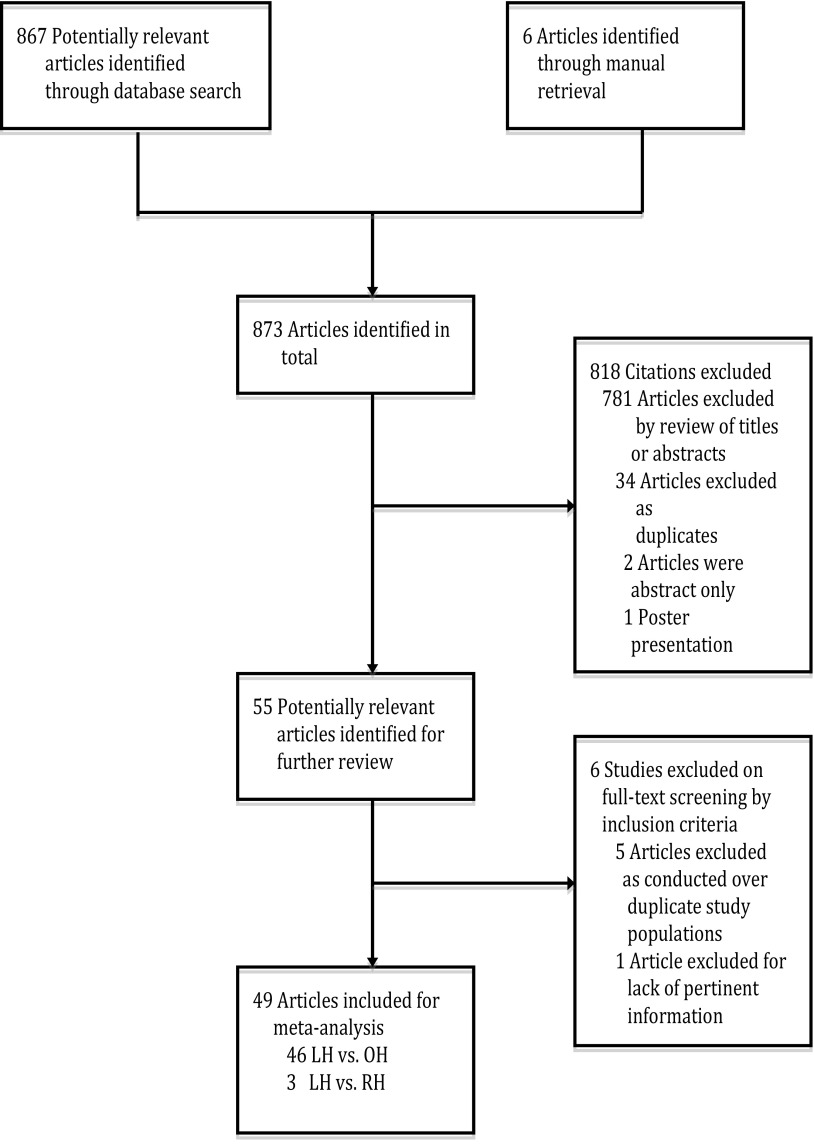
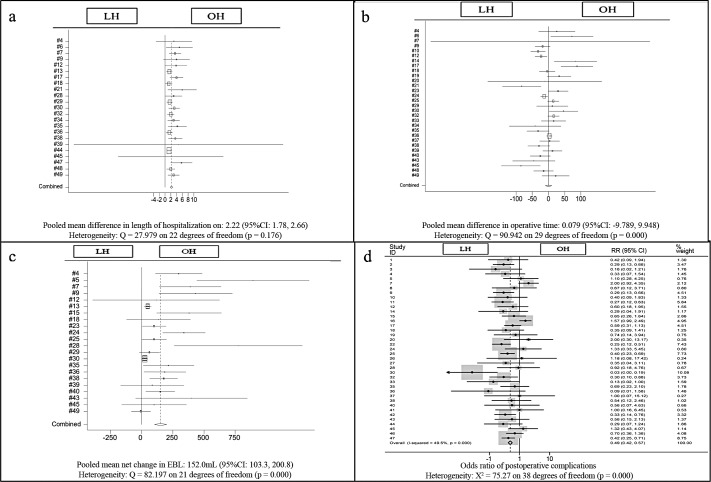
Independent reviewers conducted a systematic review of publications in PubMed and Embase, with searches limited to comparative articles of laparoscopic hepatectomy with either conventional or robotic liver approaches. Outcomes included total operative time, estimated blood loss, length of hospitalization, resection margins, postoperative complications, perioperative mortality rates, and cost measures. Outcome comparisons were calculated using random-effects models to pool estimates of mean net differences or of the relative risk between group outcomes. Forty-nine articles, representing 3702 patients, comprise this analysis: 1901 (51.35%) underwent a laparoscopic approach, 1741 (47.03%) underwent an open approach, and 60 (1.62%) underwent a robotic approach. There was no difference in total operative times, surgical margins, or perioperative mortality rates among groups. Across all outcome measures, laparoscopic and robotic approaches showed no difference. As compared with the minimally invasive groups, patients undergoing laparotomy had a greater estimated blood loss (pooled mean net change, 152.0 mL; 95% confidence interval, 103.3-200.8 mL), a longer length of hospital stay (pooled mean difference, 2.22 days; 95% confidence interval, 1.78-2.66 days), and a higher total complication rate (odds ratio, 0.5; 95% confidence interval, 0.42-0.57).
Minimally invasive approaches to liver resection are as safe as conventional laparotomy, affording less estimated blood loss, shorter lengths of hospitalization, lower perioperative complication rates, and equitable oncologic integrity and postoperative mortality rates. There was no proven advantage of robotic approaches compared with laparoscopic approaches.
本研究旨在比较传统开腹肝切除术与机器人辅助及腹腔镜肝切除术的安全性和疗效。
独立评审员对PubMed和Embase上的出版物进行了系统综述,搜索仅限于腹腔镜肝切除术与传统或机器人肝脏手术方法的比较文章。结果包括总手术时间、估计失血量、住院时间、切缘、术后并发症、围手术期死亡率和成本指标。使用随机效应模型计算结果比较,以汇总组间结果的平均净差异或相对风险估计值。本分析纳入了49篇文章,共3702例患者:1901例(51.35%)接受了腹腔镜手术,1741例(47.03%)接受了开放手术,60例(1.62%)接受了机器人辅助手术。各组间总手术时间、手术切缘或围手术期死亡率无差异。在所有结果指标中,腹腔镜手术和机器人辅助手术无差异。与微创组相比,接受开腹手术的患者估计失血量更多(汇总平均净变化,152.0 mL;95%置信区间,103.3 - 200.8 mL),住院时间更长(汇总平均差异,2.22天;95%置信区间,1.78 - 2.66天),总并发症发生率更高(比值比,0.5;95%置信区间,0.42 - 0.57)。
肝切除的微创方法与传统开腹手术一样安全,估计失血量更少,住院时间更短,围手术期并发症发生率更低,肿瘤切除完整性和术后死亡率相当。与腹腔镜手术相比,机器人辅助手术未显示出明显优势。