Liu Qing, Zhou Renlai, Zhao Xin, Oei Tian Po S
Beijing Key Lab of Applied Experimental Psychology, School of Psychology, Beijing Normal University, Beijing, People's Republic of China ; Research Center of Emotion Regulation, Beijing Normal University, Beijing, People's Republic of China.
Beijing Key Lab of Applied Experimental Psychology, School of Psychology, Beijing Normal University, Beijing, People's Republic of China ; Research Center of Emotion Regulation, Beijing Normal University, Beijing, People's Republic of China ; State Key Laboratory of Cognitive Neuroscience and Learning, International Data Group/McGovern Institute for Brain Research, Beijing Normal University, Beijing, People's Republic of China ; Department of Psychology, School of Social and Behavioral Science, Nanjing University, Nanjing, People's Republic of China.
Neuropsychiatr Dis Treat. 2015 Mar 26;11:835-42. doi: 10.2147/NDT.S76292. eCollection 2015.
The weightlessness caused by prolonged bed rest results in changes in cerebral circulation and thus, brain functions, which is of interest.
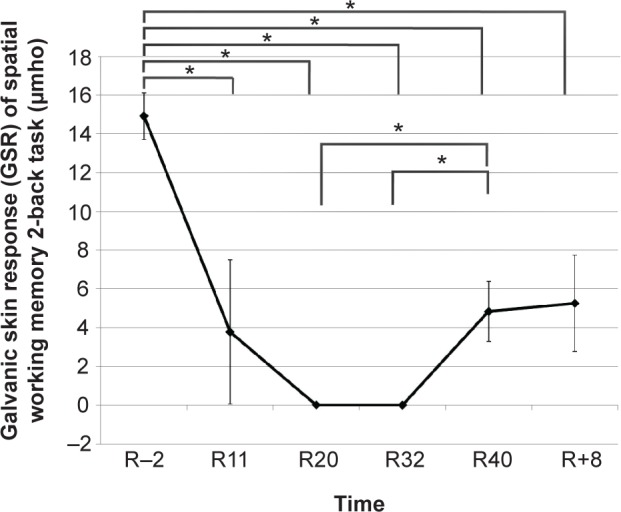
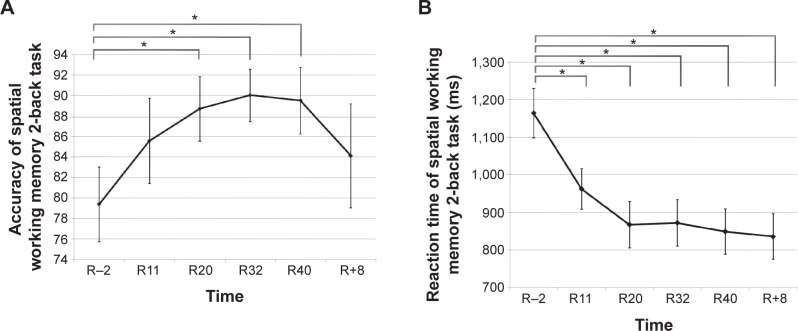
We investigated the effects of 45-day, -6° head-down bed rest, which stimulated microgravity, on working memory in 16 healthy male participants. The 2-back task was used to test the working memory variations on the 2nd day before bed rest (R-2); on the 11th (R11), 20th (R20), 32nd (R32), and 40th (R40) days of bed rest; and on the eighth day after bed rest (R+8). The cognitive response and the physiological reactivity (such as galvanic skin response, heart rate, and heart rate variability) under the 2-back task were recorded simultaneously.
The results showed that compared with R-2, on the R+8, the participants' galvanic skin response increased significantly, and the high frequency of heart rate variability (HF), low frequency of heart rate variability (LF), and reaction time in the 2-back task decreased significantly. There were positive correlations between the participants' reaction time of working memory and the LF/HF under head-down bed rest (at R11, R20, and R32).
The results suggested that the prolonged head-down bed rest may have a detrimental effect on individual physiology and working memory. Physiology indices, such as galvanic skin response and heart rate variability, were sensitive to the prolonged bed rest.
长时间卧床休息导致的失重会引起脑循环变化,进而影响脑功能,这一现象备受关注。
我们研究了模拟微重力的45天-6°头低位卧床休息对16名健康男性参与者工作记忆的影响。采用2-back任务测试卧床休息前第2天(R-2)、卧床休息第11天(R11)、第20天(R20)、第32天(R32)和第40天(R40)以及卧床休息后第8天(R+8)的工作记忆变化。同时记录2-back任务下的认知反应和生理反应(如皮肤电反应、心率和心率变异性)。
结果显示,与R-2相比,在R+8时,参与者的皮肤电反应显著增加,心率变异性的高频(HF)、低频(LF)以及2-back任务中的反应时间显著降低。在头低位卧床休息期间(R11、R20和R32),参与者工作记忆的反应时间与LF/HF之间存在正相关。
结果表明,长时间头低位卧床休息可能对个体生理和工作记忆产生不利影响。生理指标,如皮肤电反应和心率变异性,对长时间卧床休息敏感。