Chimah Carol Uzoamaka, Adogu Prosper Obunikem Uche, Odeyemi Kofoworola, Ilika Amobi Linus
Medical Department, Ministry of Defence Headquarters, Abuja, Nigeria.
Department of Community Medicine and PHC, Nnamdi Azikiwe University/Nnamdi Azikiwe University Teaching Hospital, Nnewi, Nigeria.
Int J Womens Health. 2015 Mar 10;7:287-95. doi: 10.2147/IJWH.S79176. eCollection 2015.
Intimate partner violence (IPV) occurs across the world, in various cultures, and affects people across societies irrespective of economic status or gender. Most data on IPV before World Health Organization multicountry study (WHOMCS) usually came from sources other than the military. Result of this study will contribute to the existing body of knowledge and may serve as a baseline for future studies in military populations. This study compares the prevalence of the different types of IPV against women in military and civilian communities in Abuja, Nigeria.
Using a multistage sampling technique, 260 women who had intimate male partners were selected from military and civilian communities of Abuja. Collected data on personal characteristics and different types of IPV experienced were analyzed to demonstrate comparison of the association between the different forms of IPV and the respondents' sociodemographic and partner characteristics in the two study populations using percentages and χ-square statistics, and P-value was assumed to be significant at ≤0.05.
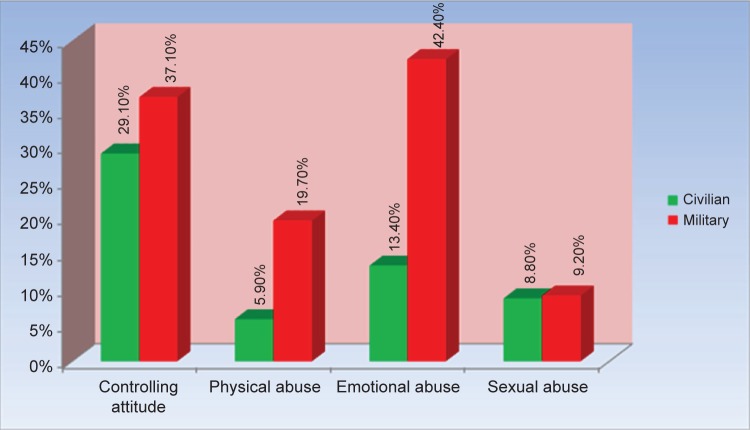
The prevalence of the four major types of IPV was higher among the military respondents than among civilians: controlling behavior, 37.1% versus 29.1%; emotional/psychological abuse, 42.4% versus 13.4%; physical abuse, 19.7% versus 5.9%, and sexual abuse, 9.2% versus 8.8%. Significantly more respondents from the military population (59 [45.4%]) compared to civilians (21 [19.4%]) were prevented by their partners from seeing their friends (P=0.000). The situation is reversed with regard to permission to seek health care for self, with civilians reporting a significantly higher prevalence (35 [32.4%]) than did military respondents (20 [15.4%]) (P=0.002). The military respondents were clearly at a higher risk of experiencing all the variants of emotional violence than the civilians (P=0.00). The commonest form of physical violence against women was "being slapped or having something thrown at them, that could hurt", which was markedly higher in the military (43 [33.1%]) than in the civilian population (10 [9.3%]), (P<0.05).
IPV is a significant public health problem in Abuja, and the military population is clearly at a higher risk of experiencing all forms of IPV compared to the civilian population. The military should encourage and finance research on effect of military operations and posttraumatic stress disorders on family relationships with a view of developing evidence-based treatment models for military personnel.
亲密伴侣暴力(IPV)在世界各地、各种文化中均有发生,影响着社会各阶层的人们,无论其经济状况或性别如何。世界卫生组织多国研究(WHOMCS)之前,大多数关于亲密伴侣暴力的数据通常来自军事领域以外的来源。本研究结果将有助于丰富现有知识体系,并可为未来针对军人的研究提供基线数据。本研究比较了尼日利亚阿布贾军人社区和平民社区中针对女性的不同类型亲密伴侣暴力的患病率。
采用多阶段抽样技术,从阿布贾的军人和平民社区中选取了260名有亲密男性伴侣的女性。对收集到的个人特征数据以及所经历的不同类型亲密伴侣暴力进行分析,以百分比和卡方统计量展示两个研究群体中不同形式亲密伴侣暴力与受访者社会人口学特征及伴侣特征之间关联的比较,P值在≤0.05时被认为具有显著性。
军人受访者中四种主要类型亲密伴侣暴力的患病率高于平民:控制行为,分别为37.1%和29.1%;情感/心理虐待,分别为42.4%和13.4%;身体虐待,分别为19.7%和5.9%;性虐待,分别为9.2%和8.8%。与平民(21人[19.4%])相比,军人群体中有更多受访者(59人[45.4%])被伴侣阻止与朋友见面(P = 0.000)。在自行寻求医疗保健的许可方面情况则相反,平民报告的患病率(35人[32.4%])显著高于军人受访者(20人[15.4%])(P = 0.002)。军人受访者遭受各种形式情感暴力的风险明显高于平民(P = 0.00)。针对女性最常见的身体暴力形式是“被扇耳光或被扔东西,可能造成伤害”,在军人中(43人[33.1%])明显高于平民群体(10人[9.3%]),(P<0.05)。
亲密伴侣暴力是阿布贾一个重要的公共卫生问题,与平民群体相比,军人显然更容易遭受各种形式的亲密伴侣暴力。军方应鼓励并资助关于军事行动和创伤后应激障碍对家庭关系影响的研究,以便为军事人员制定基于证据的治疗模式。