Yu Qibin, Plotto Anne, Baldwin Elizabeth A, Bai Jinhe, Huang Ming, Yu Yuan, Dhaliwal Harvinder S, Gmitter Frederick G
BMC Plant Biol. 2015 Mar 6;15:76. doi: 10.1186/s12870-015-0466-9.
Although many of the volatile constituents of flavor and aroma in citrus have been identified, the knowledge of molecular mechanisms and regulation of volatile production are very limited. Our aim was to understand mechanisms of flavor volatile production and regulation in mandarin fruit.
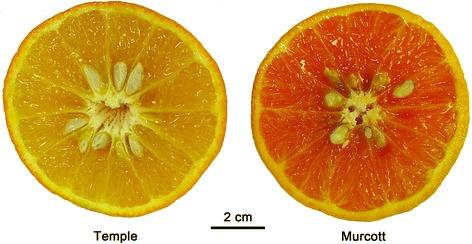
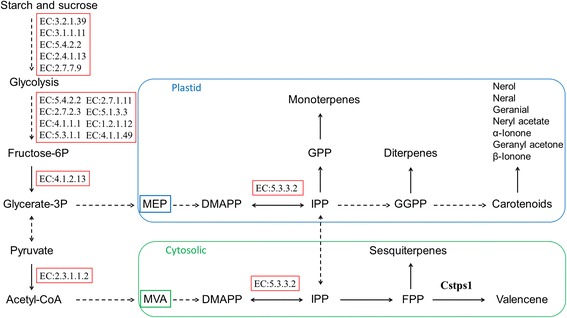
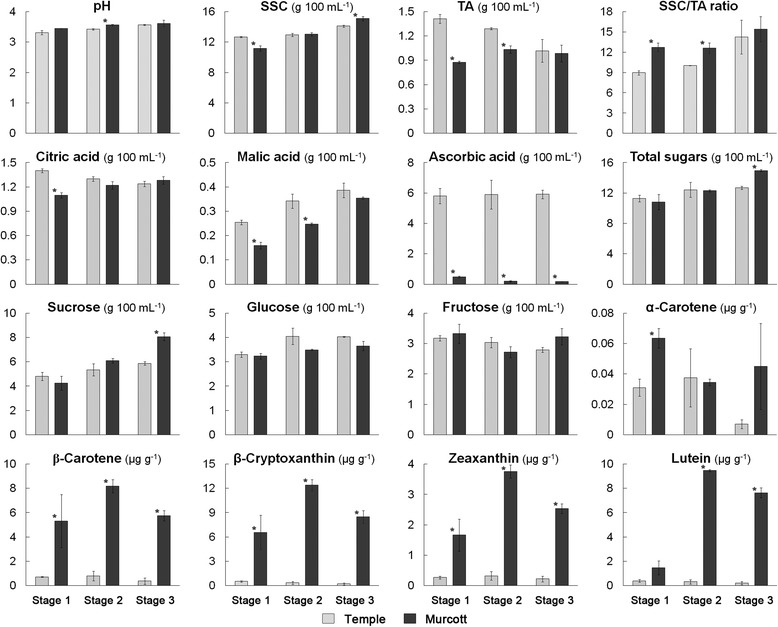
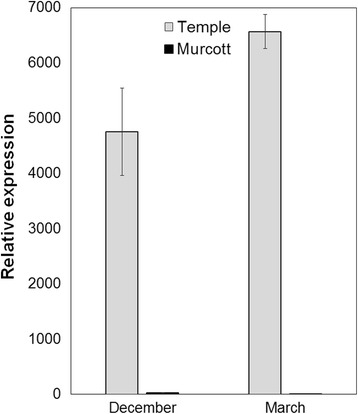
Fruits of two mandarin hybrids, Temple and Murcott with contrasting volatile and non- volatile profiles, were collected at three developmental stages. A combination of methods, including the isobaric tags for relative and absolute quantification (iTRAQ), quantitative real-time polymerase chain reaction, gas chromatography, and high-performance liquid chromatography, was used to identify proteins, measure gene expression levels, volatiles, sugars, organic acids and carotenoids. Two thirds of differentially expressed proteins were identified in the pathways of glycolysis, citric acid cycle, amino acid, sugar and starch metabolism. An enzyme encoding valencene synthase gene (Cstps1) was more abundant in Temple than in Murcott. Valencene accounted for 9.4% of total volatile content in Temple, whereas no valencene was detected in Murcott fruit. Murcott expression of Cstps1 is severely reduced.
We showed that the diversion of valencene and other sesquiterpenes into the terpenoid pathway together with high production of apocarotenoid volatiles might have resulted in the lower concentration of carotenoids in Temple fruit.
尽管柑橘中许多风味和香气的挥发性成分已被鉴定出来,但关于挥发性物质产生的分子机制和调控的知识却非常有限。我们的目的是了解柑橘果实中风味挥发性物质产生和调控的机制。
在三个发育阶段收集了两个具有不同挥发性和非挥发性特征的柑橘杂交品种坦普尔和默科特的果实。采用了包括相对和绝对定量等压标签法(iTRAQ)、定量实时聚合酶链反应、气相色谱和高效液相色谱在内的多种方法来鉴定蛋白质、测量基因表达水平、挥发性物质、糖类、有机酸和类胡萝卜素。三分之二的差异表达蛋白在糖酵解、柠檬酸循环、氨基酸、糖和淀粉代谢途径中被鉴定出来。编码瓦伦烯合酶基因(Cstps1)的一种酶在坦普尔中比在默科特中含量更高。瓦伦烯占坦普尔总挥发性成分的9.4%,而在默科特果实中未检测到瓦伦烯。默科特中Cstps1的表达严重降低。
我们表明,瓦伦烯和其他倍半萜烯进入萜类途径的转移以及脱辅基类胡萝卜素挥发性物质的高产可能导致了坦普尔果实中类胡萝卜素浓度较低。