Garawi Fatima, Ploubidis George B, Devries Karen, Al-Hamdan Nasser, Uauy Ricardo
BMC Public Health. 2015 Mar 17;15:254. doi: 10.1186/s12889-015-1608-6.
The prevalence of adult obesity is higher in women than men in most countries. However, the pathways that link female sex with excess obesity are still not fully understood. We examine whether socioeconomic and behavioural factors may mediate the association between sex and obesity in the Saudi Arabian setting where there is female excess in obesity.
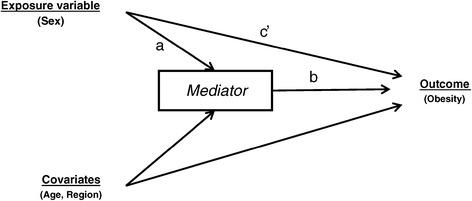
We performed a mediation analysis using a cross-sectional, national household survey from Saudi Arabia with 4758 participants (51% female). A series of multivariable regression models were fitted to test if socioeconomic position, physical activity, sedentary behaviour, diet, and smoking mediate the association between sex and obesity (BMI >=30). The findings were confirmed using causal mediation analysis.
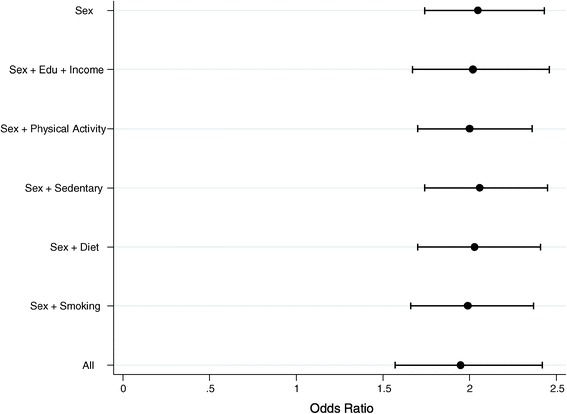
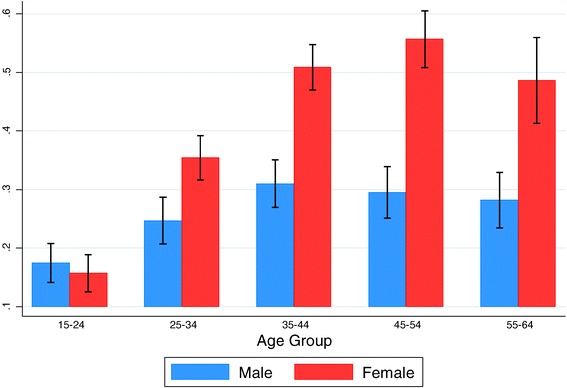
Women in this sample were roughly twice as likely as men to be obese (crude OR 1.9; 95% CI 1.6-2.3). The odds ratio remained significantly higher for women compared to men in models testing for mediation (OR range 1.95-2.06). Our data suggest that indicators of socio-economic position, physical activity, sedentary behaviour, diet, and smoking do not mediate the sex differences in obesity.
Our analysis shows that most commonly measured risk factors for obesity do not explain the sex differences in its prevalence in the Saudi context. Further research is needed to understand what might explain the female excess in obesity prevalence. We discuss how data related to the lived experience of Saudi men and women may tap into underlying mechanisms by which the sex difference in obesity prevalence are produced.
在大多数国家,成年女性肥胖的患病率高于男性。然而,将女性性别与过度肥胖联系起来的途径仍未完全明确。在沙特阿拉伯,女性肥胖现象更为普遍,我们研究社会经济和行为因素是否可能介导性别与肥胖之间的关联。
我们使用沙特阿拉伯的一项全国性家庭横断面调查进行中介分析,该调查有4758名参与者(51%为女性)。拟合了一系列多变量回归模型,以检验社会经济地位、身体活动、久坐行为、饮食和吸烟是否介导性别与肥胖(BMI≥30)之间的关联。使用因果中介分析对结果进行了验证。
该样本中女性肥胖的可能性大约是男性的两倍(粗OR为1.9;95%CI为1.6 - 2.3)。在中介检验模型中,女性的优势比仍显著高于男性(OR范围为1.95 - 2.06)。我们的数据表明,社会经济地位、身体活动、久坐行为、饮食和吸烟指标并不能介导肥胖的性别差异。
我们的分析表明,在沙特背景下,最常测量的肥胖风险因素并不能解释肥胖患病率的性别差异。需要进一步研究以了解可能解释女性肥胖患病率过高的原因。我们讨论了与沙特男性和女性生活经历相关的数据如何可能揭示肥胖患病率性别差异产生的潜在机制。