Chen Yan-Yan, Huang Xi-Bao, Xiao Ying, Jiang Yong, Shan Xiao-Wei, Zhang Juan, Cai Shun-Xiang, Liu Jian-Bing
Hubei Center for Disease Control and Prevention, Wuhan, China.
PLoS One. 2015 Apr 7;10(4):e0118362. doi: 10.1371/journal.pone.0118362. eCollection 2015.
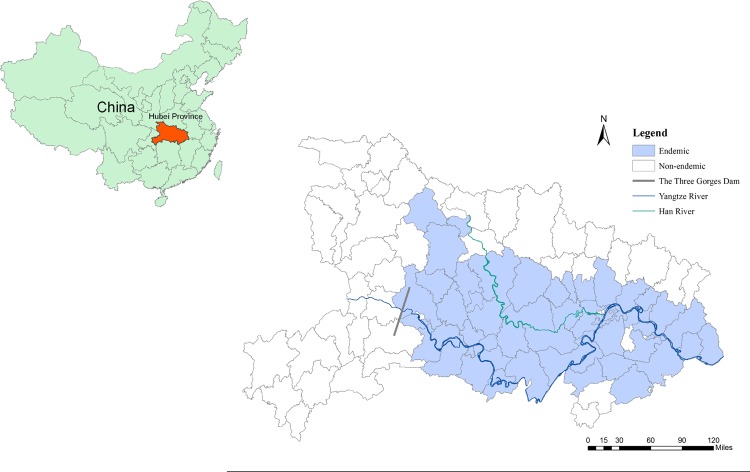
Schistosomiasis remains a major public health problem in China. The major endemic areas are located in the lake and marshland regions of southern China, particularly in areas along the middle and low reach of the Yangtze River. Spatial analytical techniques are often used in epidemiology to identify spatial clusters in disease regions. This study assesses the spatial distribution of schistosomiasis and explores high-risk regions in Hubei Province, China to provide guidance on schistosomiasis control in marshland regions.
In this study, spatial autocorrelation methodologies, including global Moran's I and local Getis-Ord statistics, were utilized to describe and map spatial clusters and areas where human Schistosoma japonicum infection is prevalent at the county level in Hubei province. In addition, linear logistic regression model was used to determine the characteristics of spatial autocorrelation with time.
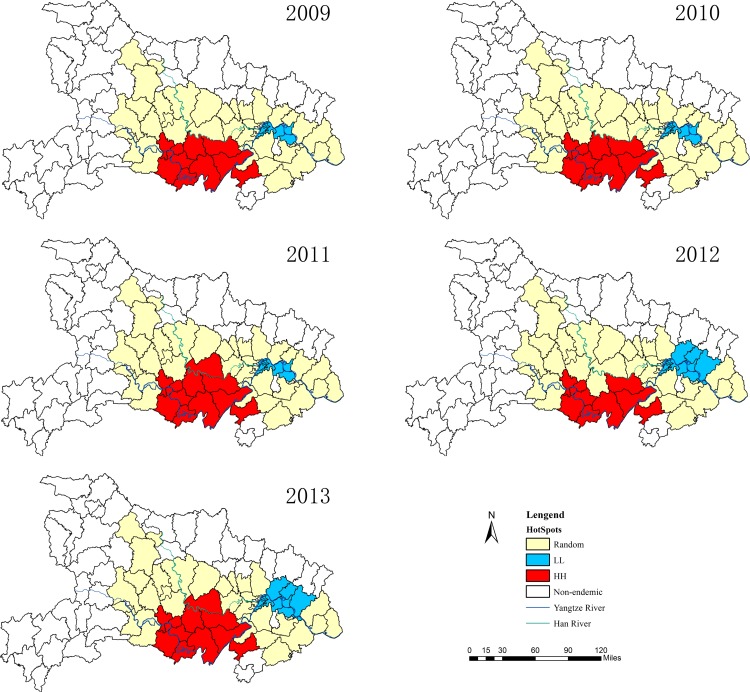
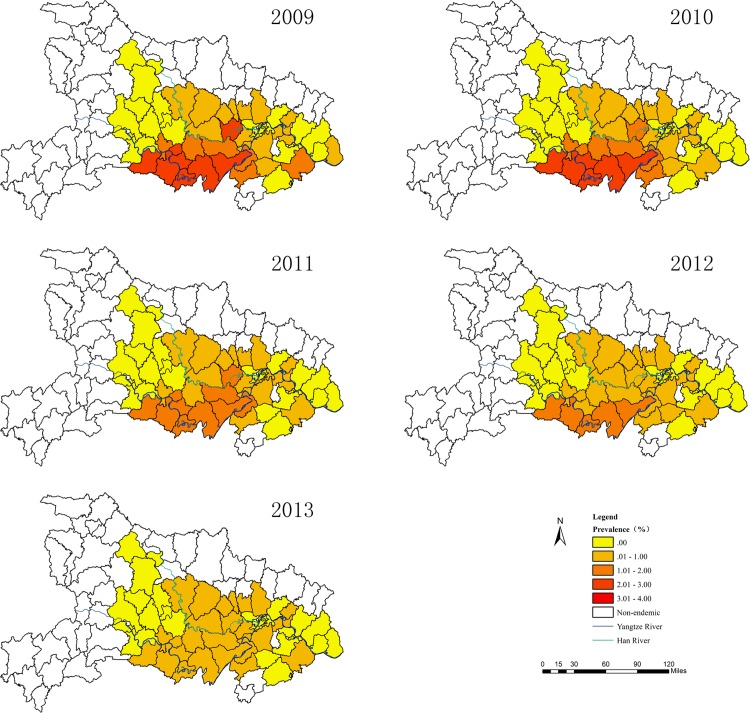
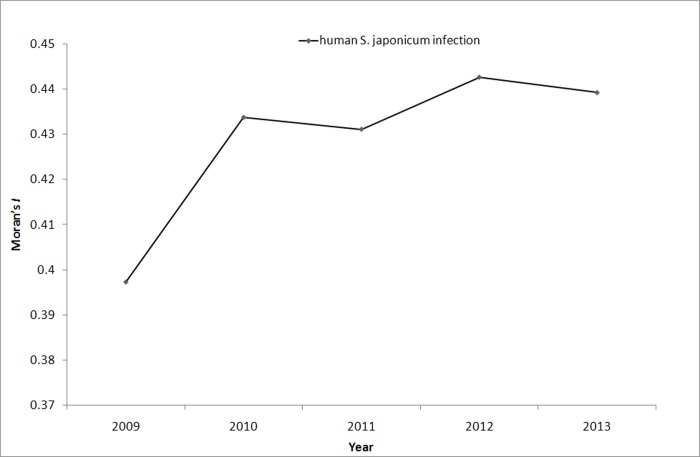
The infection rates of S. japonicum decreased from 2009 to 2013. The global autocorrelation analysis results on the infection rate of S. japonicum for five years showed statistical significance (Moran's I > 0, P < 0.01), which suggested that spatial clusters were present in the distribution of S. japonicum infection from 2009 to 2013. Local autocorrelation analysis results showed that the number of highly aggregated areas ranged from eight to eleven within the five-year analysis period. The highly aggregated areas were mainly distributed in eight counties.
The spatial distribution of human S. japonicum infections did not exhibit a temporal change at the county level in Hubei Province. The risk factors that influence human S. japonicum transmission may not have changed after achieving the national criterion of infection control. The findings indicated that spatial-temporal surveillance of S. japonicum transmission plays a significant role on schistosomiasis control. Timely and integrated prevention should be continued, especially in the Yangtze River Basin of Jianghan Plain area.
血吸虫病在中国仍然是一个主要的公共卫生问题。主要流行区位于中国南方的湖泊和沼泽地区,特别是长江中下游沿线地区。空间分析技术常用于流行病学中,以识别疾病区域的空间聚集情况。本研究评估了血吸虫病的空间分布,并探索了中国湖北省的高风险区域,为沼泽地区的血吸虫病控制提供指导。
在本研究中,利用空间自相关方法,包括全局莫兰指数(Moran's I)和局部Getis-Ord统计量,来描述和绘制湖北省县级人类日本血吸虫感染流行的空间聚集和区域。此外,使用线性逻辑回归模型来确定空间自相关随时间变化的特征。
2009年至2013年期间,日本血吸虫的感染率有所下降。对五年间日本血吸虫感染率的全局自相关分析结果显示具有统计学意义(莫兰指数I>0,P<0.01),这表明2009年至2013年期间日本血吸虫感染分布存在空间聚集。局部自相关分析结果显示,在五年的分析期内,高度聚集区域的数量在8至11个之间。高度聚集区域主要分布在8个县。
在湖北省县级层面,人类日本血吸虫感染的空间分布没有呈现出时间变化。在达到国家感染控制标准后,影响人类日本血吸虫传播的危险因素可能并未改变。研究结果表明,日本血吸虫传播的时空监测对血吸虫病控制具有重要作用。应继续及时进行综合预防,特别是在江汉平原地区的长江流域。