Fan Zhaosheng, Liang Chao
Biosciences Division, Argonne National Laboratory, Argonne, IL 60439, USA.
1] Biosciences Division, Argonne National Laboratory, Argonne, IL 60439, USA [2] State Key Laboratory of Forest and Soil Ecology, Institute of Applied Ecology, Chinese Academy of Sciences, Shenyang 110164, China.
Sci Rep. 2015 Apr 2;5:9575. doi: 10.1038/srep09575.
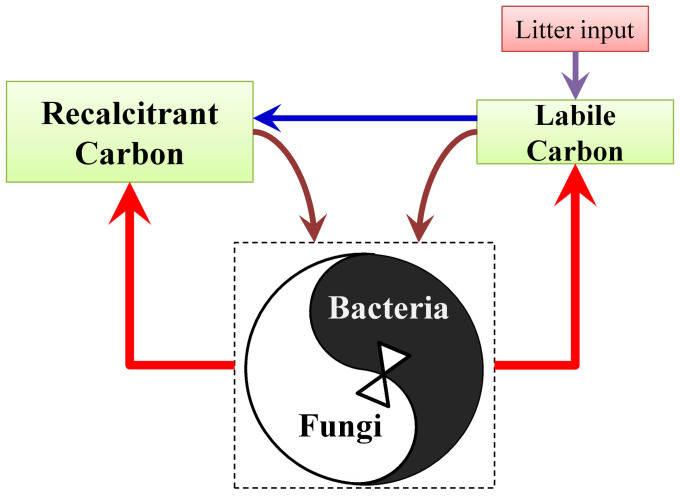
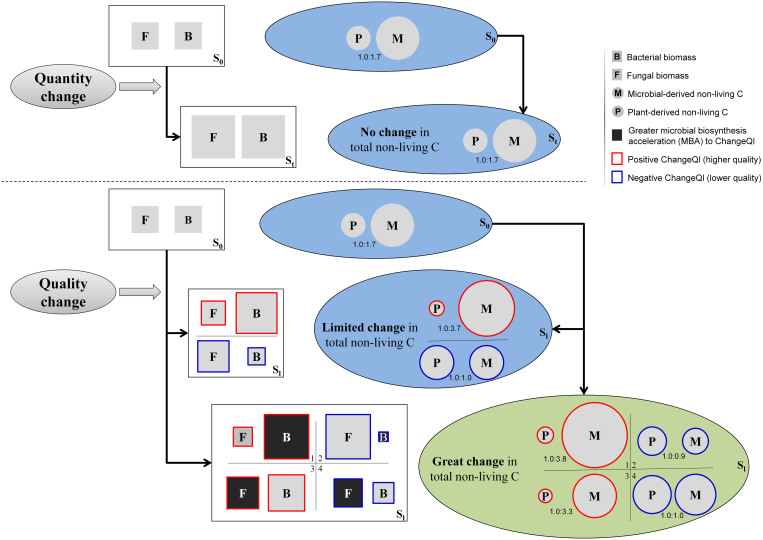
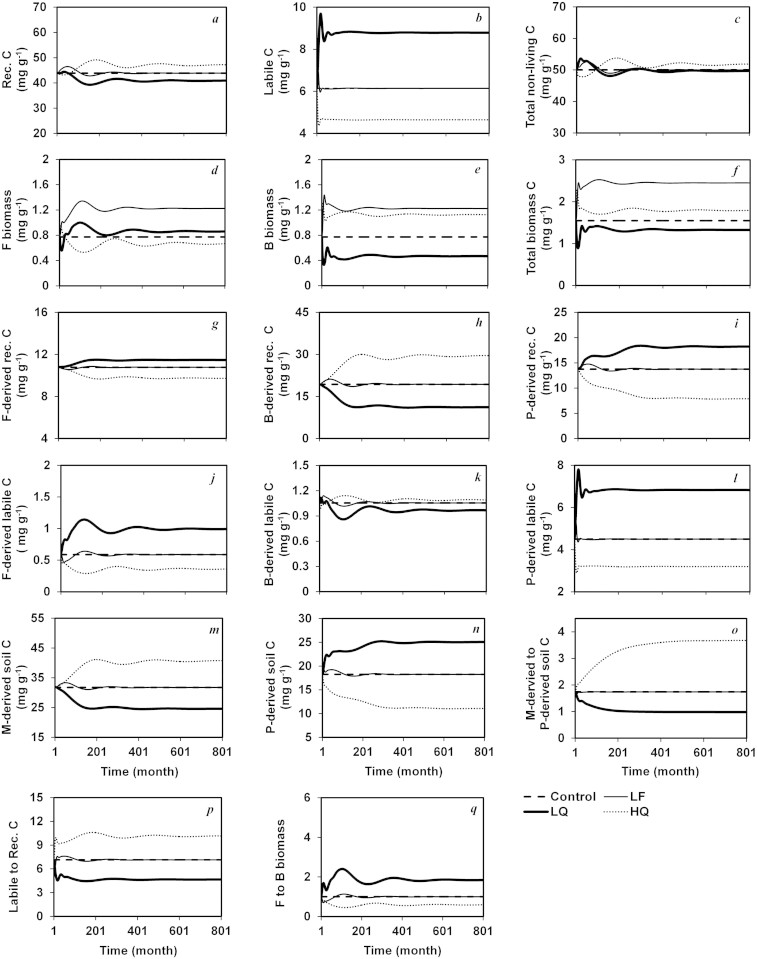
Soil organic carbon (SOC) plays an important role in the global carbon cycle. However, it remains largely unknown how plant litter inputs impact magnitude, composition and source configuration of the SOC stocks over long term through microbial catabolism and anabolism, mostly due to uncoupled research on litter decomposition and SOC formation. This limits our ability to predict soil system responses to changes in land-use and climate. Here, we examine how microbes act as a valve controlling carbon sequestrated from plant litters versus released to the atmosphere in natural ecosystems amended with plant litters varying in quantity and quality. We find that litter quality - not quantity - regulates long-term SOC dynamics under different plausible scenarios. Long-term changes in bulk SOC stock occur only when the quality of carbon inputs causes asynchronous change in a microbial physiological trait, defined as "microbial biosynthesis acceleration" (MBA). This is the first theoretical demonstration that the response of the SOC stocks to litter inputs is critically determined by the microbial physiology. Our work suggests that total SOC at an equilibrium state may be an intrinsic property of a given ecosystem, which ultimately is controlled by the asynchronous MBA between microbial functional groups.
土壤有机碳(SOC)在全球碳循环中起着重要作用。然而,长期以来,植物凋落物输入如何通过微生物分解代谢和合成代谢影响土壤有机碳储量的大小、组成和来源配置,在很大程度上仍不清楚,这主要是由于对凋落物分解和土壤有机碳形成的研究脱节。这限制了我们预测土壤系统对土地利用和气候变化响应的能力。在此,我们研究了在添加了数量和质量各异的植物凋落物的自然生态系统中,微生物如何作为一个阀门,控制从植物凋落物中固存的碳与释放到大气中的碳。我们发现,在不同的合理情景下,凋落物质量而非数量调节着长期的土壤有机碳动态。只有当碳输入质量导致一种被定义为“微生物生物合成加速”(MBA)的微生物生理特征发生异步变化时,土壤有机碳总量才会发生长期变化。这是首次从理论上证明土壤有机碳储量对凋落物输入的响应关键取决于微生物生理学。我们的研究表明,处于平衡状态的土壤有机碳总量可能是特定生态系统的固有属性,最终由微生物功能群之间的异步MBA所控制。