Department of Ecology, Evolution and Marine Biology, University of California at Santa Barbara Santa Barbara, CA, USA.
Front Microbiol. 2012 Sep 26;3:348. doi: 10.3389/fmicb.2012.00348. eCollection 2012.
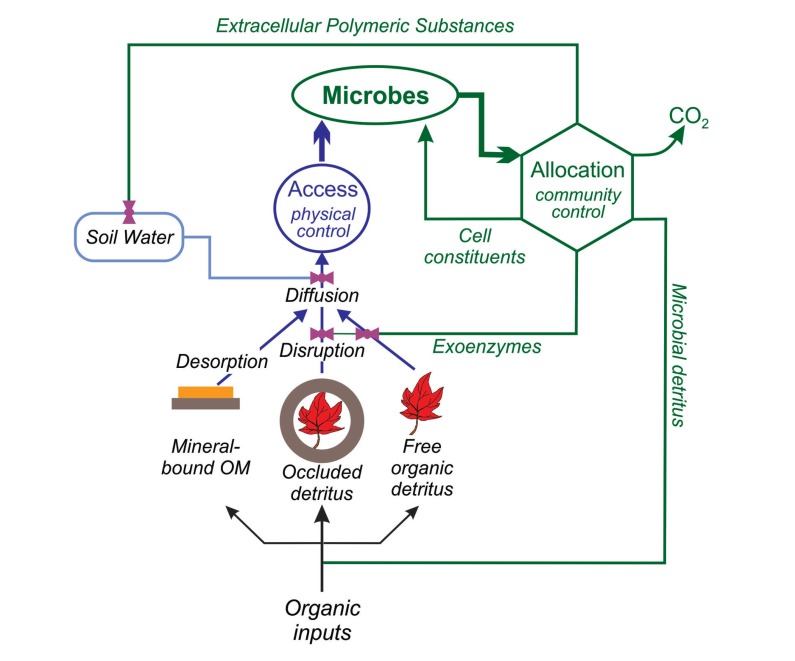
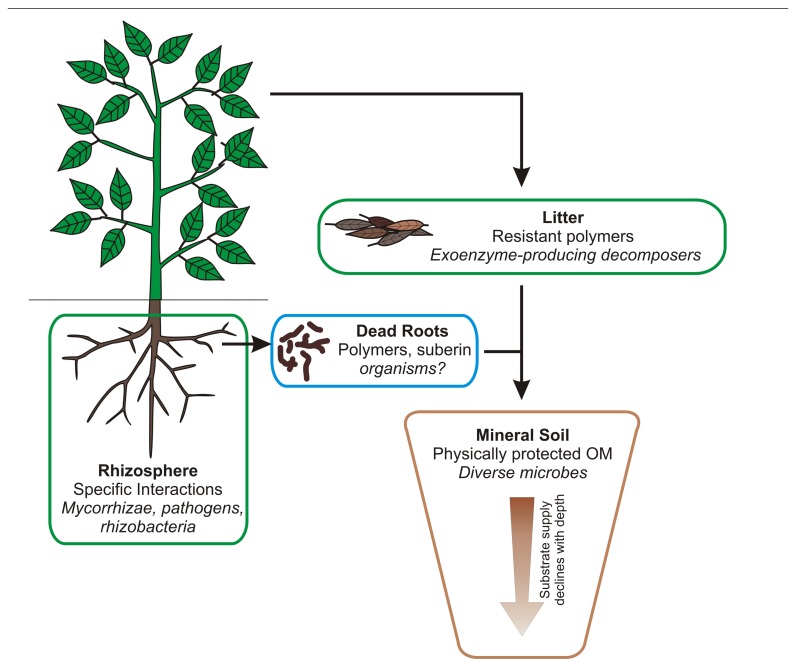
A major thrust of terrestrial microbial ecology is focused on understanding when and how the composition of the microbial community affects the functioning of biogeochemical processes at the ecosystem scale (meters-to-kilometers and days-to-years). While research has demonstrated these linkages for physiologically and phylogenetically "narrow" processes such as trace gas emissions and nitrification, there is less conclusive evidence that microbial community composition influences the "broad" processes of decomposition and organic matter (OM) turnover in soil. In this paper, we consider how soil microbial community structure influences C cycling. We consider the phylogenetic level at which microbes form meaningful guilds, based on overall life history strategies, and suggest that these are associated with deep evolutionary divergences, while much of the species-level diversity probably reflects functional redundancy. We then consider under what conditions it is possible for differences among microbes to affect process dynamics, and argue that while microbial community structure may be important in the rate of OM breakdown in the rhizosphere and in detritus, it is likely not important in the mineral soil. In mineral soil, physical access to occluded or sorbed substrates is the rate-limiting process. Microbial community influences on OM turnover in mineral soils are based on how organisms allocate the C they take up - not only do the fates of the molecules differ, but they can affect the soil system differently as well. For example, extracellular enzymes and extracellular polysaccharides can be key controls on soil structure and function. How microbes allocate C may also be particularly important for understanding the long-term fate of C in soil - is it sequestered or not?
陆地微生物生态学的一个主要重点是理解微生物群落的组成何时以及如何影响生态系统尺度(米到千米和天到年)上生物地球化学过程的功能。虽然研究已经证明了这些与生理和系统发育上“狭窄”的过程(如痕量气体排放和硝化作用)的联系,但对于微生物群落组成是否影响土壤中“广泛”的分解和有机物质(OM)转化过程,证据还不太确凿。在本文中,我们考虑了土壤微生物群落结构如何影响 C 循环。我们考虑了基于总体生活史策略的微生物形成有意义的类群的系统发育水平,并认为这些类群与深层进化分歧有关,而大部分种水平的多样性可能反映了功能冗余。然后,我们考虑了微生物之间的差异在什么条件下可以影响过程动态,并认为尽管微生物群落结构可能对根际和碎屑中 OM 分解的速率很重要,但在矿物质土壤中可能不重要。在矿物质土壤中,对被封锁或吸附的基质的物理接近是限速过程。微生物群落对矿物质土壤中 OM 周转的影响取决于生物体如何分配它们吸收的 C-不仅分子的命运不同,而且它们对土壤系统的影响也不同。例如,细胞外酶和细胞外多糖可以是土壤结构和功能的关键控制因素。微生物对 C 的分配也可能对理解土壤中 C 的长期命运特别重要——它是否被隔离了?