Hrossova Dominika, Sikorsky Tomas, Potesil David, Bartosovic Marek, Pasulka Josef, Zdrahal Zbynek, Stefl Richard, Vanacova Stepanka
CEITEC-Central European Institute of Technology, Masaryk University, Brno, 62500, Czech Republic National Centre for Biomolecular Research, Faculty of Science, Masaryk University, Brno, 62500, Czech Republic.
CEITEC-Central European Institute of Technology, Masaryk University, Brno, 62500, Czech Republic.
Nucleic Acids Res. 2015 Apr 30;43(8):4236-48. doi: 10.1093/nar/gkv240. Epub 2015 Apr 7.
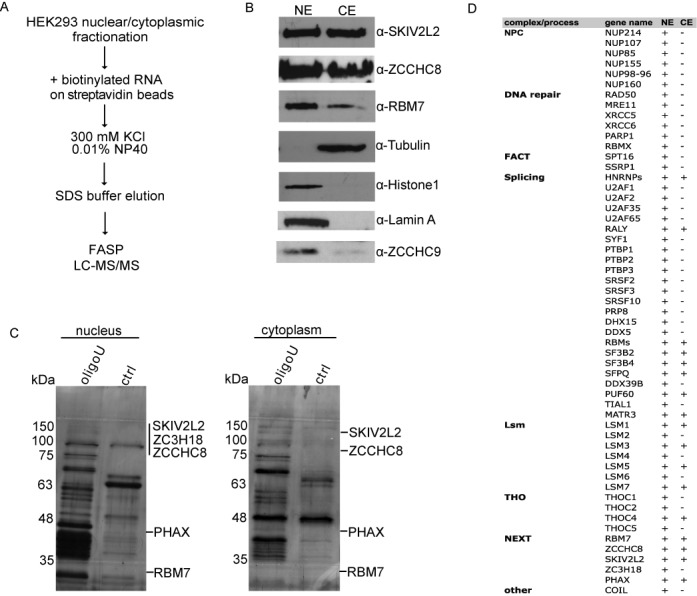
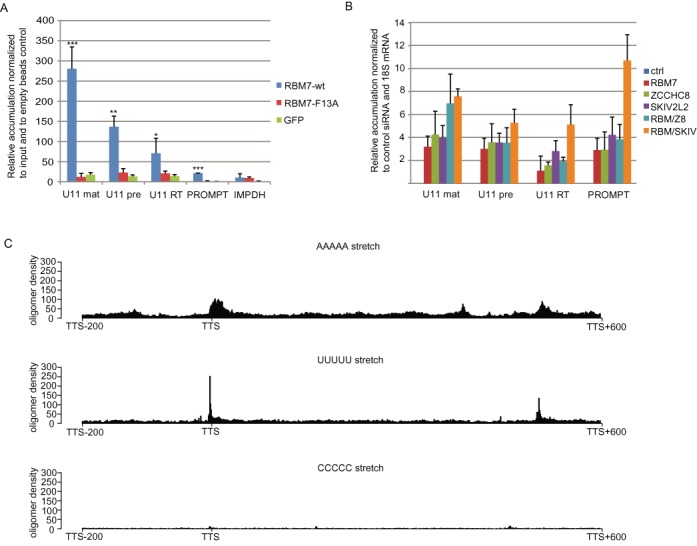
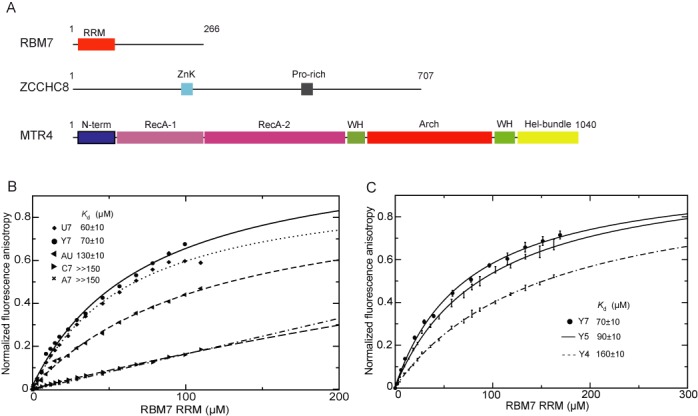
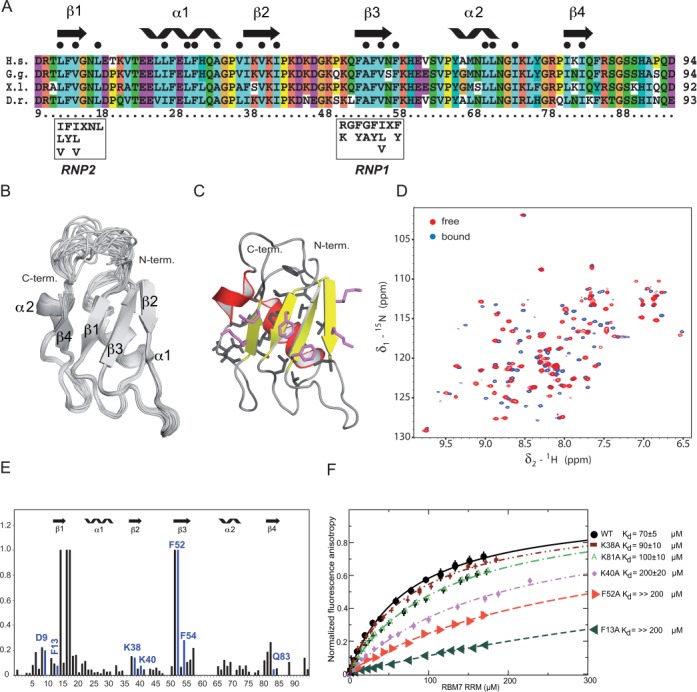
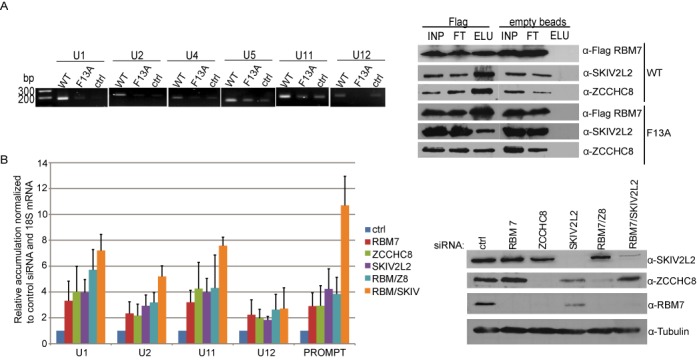
The Nuclear Exosome Targeting (NEXT) complex is a key cofactor of the mammalian nuclear exosome in the removal of Promoter Upstream Transcripts (PROMPTs) and potentially aberrant forms of other noncoding RNAs, such as snRNAs. NEXT is composed of three subunits SKIV2L2, ZCCHC8 and RBM7. We have recently identified the NEXT complex in our screen for oligo(U) RNA-binding factors. Here, we demonstrate that NEXT displays preference for U-rich pyrimidine sequences and this RNA binding is mediated by the RNA recognition motif (RRM) of the RBM7 subunit. We solved the structure of RBM7 RRM and identified two phenylalanine residues that are critical for interaction with RNA. Furthermore, we showed that these residues are required for the NEXT interaction with snRNAs in vivo. Finally, we show that depletion of components of the NEXT complex alone or together with exosome nucleases resulted in the accumulation of mature as well as extended forms of snRNAs. Thus, our data suggest a new scenario in which the NEXT complex is involved in the surveillance of snRNAs and/or biogenesis of snRNPs.
核外泌体靶向(NEXT)复合物是哺乳动物核外泌体在去除启动子上游转录本(PROMPT)以及其他非编码RNA(如小核RNA,snRNA)潜在异常形式过程中的关键辅助因子。NEXT由三个亚基SKIV2L2、ZCCHC8和RBM7组成。我们最近在筛选寡聚(U)RNA结合因子的过程中鉴定出了NEXT复合物。在此,我们证明NEXT对富含U的嘧啶序列具有偏好性,并且这种RNA结合是由RBM7亚基的RNA识别基序(RRM)介导的。我们解析了RBM7 RRM的结构,并鉴定出两个对与RNA相互作用至关重要的苯丙氨酸残基。此外,我们表明这些残基是NEXT在体内与snRNA相互作用所必需的。最后,我们表明单独耗尽NEXT复合物的组分或与外泌体核酸酶一起耗尽会导致成熟以及延长形式的snRNA积累。因此,我们的数据提示了一种新的情况,即NEXT复合物参与了snRNA的监测和/或snRNP的生物发生。