
下丘脑组织的新图景:更新的前脑模式中引入的新假说的基本原理。
A new scenario of hypothalamic organization: rationale of new hypotheses introduced in the updated prosomeric model.
作者信息
Puelles Luis, Rubenstein John L R
机构信息
Department of Human Anatomy, School of Medicine, University Murcia and Instituto Murciano de Investigación Biosanitaria Murcia, Spain.
Nina Ireland Laboratory of Developmental Neurobiology, Department of Psychiatry, University of California, San Francisco San Francisco, CA, USA.
出版信息
Front Neuroanat. 2015 Mar 19;9:27. doi: 10.3389/fnana.2015.00027. eCollection 2015.
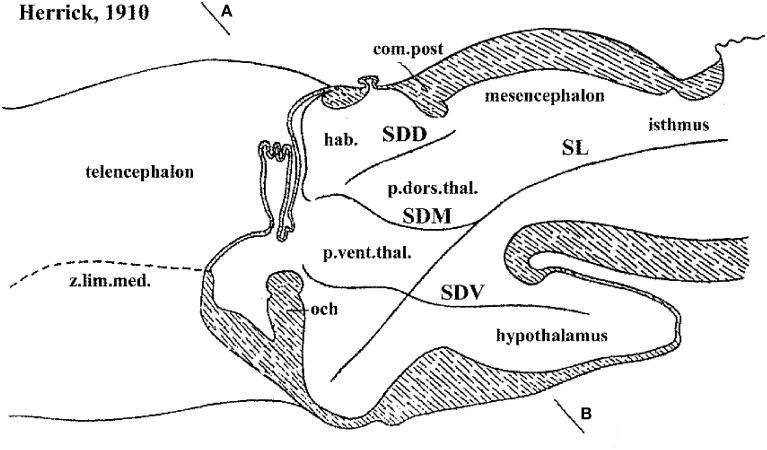
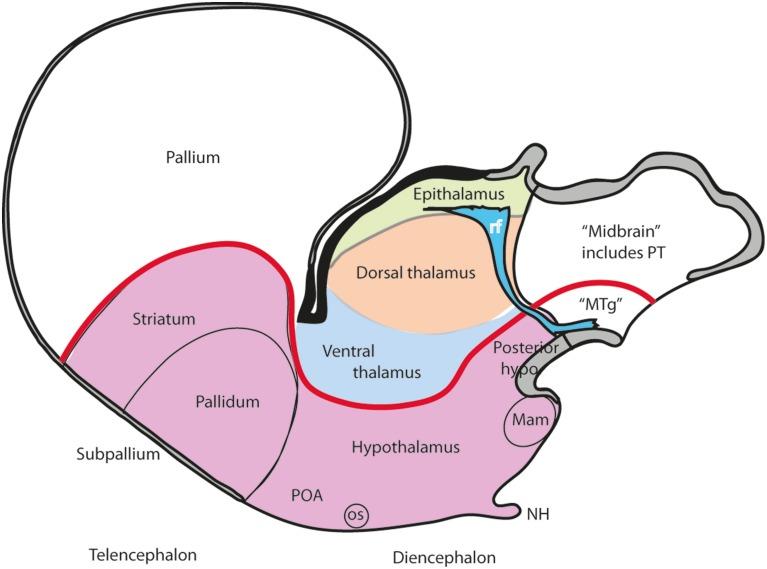
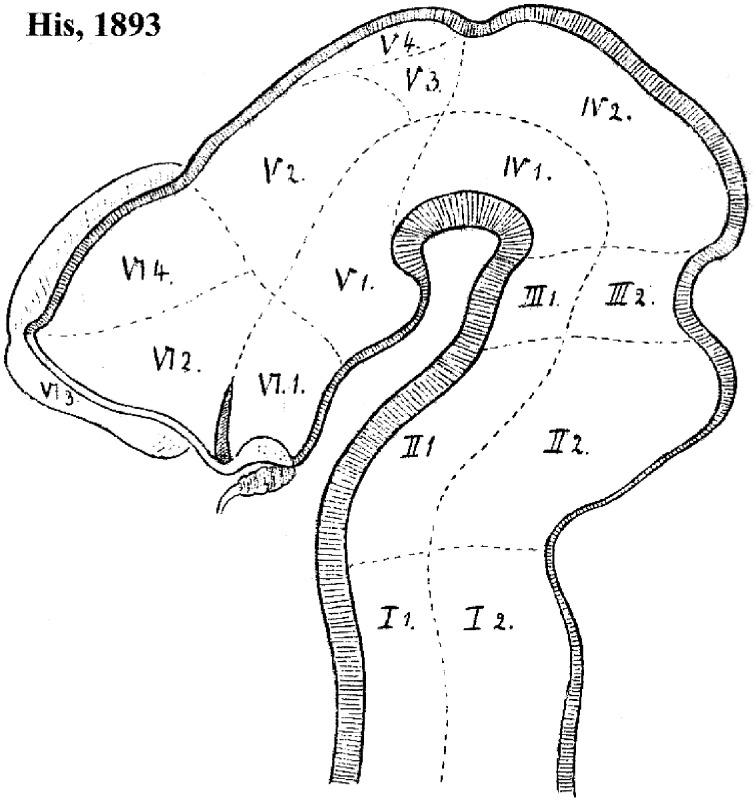
In this essay, we aim to explore in depth the new concept of the hypothalamus that was presented in the updated prosomeric model (Puelles et al., 2012b; Allen Developing Mouse Brain Atlas). Initial sections deal with the antecedents of prosomeric ideas represented by the extensive literature centered on the alternative columnar model of Herrick (1910), Kuhlenbeck (1973) and Swanson (1992, 2003); a detailed critique explores why the columnar model is not helpful in the search for causal developmental explanations. In contrast, the emerging prosomeric scenario visibly includes many possibilities to propose causal explanations of hypothalamic structure relative to both anteroposterior and dorsoventral patterning mechanisms, and insures the possibility to compare hypothalamic histogenesis with that of more caudal parts of the brain. Next the four major changes introduced in the organization of the hypothalamus on occasion of the updated model are presented, and our rationale for these changes is explored in detail. It is hoped that this example of morphological theoretical analysis may be useful for readers interested in brain models, or in understanding why models may need to change in the quest for higher consistency.
在本文中,我们旨在深入探讨在更新的前脑模型(普列尔斯等人,2012b;艾伦发育小鼠脑图谱)中提出的下丘脑新概念。开篇部分论述了以前脑概念为前身的相关内容,这些内容以围绕赫里克(1910年)、库伦贝克(1973年)和斯旺森(1992年、2003年)的替代柱状模型的大量文献为代表;详细的批判探讨了为何柱状模型无助于寻找因果发育解释。相比之下,新出现的前脑模型明显包含了许多可能性,可就下丘脑结构相对于前后和背腹模式形成机制提出因果解释,并确保能够将下丘脑组织发生与大脑更靠后的部分进行比较。接下来介绍了在更新模型时下丘脑组织结构中引入的四个主要变化,并详细探讨了我们做出这些变化的理由。希望这个形态学理论分析的例子对那些对脑模型感兴趣的读者,或者对理解为何在追求更高一致性的过程中模型可能需要改变的读者有所帮助。




 Zotero 插件