Jarvis Joseph N, Meintjes Graeme, Bicanic Tihana, Buffa Viviana, Hogan Louise, Mo Stephanie, Tomlinson Gillian, Kropf Pascale, Noursadeghi Mahdad, Harrison Thomas S
Department of Clinical Research, Faculty of Infectious and Tropical Diseases, London School of Hygiene and Tropical Medicine, London, United Kingdom; Botswana-UPenn Partnership, Gaborone, Botswana; Division of Infectious Diseases, Department of Medicine, Perelman School of Medicine, University of Pennsylvania, Philadelphia, Pennsylvania, United States of America; Desmond Tutu HIV Centre, Institute of Infectious Disease and Molecular Medicine, University of Cape Town, South Africa.
Institute of Infectious Disease and Molecular Medicine and Department of Medicine, University of Cape Town, South Africa; Department of Medicine, Imperial College London, London, United Kingdom.
PLoS Pathog. 2015 Apr 8;11(4):e1004754. doi: 10.1371/journal.ppat.1004754. eCollection 2015 Apr.
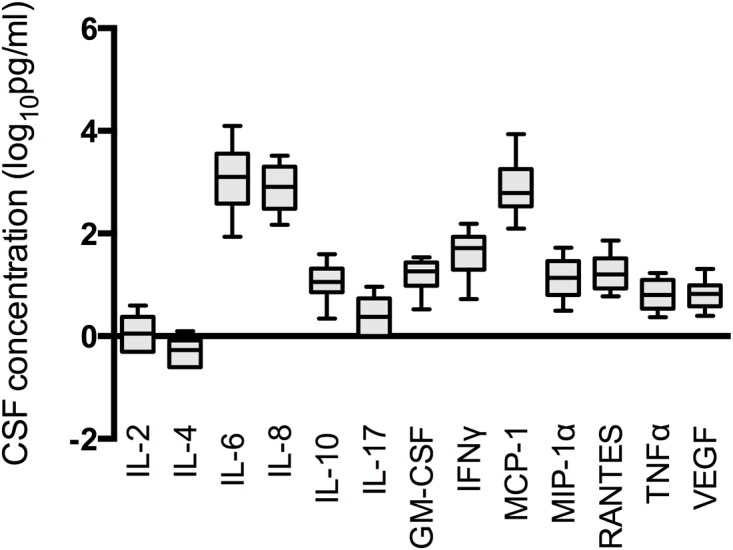
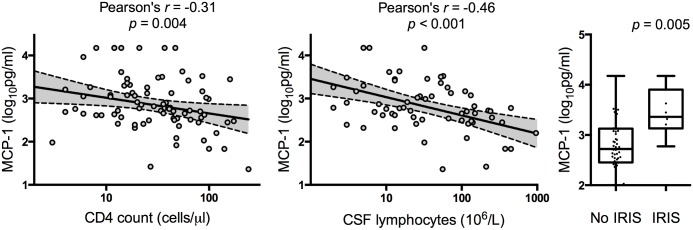
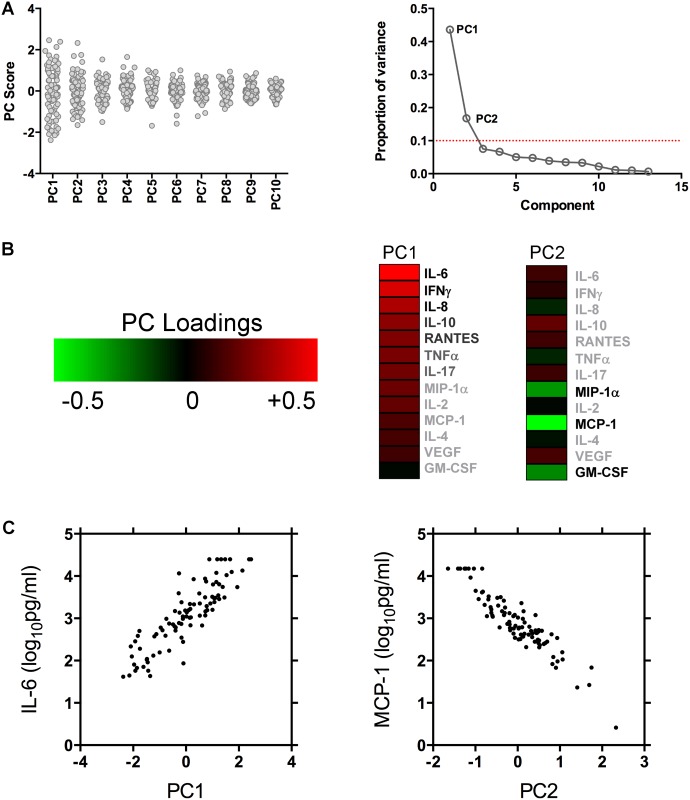
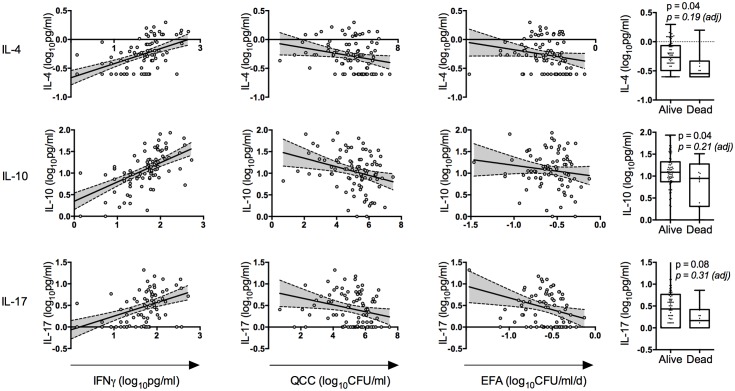
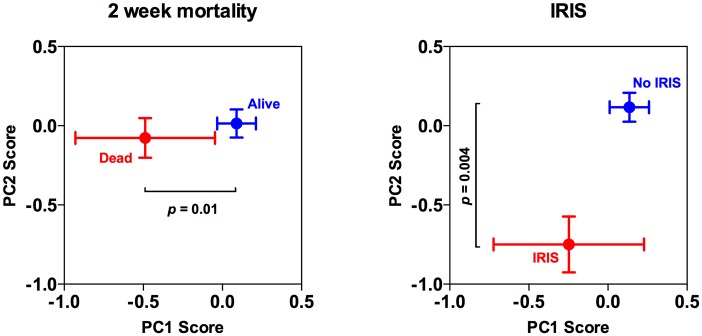
Understanding the host immune response during cryptococcal meningitis (CM) is of critical importance for the development of immunomodulatory therapies. We profiled the cerebrospinal fluid (CSF) immune-response in ninety patients with HIV-associated CM, and examined associations between immune phenotype and clinical outcome. CSF cytokine, chemokine, and macrophage activation marker concentrations were assayed at disease presentation, and associations between these parameters and microbiological and clinical outcomes were examined using principal component analysis (PCA). PCA demonstrated a co-correlated CSF cytokine and chemokine response consisting primarily of Th1, Th2, and Th17-type cytokines. The presence of this CSF cytokine response was associated with evidence of increased macrophage activation, more rapid clearance of Cryptococci from CSF, and survival at 2 weeks. The key components of this protective immune-response were interleukin (IL)-6 and interferon-γ, IL-4, IL-10 and IL-17 levels also made a modest positive contribution to the PC1 score. A second component of co-correlated chemokines was identified by PCA, consisting primarily of monocyte chemotactic protein-1 (MCP-1) and macrophage inflammatory protein-1α (MIP-1α). High CSF chemokine concentrations were associated with low peripheral CD4 cell counts and CSF lymphocyte counts and were predictive of immune reconstitution inflammatory syndrome (IRIS). In conclusion CSF cytokine and chemokine profiles predict risk of early mortality and IRIS in HIV-associated CM. We speculate that the presence of even minimal Cryptococcus-specific Th1-type CD4+ T-cell responses lead to increased recruitment of circulating lymphocytes and monocytes into the central nervous system (CNS), more effective activation of CNS macrophages and microglial cells, and faster organism clearance; while high CNS chemokine levels may predispose to over recruitment or inappropriate recruitment of immune cells to the CNS and IRIS following peripheral immune reconstitution with ART. These results provide a rational basis for future studies of immune modulation in CM, and demonstrate the potential of baseline immune profiling to identify CM patients most at risk of mortality and subsequent IRIS.
了解隐球菌性脑膜炎(CM)期间的宿主免疫反应对于免疫调节疗法的开发至关重要。我们对90例HIV相关CM患者的脑脊液(CSF)免疫反应进行了分析,并研究了免疫表型与临床结局之间的关联。在疾病初发时检测CSF细胞因子、趋化因子和巨噬细胞激活标志物浓度,并使用主成分分析(PCA)研究这些参数与微生物学和临床结局之间的关联。PCA显示CSF细胞因子和趋化因子反应呈共相关,主要由Th1、Th2和Th17型细胞因子组成。这种CSF细胞因子反应的存在与巨噬细胞激活增加、CSF中隐球菌清除加快以及2周生存率相关。这种保护性免疫反应的关键成分是白细胞介素(IL)-6和干扰素-γ,IL-4、IL-10和IL-17水平对PC1评分也有适度的正向贡献。PCA识别出共相关趋化因子的第二个成分,主要由单核细胞趋化蛋白-1(MCP-1)和巨噬细胞炎性蛋白-1α(MIP-1α)组成。高CSF趋化因子浓度与外周CD4细胞计数和CSF淋巴细胞计数低相关,并可预测免疫重建炎症综合征(IRIS)。总之,CSF细胞因子和趋化因子谱可预测HIV相关CM的早期死亡风险和IRIS。我们推测,即使存在最小程度的隐球菌特异性Th1型CD4 + T细胞反应,也会导致循环淋巴细胞和单核细胞向中枢神经系统(CNS)的募集增加、CNS巨噬细胞和小胶质细胞的更有效激活以及病原体清除加快;而高CNS趋化因子水平可能会使免疫细胞在外周免疫通过抗逆转录病毒治疗重建后过度募集或不适当募集到CNS并引发IRIS。这些结果为未来CM免疫调节研究提供了合理依据,并证明了基线免疫分析在识别最有死亡风险和后续IRIS的CM患者方面的潜力。