
向中枢神经系统播散的机制及毒力因子
Mechanisms and Virulence Factors of Dissemination to the Central Nervous System.
作者信息
Al-Huthaifi Ammar Mutahar, Radman Bakeel A, Al-Alawi Abdullah Ali, Mahmood Fawad, Liu Tong-Bao
机构信息
Medical Research Institute, Southwest University, Chongqing 400715, China.
Cancer Center, Integrated Hospital of Traditional Chinese Medicine, Southern Medical University, Guangzhou 510315, China.
出版信息
J Fungi (Basel). 2024 Aug 17;10(8):586. doi: 10.3390/jof10080586.
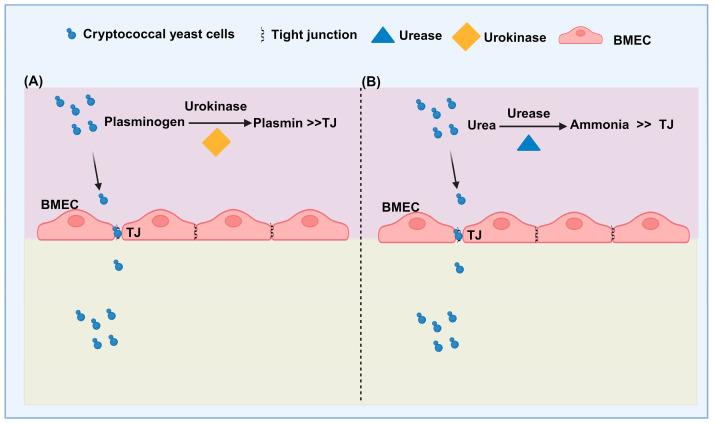
Cryptococcosis is a prevalent fungal infection of the central nervous system (CNS) caused by , a yeast with a polysaccharide capsule in the basidiomycete group. Normally, infects the respiratory tract and then breaches the blood-brain barrier (BBB), leading to meningitis or meningoencephalitis, which leads to hundreds of thousands of deaths each year. Although the mechanism by which infiltrates the BBB to invade the brain has yet to be fully understood, research has revealed that can cross the BBB using transcellular penetration, paracellular traversal, and infected phagocytes (the "Trojan horse" mechanism). The secretion of multiple virulence factors by is crucial in facilitating the spread of infection after breaching the BBB and causing brain infections. Extensive research has shown that various virulence factors play a significant role in the dissemination of infection beyond the lungs. This review explores the mechanisms of entering the CNS and explains how it bypasses the BBB. Additionally, it aims to understand the interplay between the regulatory mechanisms and virulence factors of .
隐球菌病是由一种担子菌纲中带有多糖荚膜的酵母引起的中枢神经系统(CNS)常见真菌感染。通常情况下,它感染呼吸道,然后突破血脑屏障(BBB),导致脑膜炎或脑膜脑炎,每年造成数十万人死亡。尽管其浸润血脑屏障以侵入大脑的机制尚未完全明确,但研究表明,它可通过跨细胞穿透、细胞旁穿越以及感染吞噬细胞(“特洛伊木马”机制)穿过血脑屏障。在突破血脑屏障并引发脑部感染后,其多种毒力因子的分泌对于促进感染传播至关重要。大量研究表明,各种毒力因子在感染扩散至肺部以外的过程中发挥着重要作用。本综述探讨了其进入中枢神经系统的机制,并解释了它如何绕过血脑屏障。此外,旨在了解其调节机制与毒力因子之间的相互作用。


 Zotero 插件