Rouhani Sherin J, Eccles Jacob D, Riccardi Priscila, Peske J David, Tewalt Eric F, Cohen Jarish N, Liblau Roland, Mäkinen Taija, Engelhard Victor H
Carter Immunology Center, Department of Microbiology, Immunology and Cancer Biology, University of Virginia School of Medicine, Charlottesville, Virginia 22908, USA.
1] INSERM, Unité 1043, F-31300 Toulouse, France [2] Centre National de la Recherche Scientifique, Unité 5282, F-31300 Toulouse, France [3] Centre de Physiopathologie Toulouse-Purpan, Université de Toulouse, Université Paul Sabatier, F-31300 Toulouse, France [4] Département d'Immunologie, Centre Hospitalier Universitaire de Toulouse, Hôpital Purpan, F-31300 Toulouse, France.
Nat Commun. 2015 Apr 10;6:6771. doi: 10.1038/ncomms7771.
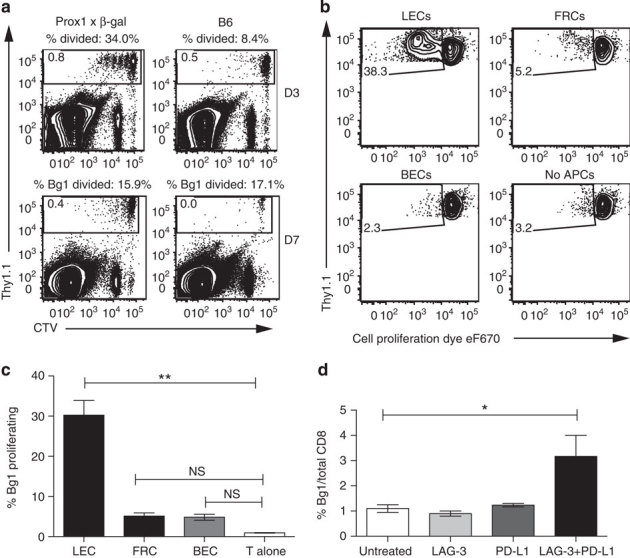
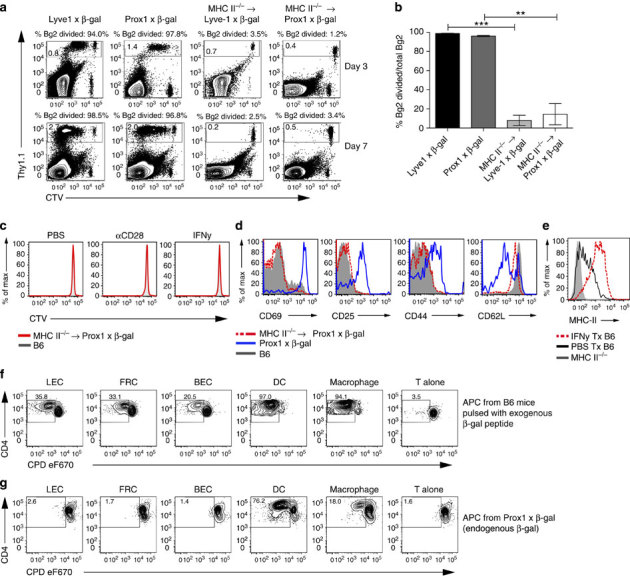
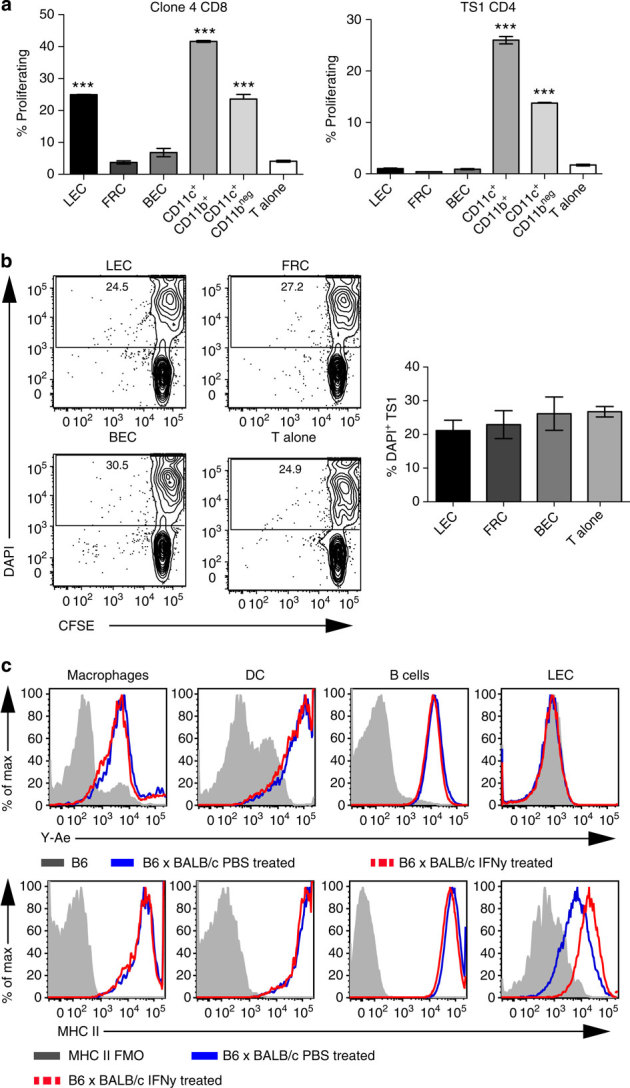
Lymphatic endothelial cells (LECs) directly express peripheral tissue antigens and induce CD8 T-cell deletional tolerance. LECs express MHC-II molecules, suggesting they might also tolerize CD4 T cells. We demonstrate that when β-galactosidase (β-gal) is expressed in LECs, β-gal-specific CD8 T cells undergo deletion via the PD-1/PD-L1 and LAG-3/MHC-II pathways. In contrast, LECs do not present endogenous β-gal in the context of MHC-II molecules to β-gal-specific CD4 T cells. Lack of presentation is independent of antigen localization, as membrane-bound haemagglutinin and I-Eα are also not presented by MHC-II molecules. LECs express invariant chain and cathepsin L, but not H2-M, suggesting that they cannot load endogenous antigenic peptides onto MHC-II molecules. Importantly, LECs transfer β-gal to dendritic cells, which subsequently present it to induce CD4 T-cell anergy. Therefore, LECs serve as an antigen reservoir for CD4 T-cell tolerance, and MHC-II molecules on LECs are used to induce CD8 T-cell tolerance via LAG-3.
淋巴管内皮细胞(LECs)直接表达外周组织抗原并诱导CD8 T细胞的缺失性耐受。LECs表达MHC-II分子,提示它们也可能使CD4 T细胞产生耐受。我们证明,当β-半乳糖苷酶(β-gal)在LECs中表达时,β-gal特异性CD8 T细胞通过PD-1/PD-L1和LAG-3/MHC-II途径发生缺失。相反,LECs不会在MHC-II分子的背景下将内源性β-gal呈递给β-gal特异性CD4 T细胞。呈递的缺失与抗原定位无关,因为膜结合的血凝素和I-Eα也不会由MHC-II分子呈递。LECs表达恒定链和组织蛋白酶L,但不表达H2-M,提示它们无法将内源性抗原肽加载到MHC-II分子上。重要的是,LECs将β-gal转移给树突状细胞,后者随后呈递它以诱导CD4 T细胞无反应性。因此,LECs作为CD4 T细胞耐受的抗原储存库,并且LECs上的MHC-II分子通过LAG-3用于诱导CD8 T细胞耐受。