Forni Ogna Valentina, Ogna Adam, Vuistiner Philippe, Pruijm Menno, Ponte Belen, Ackermann Daniel, Gabutti Luca, Vakilzadeh Nima, Mohaupt Markus, Martin Pierre-Yves, Guessous Idris, Péchère-Bertschi Antoinette, Paccaud Fred, Bochud Murielle, Burnier Michel
BMC Med. 2015 Feb 27;13:40. doi: 10.1186/s12916-015-0275-x.
Urinary creatinine excretion is used as a marker of completeness of timed urine collections, which are a keystone of several metabolic evaluations in clinical investigations and epidemiological surveys.
We used data from two independent Swiss cross-sectional population-based studies with standardised 24-hour urinary collection and measured anthropometric variables. Only data from adults of European descent, with estimated glomerular filtration rate (eGFR) ≥60 ml/min/1.73 m2 and reported completeness of the urinary collection were retained. A linear regression model was developed to predict centiles of the 24-hour urinary creatinine excretion in 1,137 participants from the Swiss Survey on Salt and validated in 994 participants from the Swiss Kidney Project on Genes in Hypertension.
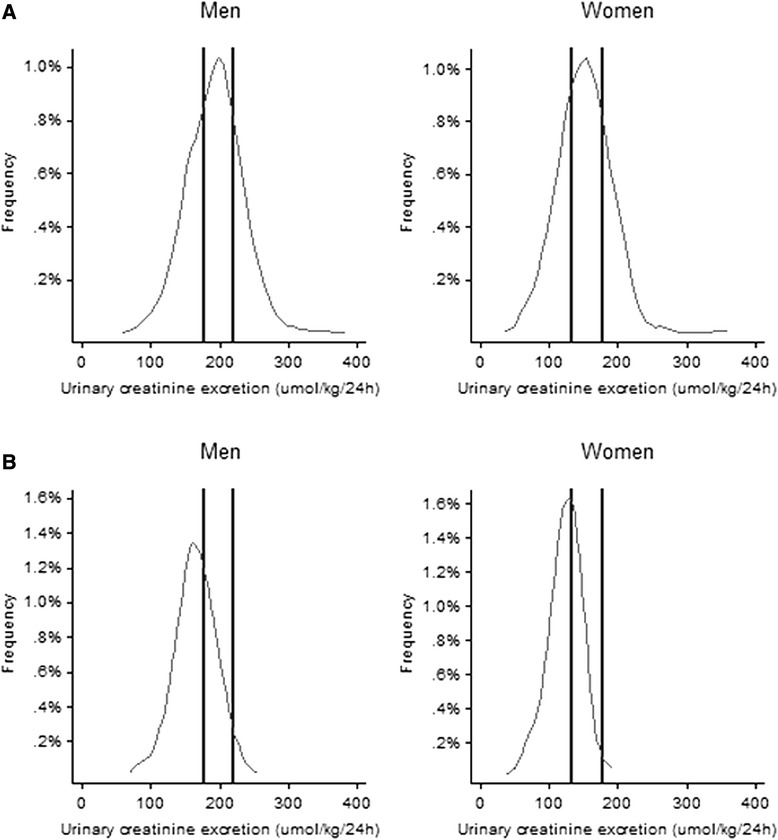
The mean urinary creatinine excretion was 193 ± 41 μmol/kg/24 hours in men and 151 ± 38 μmol/kg/24 hours in women in the Swiss Survey on Salt. The values were inversely correlated with age and body mass index (BMI).
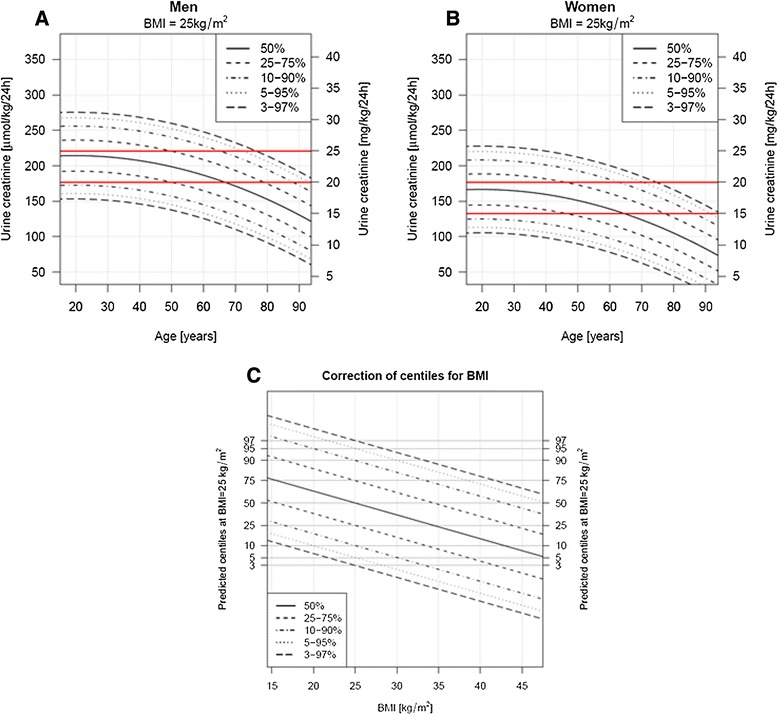
We propose a validated prediction equation for 24-hour urinary creatinine excretion in the general European population, based on readily available variables such as age, sex and BMI, and a few derived normograms to ease its clinical application. This should help healthcare providers to interpret the completeness of a 24-hour urine collection in daily clinical practice and in epidemiological population studies.
尿肌酐排泄量被用作定时尿液收集完整性的标志物,而定时尿液收集是临床研究和流行病学调查中多项代谢评估的关键。
我们使用了两项基于瑞士人群的独立横断面研究的数据,这些研究采用标准化的24小时尿液收集并测量了人体测量变量。仅保留来自欧洲血统成年人的数据,其估计肾小球滤过率(eGFR)≥60 ml/min/1.73 m²且报告了尿液收集的完整性。建立了线性回归模型,以预测来自瑞士盐调查的1137名参与者的24小时尿肌酐排泄百分位数,并在来自瑞士高血压基因肾脏项目的994名参与者中进行了验证。
在瑞士盐调查中,男性的平均尿肌酐排泄量为193±41 μmol/kg/24小时,女性为151±38 μmol/kg/24小时。这些值与年龄和体重指数(BMI)呈负相关。
我们基于年龄、性别和BMI等易于获得的变量,提出了一个经过验证的欧洲普通人群24小时尿肌酐排泄预测方程,以及一些派生的标准化图以方便其临床应用。这应有助于医疗保健提供者在日常临床实践和流行病学人群研究中解释24小时尿液收集的完整性。