Körnig André, Winklhofer Michael, Baumgartner Jens, Gonzalez Teresa Perez, Fratzl Peter, Faivre Damien
Department of Biomaterials, Max Planck Institute of Colloids and Interfaces Science Park Golm, 14424, Potsdam, Germany.
Department of Earth and Environmental Sciences, Ludwig-Maximilians-University Munich Theresienstr. 41, 80333, Munich, Germany.
Adv Funct Mater. 2014 Jul;24(25):3926-3932. doi: 10.1002/adfm.201303737. Epub 2014 Mar 10.
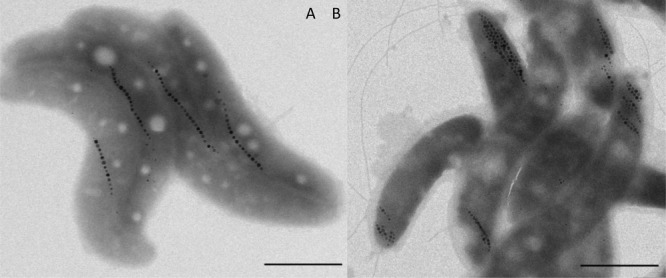
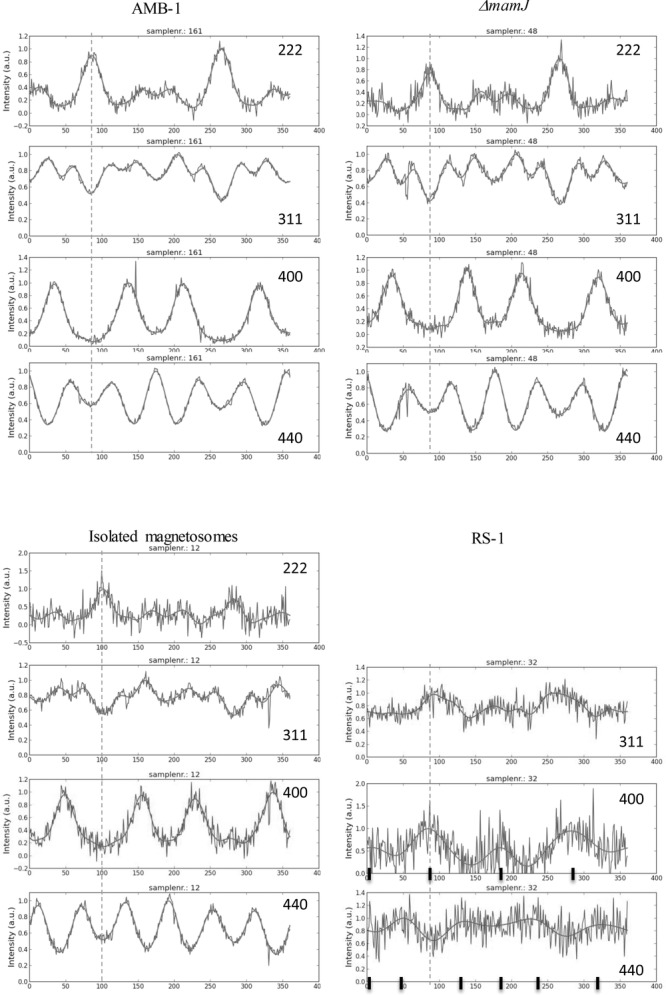
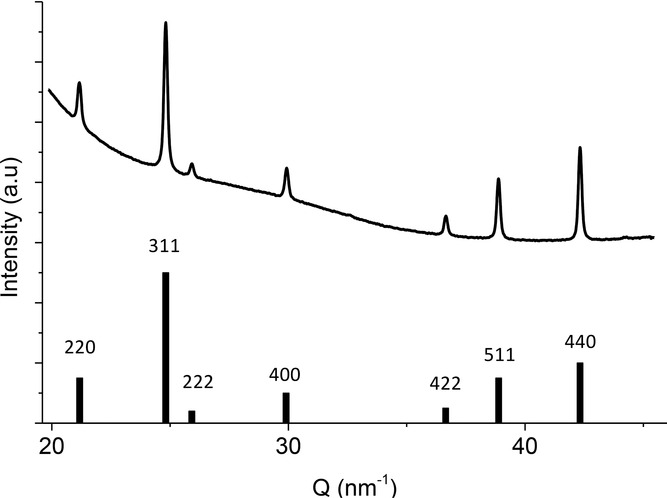
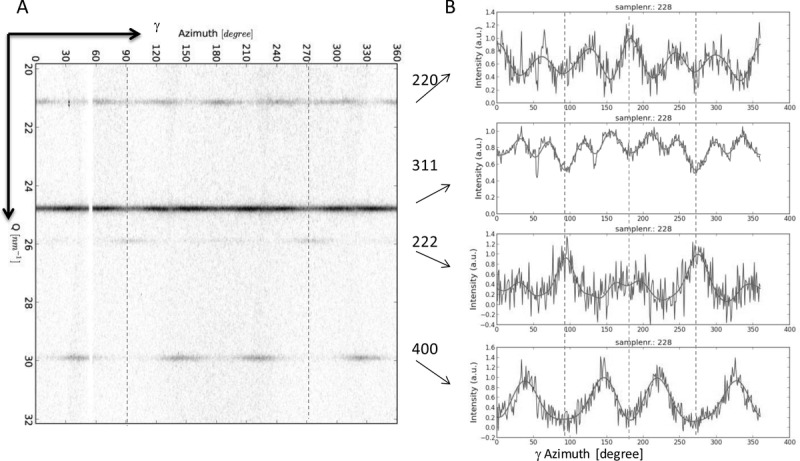
One-dimensional magnetic nanostructures have magnetic properties superior to non-organized materials due to strong uniaxial shape anisotropy. Magnetosome chains in magnetotactic bacteria represent a biological paradigm of such magnet, where magnetite crystals synthesized in organelles called magnetosomes are arranged into linear chains. Two-dimensional synchrotron X-ray diffraction (XRD) is applied to cells of magnetotactic bacteria that are pre-aligned with a magnetic field to determine the crystallographic orientation of magnetosomes relative to the chain axis. The obtained pole figure patterns reveal a [111] fiber texture along the chain direction for strains MSR-1 and AMB-1, whereas a [100] fiber texture is measured for strain RS-1. The [100] axis appears energetically unfavorable because it represents a magnetic hard axis in magnetite, but can be turned into an effective easy axis by particle elongation along [100] for aspect ratios higher than 1.25, consistent with aspect ratios in RS-1 magnetosomes determined earlier. The pronounced fiber textures can be explained either by a strain-specific biological control on crystal orientation at the chain level or by physical alignment effects due to intra-chain magnetic interactions. In this case, biological control of the axis of elongation would be sufficient to influence the crystallographic texture of the magnetosome chain.
由于强烈的单轴形状各向异性,一维磁性纳米结构具有优于非组织材料的磁性。趋磁细菌中的磁小体链代表了这种磁体的生物学范例,其中在称为磁小体的细胞器中合成的磁铁矿晶体排列成线性链。二维同步加速器X射线衍射(XRD)应用于预先用磁场排列的趋磁细菌细胞,以确定磁小体相对于链轴的晶体学取向。获得的极图模式显示,菌株MSR-1和AMB-1沿链方向呈现[111]纤维织构,而菌株RS-1测量到的是[100]纤维织构。[100]轴在能量上似乎不利,因为它代表磁铁矿中的磁硬轴,但对于长径比高于1.25的情况,通过沿[100]方向的颗粒伸长,它可以转变为有效的易轴,这与先前确定的RS-1磁小体的长径比一致。明显的纤维织构可以通过链水平上对晶体取向的应变特异性生物控制或链内磁相互作用引起的物理排列效应来解释。在这种情况下,对伸长轴的生物控制足以影响磁小体链的晶体学织构。