Köhl Karin, Gremmels Jürgen
Max-Planck-Institute of Molecular Plant Physiology, 14424 Potsdam-Golm, Germany.
Plant Methods. 2015 Apr 7;11:25. doi: 10.1186/s13007-015-0069-3. eCollection 2015.
Plant breeding and genetics demand fast, exact and reproducible phenotyping. Efficient statistical evaluation of phenotyping data requires standardised data storage ensuring long-term data availability while maintaining intellectual property rights. This is state of the art at phenomics centres, which, however, are unavailable for most scientists. For them we developed a simple and cost-efficient system, the Phenotyper, which employs mobile devices or personal digital assistants (PDA) for on-site data entry and open-source software for data management.
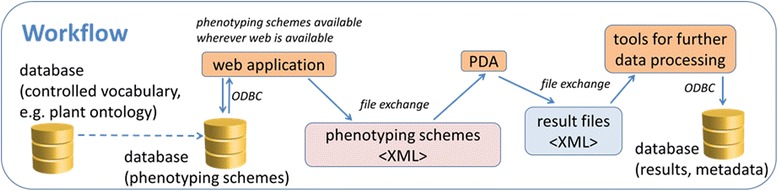
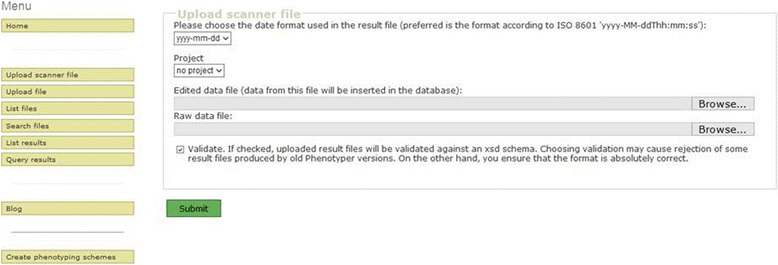
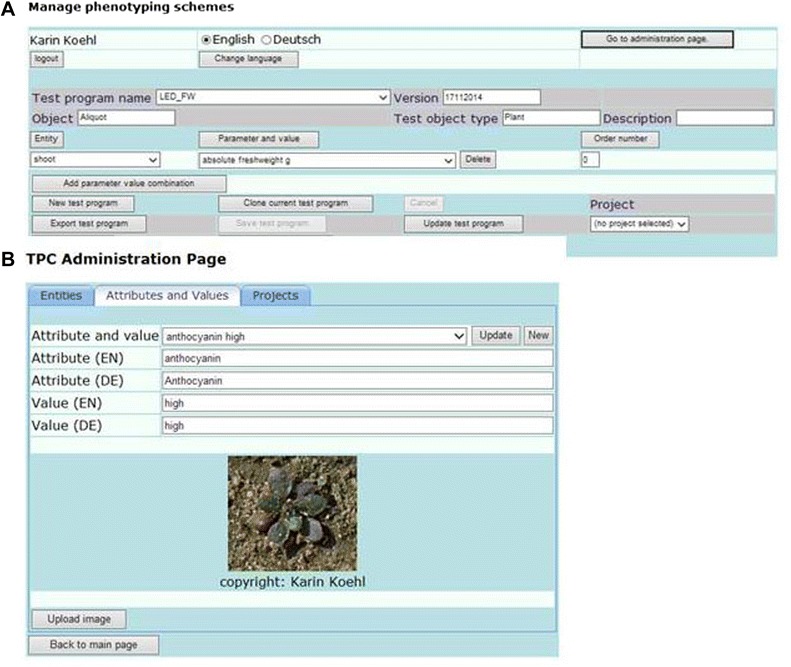
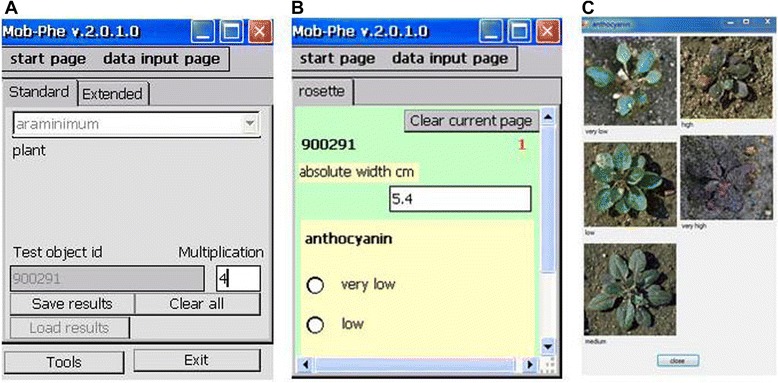
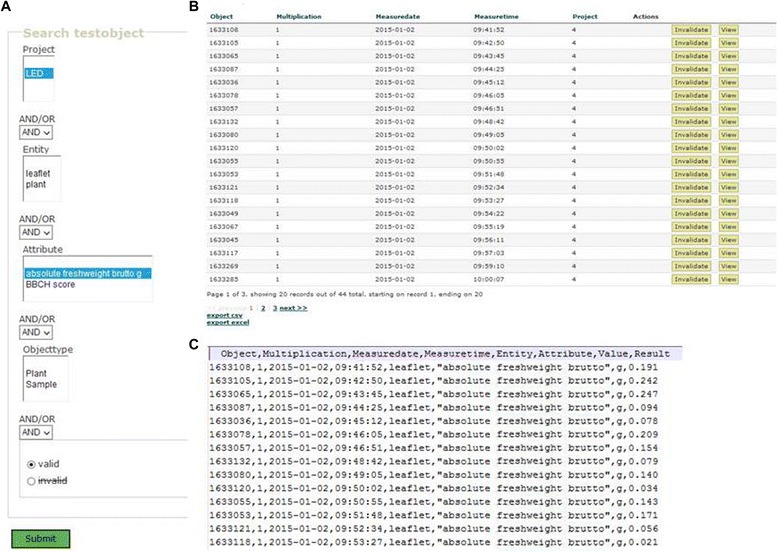
A graphical user interface (GUI) on a PDA replaces paper-based form sheet and data entry on a desktop. The user can define his phenotyping schemes in a web tool without in-depth knowledge of the system and thus adjust it more easily to new research aspects than in a classical laboratory information management system (LIMS). In the Phenotyper, schemes are built from controlled vocabulary gained from published ontologies. Vocabulary and schemes are stored in a database that also manages the user access. From the web page, schemes are downloaded as extended markup language (XML) files for the transfer to the PDA and the exchange between users. On the PDA, the GUI displays the schemes and stores data in comma separated value format and XML format. After manual quality control, data are uploaded via a web page to an independently hosted results database, in which data are stored in an entity-attribute-value structure to provide maximum flexibility. Datasets are linked to the original and curated data files stored on a file server. The ownership stamp, project affiliation and date stamp of a dataset are used to regulate data access, which is restricted to data belonging to the user or to his projects and data, for which the embargo period has ended. By export of standardised ASCII reports to long-term data storage facility, long-term accessibility allows searching, citing and use of raw data beyond the lifetime of the database. The Phenotyper is available to the scientific community for use and further development.
The Phenotyper provides a well-structured, but flexible data acquisition and management structure for mobile on-site measurements for efficient evaluation and shared use of data.
植物育种与遗传学需要快速、准确且可重复的表型分析。对表型分析数据进行高效的统计评估需要标准化的数据存储,以确保长期的数据可用性,同时维护知识产权。这是表型组学中心的现有技术水平,但大多数科学家无法使用这些中心。为此,我们为他们开发了一个简单且经济高效的系统——表型分析器(Phenotyper),该系统使用移动设备或个人数字助理(PDA)进行现场数据录入,并使用开源软件进行数据管理。
PDA上的图形用户界面(GUI)取代了纸质表单和桌面数据录入。用户可以在网络工具中定义其表型分析方案,而无需深入了解系统,因此与传统实验室信息管理系统(LIMS)相比,能更轻松地根据新的研究方面进行调整。在表型分析器中,方案由从已发表的本体中获取的受控词汇构建而成。词汇和方案存储在一个数据库中,该数据库还管理用户访问权限。通过网页,方案以可扩展标记语言(XML)文件的形式下载,以便传输到PDA并在用户之间交换。在PDA上,GUI显示方案并以逗号分隔值格式和XML格式存储数据。经过人工质量控制后,数据通过网页上传到独立托管的结果数据库,数据在该数据库中以实体-属性-值结构存储,以提供最大的灵活性。数据集与存储在文件服务器上的原始数据文件和经过整理的数据文件相关联。数据集的所有权印章、项目归属和日期印章用于规范数据访问,数据访问仅限于属于用户或其项目的数据以及禁运期已结束的数据。通过将标准化的ASCII报告导出到长期数据存储设施,长期可访问性允许在数据库的生命周期之后搜索、引用和使用原始数据。表型分析器可供科学界使用和进一步开发。
表型分析器为移动现场测量提供了一个结构良好但灵活的数据采集和管理结构,以实现数据的高效评估和共享使用。