Zhu Z, Xu Y, Zhao J, Liu Q, Feng W, Fan J, Wang P
1] Department of Radiation Oncology, Fudan University Shanghai Cancer Center, 270 Dong An Road, Shanghai 200032, China [2] Department of Oncology, Shanghai Medical College, Fudan University, 130 Dong An Road, Shanghai 200032, China.
1] Department of Oncology, Shanghai Medical College, Fudan University, 130 Dong An Road, Shanghai 200032, China [2] Department of Pancreatic and Hepatobiliary Surgery, Fudan University Shanghai Cancer Center, 270 Dong An Road, Shanghai 200032, China.
Br J Cancer. 2015 Apr 14;112(8):1367-75. doi: 10.1038/bjc.2015.102. Epub 2015 Mar 17.
Aberrant Smad7 expression contributes to the invasion and metastasis of pancreatic cancer cells. However, the potential mechanism underlying aberrant Smad7 expression in human pancreatic ductal adenocarcinoma (PDAC) remains largely unknown.
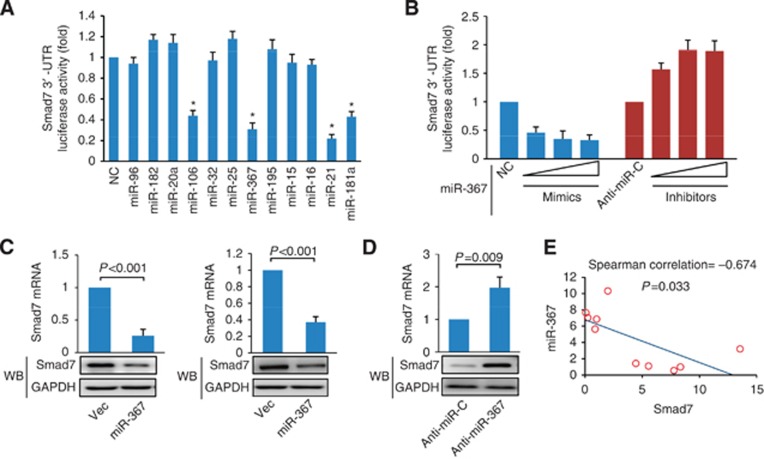
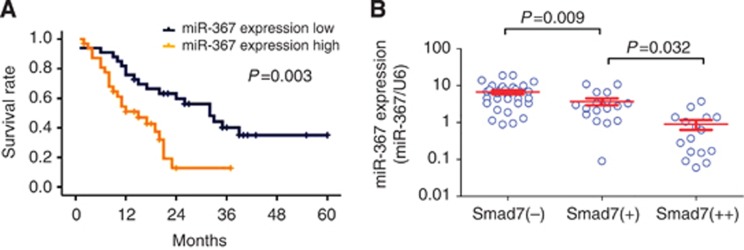
Bioinformatic prediction programmes and luciferase reporter assay were used to identify microRNAs regulating Smad7. The association between miR-367 expression and the overall survival of PDAC patients was evaluated by Kaplan-Meier analysis. The effects of miR-367 and Smad7 on the invasion and metastasis of pancreatic cancer cells were investigated both in vitro and in vivo.
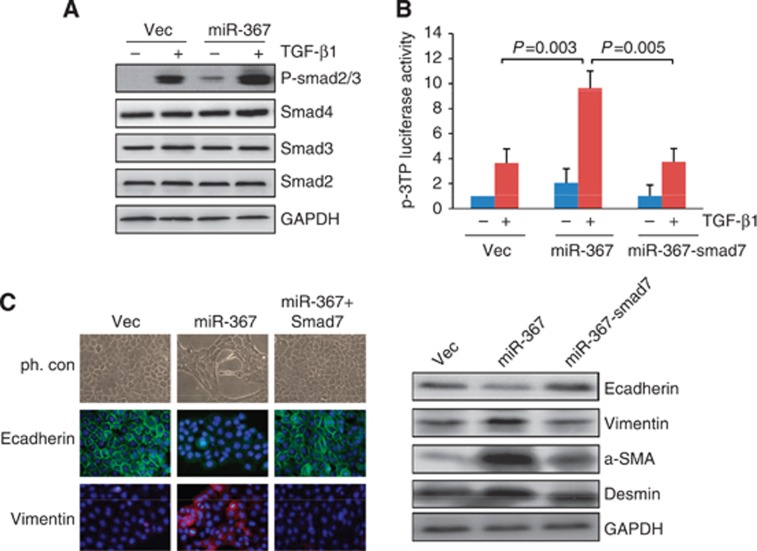
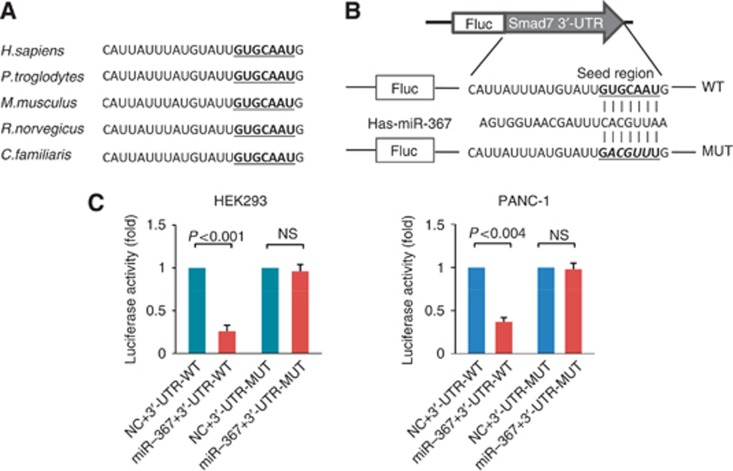
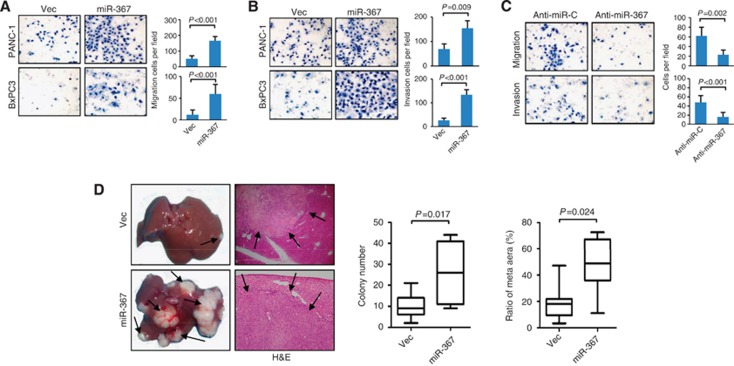
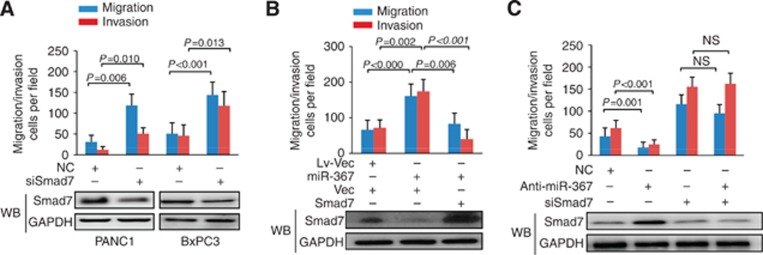
We found that miR-367 downregulated Smad7 expression by directly targeting its 3'-UTR in human pancreatic cancer cells. High level of miR-367 expression correlated with poor prognosis of PDAC patients. Functional studies showed that miR-367 promoted pancreatic cancer invasion in vitro and metastasis in vivo through downregulating Smad7. In addition, we showed that miR-367 promoted epithelial-to-mesenchymal transition by increasing transforming growth factor-β (TGF-β)-induced transcriptional activity.
The present study identified and characterised a signalling pathway, the miR-367/Smad7-TGF-β pathway, which is involved in the invasion and metastasis of pancreatic cancer cells. Our results suggest that miR-367 may be a promising therapeutic target for the treatment of human pancreatic cancer.
异常的Smad7表达促进胰腺癌细胞的侵袭和转移。然而,人类胰腺导管腺癌(PDAC)中Smad7异常表达的潜在机制仍 largely 未知。
使用生物信息学预测程序和荧光素酶报告基因检测来鉴定调节Smad7的微小RNA。通过Kaplan-Meier分析评估miR-367表达与PDAC患者总生存之间的关联。在体外和体内研究了miR-367和Smad7对胰腺癌细胞侵袭和转移的影响。
我们发现miR-367通过直接靶向人类胰腺癌细胞中的Smad7的3'-UTR来下调其表达。miR-367高表达与PDAC患者的不良预后相关。功能研究表明,miR-367通过下调Smad7促进体外胰腺癌细胞侵袭和体内转移。此外,我们表明miR-367通过增加转化生长因子-β(TGF-β)诱导的转录活性促进上皮-间质转化。
本研究鉴定并表征了一条信号通路,即miR-367/Smad7-TGF-β通路,其参与胰腺癌细胞的侵袭和转移。我们的结果表明,miR-367可能是治疗人类胰腺癌的一个有前景的治疗靶点。