Toyota Kenji, Miyakawa Hitoshi, Yamaguchi Katsushi, Shigenobu Shuji, Ogino Yukiko, Tatarazako Norihisa, Miyagawa Shinichi, Iguchi Taisen
BMC Genomics. 2015 Mar 14;16(1):186. doi: 10.1186/s12864-015-1392-9.
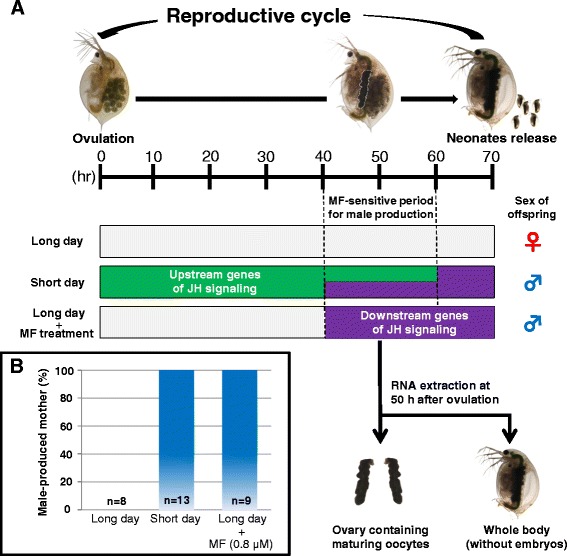
The cladoceran crustacean Daphnia pulex produces female offspring by parthenogenesis under favorable conditions, but in response to various unfavorable external stimuli, it produces male offspring (environmental sex determination: ESD). We recently established an innovative system for ESD studies using D. pulex WTN6 strain, in which the sex of the offspring can be controlled simply by changes in the photoperiod: the long-day and short-day conditions can induce female and male offspring, respectively. Taking advantage of this system, we demonstrated that de novo methyl farnesoate (MF) synthesis is necessary for male offspring production. These results indicate the key role of innate MF signaling as a conductor between external environmental stimuli and the endogenous male developmental pathway. Despite these findings, the molecular mechanisms underlying up- and downstream signaling of MF have not yet been well elucidated in D. pulex.
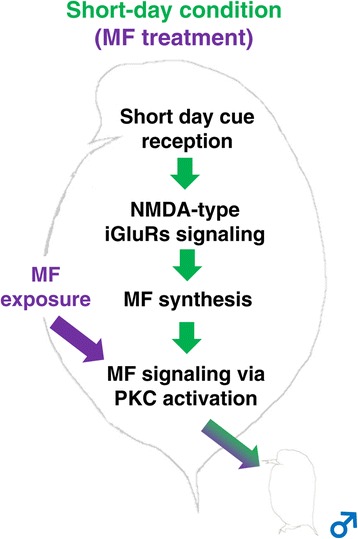
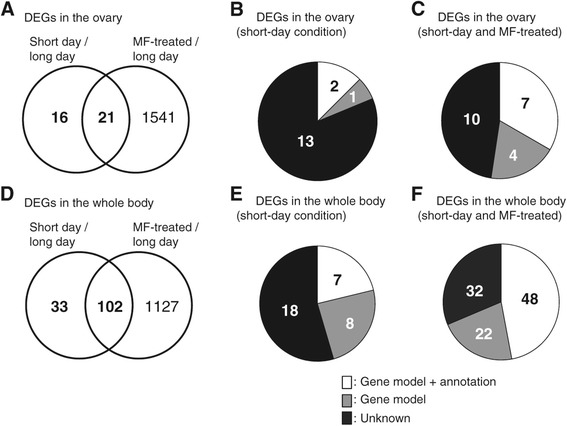
To elucidate up- and downstream events of MF signaling during sex determination processes, we compared the transcriptomes of daphnids reared under the long-day (female) condition with short-day (male) and MF-treated (male) conditions. We found that genes involved in ionotropic glutamate receptors, known to mediate the vast majority of excitatory neurotransmitting processes in various organisms, were significantly activated in daphnids by the short-day condition but not by MF treatment. Administration of specific agonists and antagonists, especially for the N-methyl-D-aspartic acid (NMDA) receptor, strongly increased or decreased, respectively, the proportion of male-producing mothers. Moreover, we also identified genes responsible for male production (e.g., protein kinase C pathway-related genes). Such genes were generally shared between the short-day reared and MF-treated daphnids.
We identified several candidate genes regulating ESD which strongly suggests that these genes may be essential factors for male offspring production as an upstream regulator of MF signaling in D. pulex. This study provides new insight into the fundamental mechanisms underlying how living organisms alter their phenotypes in response to various external environments.
枝角类甲壳动物大型溞在适宜条件下通过孤雌生殖产生雌性后代,但在受到各种不利外部刺激时,会产生雄性后代(环境性别决定:ESD)。我们最近利用大型溞WTN6品系建立了一种用于ESD研究的创新系统,在该系统中,后代的性别可以通过光周期的变化简单地控制:长日照和短日照条件分别可诱导产生雌性和雄性后代。利用这个系统,我们证明了从头合成法尼酸甲酯(MF)对于雄性后代的产生是必要的。这些结果表明,先天性MF信号作为外部环境刺激与内源性雄性发育途径之间的传导者起着关键作用。尽管有这些发现,但在大型溞中,MF上下游信号传导的分子机制尚未得到很好的阐明。
为了阐明性别决定过程中MF信号的上下游事件,我们比较了在长日照(雌性)条件下饲养的大型溞与短日照(雄性)和MF处理(雄性)条件下饲养的大型溞的转录组。我们发现,离子型谷氨酸受体相关基因在各种生物体中介导绝大多数兴奋性神经传递过程,在短日照条件下的大型溞中被显著激活,但在MF处理下未被激活。给予特定的激动剂和拮抗剂,特别是针对N-甲基-D-天冬氨酸(NMDA)受体的激动剂和拮抗剂,分别强烈增加或减少了产生雄性后代的母体比例。此外,我们还鉴定了负责雄性产生的基因(例如,蛋白激酶C途径相关基因)。这些基因通常在短日照饲养和MF处理的大型溞中共享。
我们鉴定了几个调节ESD的候选基因,这强烈表明这些基因可能是大型溞中作为MF信号上游调节因子的雄性后代产生的必需因子。这项研究为生物体如何响应各种外部环境改变其表型的基本机制提供了新的见解。