Murphy Jennifer, Ipser Alberta, Gaigg Sebastian B, Cook Richard
Department of Psychology, City University London.
J Exp Psychol Hum Percept Perform. 2015 Jun;41(3):577-81. doi: 10.1037/xhp0000049. Epub 2015 Apr 13.
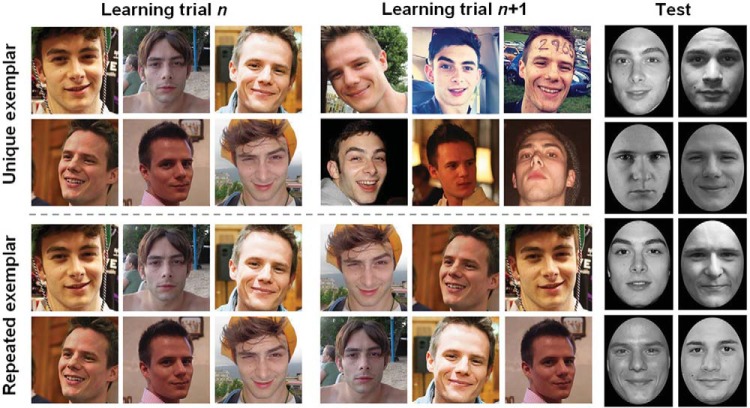
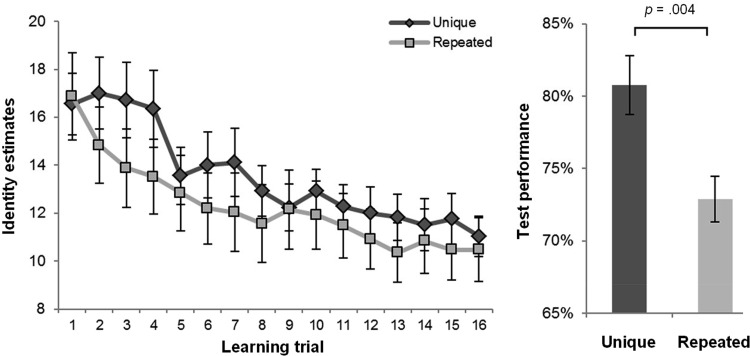
Differences in the visual processing of familiar and unfamiliar faces have prompted considerable interest in face learning, the process by which unfamiliar faces become familiar. Previous work indicates that face learning is determined in part by exposure duration; unsurprisingly, viewing faces for longer affords superior performance on subsequent recognition tests. However, there has been further speculation that exemplar variation, experience of different exemplars of the same facial identity, contributes to face learning independently of viewing time. Several leading accounts of face learning, including the averaging and pictorial coding models, predict an exemplar variation advantage. Nevertheless, the exemplar variation hypothesis currently lacks empirical support. The present study therefore sought to test this prediction by comparing the effects of unique exemplar face learning--a condition rich in exemplar variation--and repeated exemplar face learning--a condition that equates viewing time, but constrains exemplar variation. Crucially, observers who received unique exemplar learning displayed better recognition of novel exemplars of the learned identities at test, than observers in the repeated exemplar condition. These results have important theoretical and substantive implications for models of face learning and for approaches to face training in applied contexts.
熟悉面孔和不熟悉面孔在视觉处理上的差异引发了人们对面孔学习(即不熟悉面孔变得熟悉的过程)的浓厚兴趣。先前的研究表明,面孔学习部分取决于暴露时长;不出所料,更长时间地观察面孔会在后续识别测试中带来更优表现。然而,有进一步推测认为,范例变化(即同一面部身份的不同范例的体验)独立于观察时间对面孔学习有贡献。包括平均模型和图像编码模型在内的几种主要面孔学习理论都预测了范例变化优势。尽管如此,范例变化假说目前缺乏实证支持。因此,本研究试图通过比较独特范例面孔学习(一种富含范例变化的条件)和重复范例面孔学习(一种使观察时间相等但限制范例变化的条件)的效果来检验这一预测。至关重要的是,接受独特范例学习的观察者在测试时对所学身份的新范例的识别表现优于重复范例条件下的观察者。这些结果对面孔学习模型以及应用情境中的面孔训练方法具有重要的理论和实际意义。