Liao Hongzhan, Bai Yifeng, Qiu Shengcong, Zheng Lei, Huang Lianyan, Liu Tianzhu, Wang Xin, Liu Yanting, Xu Ningbo, Yan Xiaohui, Guo Hongbo
Department of Neurosurgery, Neurosurgery Institute of Guangdong, Key Laboratory on Brain Function Repair and Regeneration of Guangdong, Zhujiang Hospital, Southern Medical University, Guangzhou, China.
Department of Oncology, Sichuan Academy of Medical Sciences & Sichuan Provincial People's Hospital, Chengdu, China.
Oncotarget. 2015 Apr 20;6(11):8914-28. doi: 10.18632/oncotarget.3563.
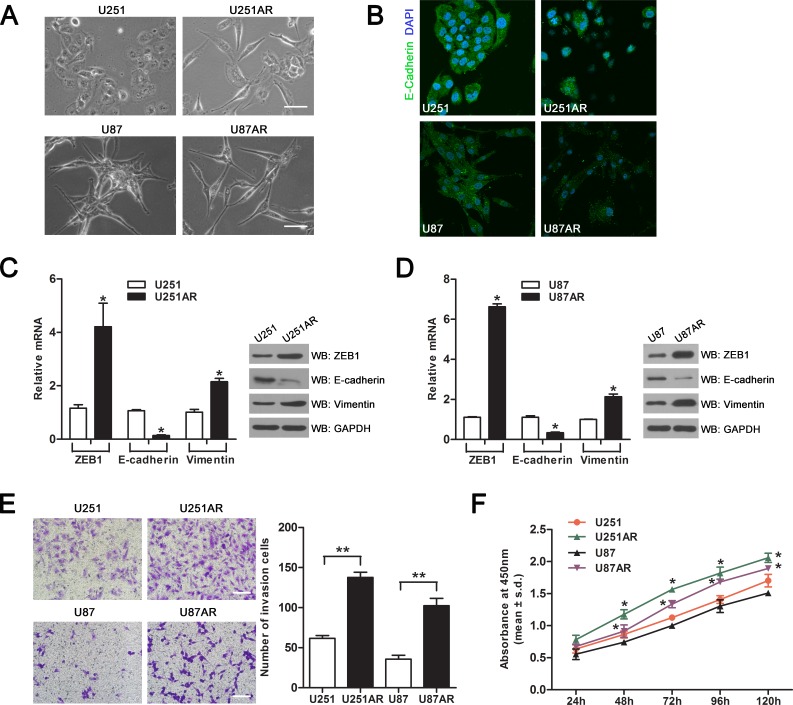
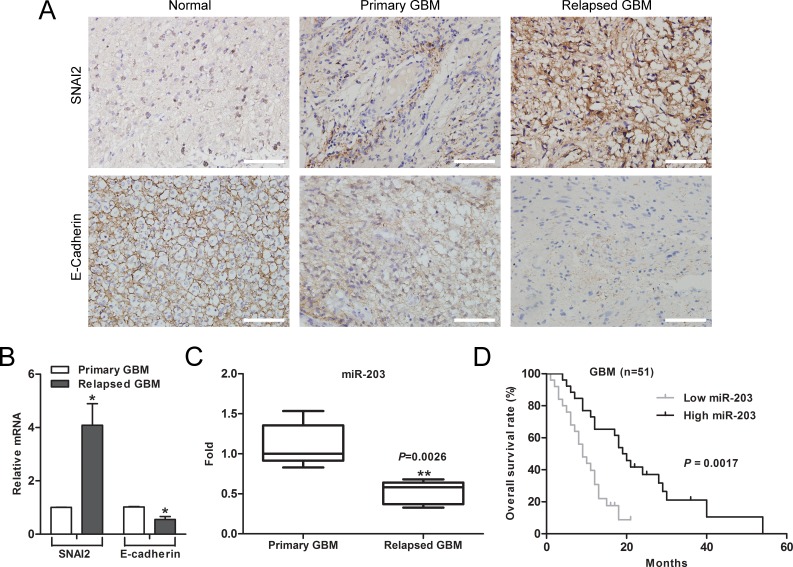
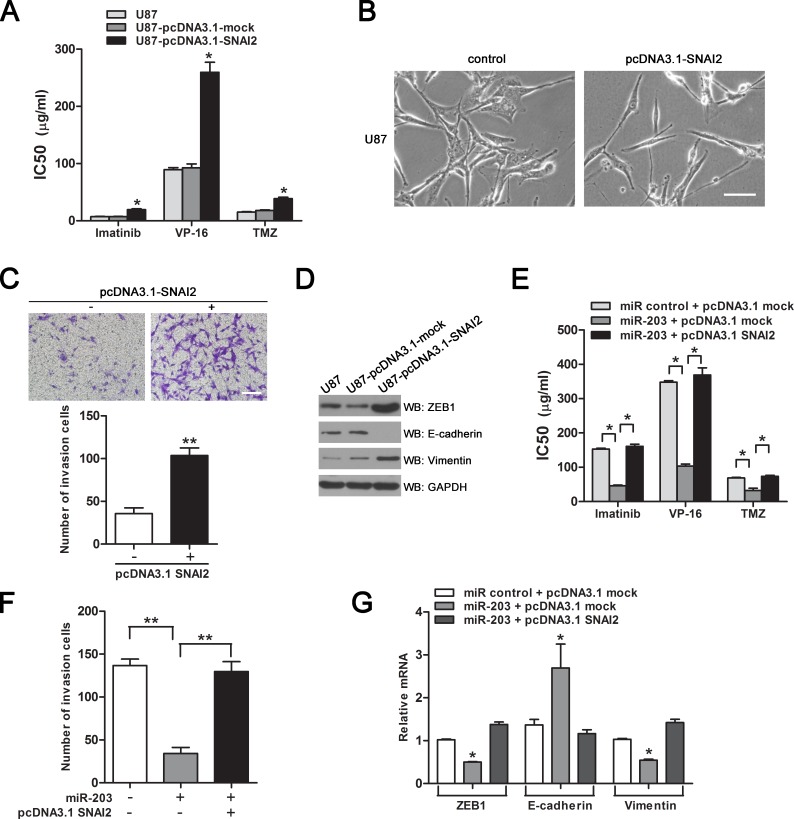
Epithelial-mesenchymal transition (EMT) has been recognized as a key element of cell migration, invasion, and drug resistance in several types of cancer. In this study, our aim was to clarify microRNAs (miRNAs)-related mechanisms underlying EMT followed by acquired resistance to chemotherapy in glioblastoma (GBM). We used multiple methods to achieve our goal including microarray analysis, qRT-PCR, western blotting analysis, loss/gain-of-function analysis, luciferase assays, drug sensitivity assays, wound-healing assay and invasion assay. We found that miR-203 expression was significantly lower in imatinib-resistant GBM cells (U251AR, U87AR) that underwent EMT than in their parental cells (U251, U87). Ectopic expression of miR-203 with miRNA mimics effectively reversed EMT in U251AR and U87AR cells, and sensitized them to chemotherapy, whereas inhibition of miR-203 in the sensitive lines with antisense oligonucleotides induced EMT and conferred chemoresistance. SNAI2 was identified as a direct target gene of miR-203. The knockdown of SNAI2 by short hairpin RNA (shRNA) inhibited EMT and drug resistance. In GBM patients, miR-203 expression was inversely related to SNAI2 expression, and those tumors with low expression of miR-203 experienced poorer clinical outcomes. Our findings indicate that re-expression of miR-203 or targeting SNAI2 might serve as potential therapeutic approaches to overcome chemotherapy resistance in GBM.
上皮-间质转化(EMT)已被认为是多种癌症中细胞迁移、侵袭和耐药性的关键因素。在本研究中,我们的目的是阐明胶质母细胞瘤(GBM)中EMT及随后获得性化疗耐药背后的微小RNA(miRNA)相关机制。我们使用了多种方法来实现这一目标,包括微阵列分析、qRT-PCR、蛋白质印迹分析、功能缺失/获得分析、荧光素酶测定、药物敏感性测定、伤口愈合测定和侵袭测定。我们发现,经历EMT的伊马替尼耐药GBM细胞(U251AR、U87AR)中miR-203的表达明显低于其亲本细胞(U251、U87)。用miRNA模拟物异位表达miR-203可有效逆转U251AR和U87AR细胞中的EMT,并使其对化疗敏感,而用反义寡核苷酸抑制敏感细胞系中的miR-203则诱导EMT并赋予化疗耐药性。SNAI2被确定为miR-203的直接靶基因。短发夹RNA(shRNA)敲低SNAI2可抑制EMT和耐药性。在GBM患者中,miR-203表达与SNAI2表达呈负相关,且miR-203低表达的肿瘤临床预后较差。我们的研究结果表明,重新表达miR-203或靶向SNAI2可能是克服GBM化疗耐药性的潜在治疗方法。