Yang Yan, Hao Yan-lei, Tian Wen-jing, Gong Li, Zhang Kui, Shi Qi-guang, Sun Da-fang, Li Cui-lan, Zhao Zhi-ling
Department of Neurology, Affiliated Hospital of Jining Medical University, 79 Guhuai Rd, Jining, Shandong, China.
Trials. 2015 Mar 24;16:111. doi: 10.1186/s13063-015-0639-8.
Parkinson's disease (PD) is a common degenerative neurological disorder that causes loss of independence and decreased quality of life. The prevalence of PD tends to increase with age. In China, the morbidity rate of PD among people aged more than 65 years old is 1.70%. As an important component of traditional Chinese Qigong exercises, Tai Chi is a popular and safe exercise, especially for older adults in China. And it may result in promising gains for PD patients. However, current evidence is insufficient to inform the use of Tai Chi in the management of PD. Therefore, the aim of this trial is to systematically evaluate the effect of Tai Chi on PD and determine whether Tai Chi is an eligible exercise program for Chinese PD patients.
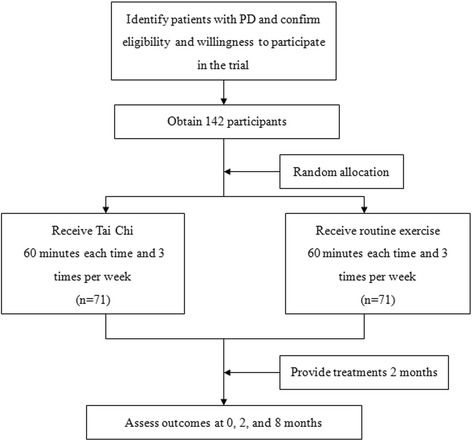
METHODS/DESIGN: A single-blind, parallel randomized controlled trial will be conducted. One hundred and forty-two patients with PD will be randomly assigned to a Tai Chi group (n = 71) or routine exercise group (n = 71). Subjects will participate in supervised study programs 3 times per week for 2 months and will be followed for an additional 6 months after formal training stops. The primary outcome measures include Berg Balance Scale, Timed Up and Go Test and Six-Minute Walk Test, which are known to be valid and reliable clinical instruments. The Unified Parkinson's Disease Rating Scale Motor Section and Parkinson's Disease Questionnaire-39 will be used as the secondary outcome measure. All outcomes will be measured at baseline, 2 and 8 months. The sample for this trial (N = 142) will provide relevant information to detect the improvement of balance, gait and quality of life in either of the 2 exercise groups.
Findings from this study will provide insights into the effects of Tai Chi in people with PD. The information gained from this project has the potential to influence the clinical decisions of Chinese doctors, and will provide clear evidence as to whether Tai Chi should be advocated in people with PD.
The trial was registered at ( ChiCTR-TRC-14004549 ) on 22 April 2014.
帕金森病(PD)是一种常见的退行性神经疾病,会导致患者失去自理能力并降低生活质量。PD的患病率往往随年龄增长而增加。在中国,65岁以上人群中PD的发病率为1.70%。太极拳作为中国传统气功练习的重要组成部分,是一种广受欢迎且安全的运动,尤其在中国的老年人中。它可能会给PD患者带来显著益处。然而,目前的证据不足以支持在PD管理中使用太极拳。因此,本试验的目的是系统评估太极拳对PD的影响,并确定太极拳是否是适合中国PD患者的运动项目。
方法/设计:将进行一项单盲、平行随机对照试验。142例PD患者将被随机分为太极拳组(n = 71)或常规运动组(n = 71)。受试者将每周参加3次监督学习项目,为期2个月,在正式训练停止后还将随访6个月。主要结局指标包括伯格平衡量表、计时起立行走测试和六分钟步行测试,这些都是已知有效的临床工具。统一帕金森病评定量表运动部分和帕金森病问卷-39将用作次要结局指标。所有结局指标将在基线、2个月和8个月时进行测量。本试验的样本(N = 142)将提供相关信息,以检测两个运动组中任何一组在平衡、步态和生活质量方面的改善情况。
本研究的结果将为太极拳对PD患者的影响提供见解。从该项目获得的信息有可能影响中国医生的临床决策,并将为是否应在PD患者中提倡太极拳提供明确证据。
该试验于2014年4月22日在(ChiCTR-TRC-14004549)注册。