Buttolph Lita, Wooliscroft Lindsey, Bradley Ryan, Zwickey Heather
Helfgott Research Institute, National University of Natural Medicine, Portland, OR, USA.
Department of Neurology, Oregon Health and Science University, Portland, OR, USA.
Integr Med Rep. 2023 Feb 1;2(1):26-34. doi: 10.1089/imr.2022.0079.
Multiple sclerosis (MS) is a progressive neurodegenerative disorder affecting motor and nonmotor function including physical and cognitive decline, fatigue, anxiety, and depression. Qigong is a mind-body self-care practice with the potential to address MS symptoms. Publicly available community qigong classes may provide opportunities for people with MS to access qigong, but little is known about the risks and benefits. A mixed methods study of community qigong was conducted for people with MS. In this article, the results of this qualitative analysis to identify benefits and challenges faced by people with MS attending community qigong classes were presented.
Qualitative data were collected from an exit survey of 14 study participants with MS who enrolled in a pragmatic trial of community qigong classes for 10 weeks. Participants were new to community-based classes offered but some had experience with qigong/tai chi/other martial arts or yoga. Data were analyzed using reflexive thematic analysis.
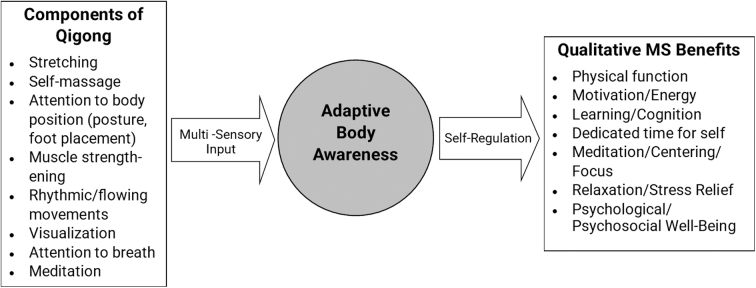
Seven common themes were identified from this analysis: (1) physical function, (2) motivation/energy, (3) learning, (4) dedicating time for self, (5) meditation/centering/focus, (6) relaxation/stress relief, and (7) psychological/psychosocial. These themes reflected both positive and negative experiences with community qigong classes and home practice. Self-reported benefits centered around improved flexibility, endurance, energy, and focus; stress relief; and psychological/psychosocial benefits. Challenges included physical discomfort including short-term pain, balance difficulty, and heat intolerance.
The qualitative findings provide evidence to support qigong as a self-care practice that may benefit people with MS. The challenges identified in the study will help to inform future clinical trials of qigong for MS.
ClinicalTrials.gov (CTR#: NCT04585659).
多发性硬化症(MS)是一种进行性神经退行性疾病,会影响运动和非运动功能,包括身体和认知能力下降、疲劳、焦虑和抑郁。气功是一种身心自我保健方法,有可能缓解MS症状。公开的社区气功课程可能为MS患者提供接触气功的机会,但人们对其风险和益处知之甚少。针对MS患者开展了一项关于社区气功的混合方法研究。本文介绍了这项定性分析的结果,以确定参加社区气功课程的MS患者所面临的益处和挑战。
通过对14名参加为期10周社区气功课程实用试验的MS研究参与者的退出调查收集定性数据。参与者对所提供的基于社区的课程并不熟悉,但有些人有气功/太极拳/其他武术或瑜伽的经验。使用反思性主题分析法对数据进行分析。
从该分析中确定了七个常见主题:(1)身体功能,(2)动力/精力,(3)学习,(4)为自己留出时间,(5)冥想/定心/专注,(6)放松/缓解压力,以及(7)心理/心理社会。这些主题反映了社区气功课程和家庭练习的积极和消极体验。自我报告的益处集中在提高灵活性、耐力、精力和专注力;缓解压力;以及心理/心理社会效益。挑战包括身体不适,如短期疼痛、平衡困难和不耐热。
定性研究结果为支持气功作为一种可能使MS患者受益的自我保健方法提供了证据。该研究中确定的挑战将有助于为未来MS气功临床试验提供信息。
ClinicalTrials.gov(CTR#:NCT04585659)。