Forsblom Erik, Ruotsalainen Eeva, Järvinen Asko
Division of Infectious Diseases, Department of Medicine, Helsinki University Central Hospital, Helsinki, Finland.
PLoS One. 2015 Apr 13;10(4):e0122824. doi: 10.1371/journal.pone.0122824. eCollection 2015.
Rifampicin has been used as adjunctive therapy in Staphylococcus aureus bacteraemia (SAB) with a deep infection focus. However, data for prognostic impact of rifampicin therapy is unestablished including the optimal initiation time point. We studied the impact of rifampicin therapy and the optimal initiation time for rifampicin treatment on prognosis in methicillin-sensitive S. aureus bacteraemia with a deep infection.
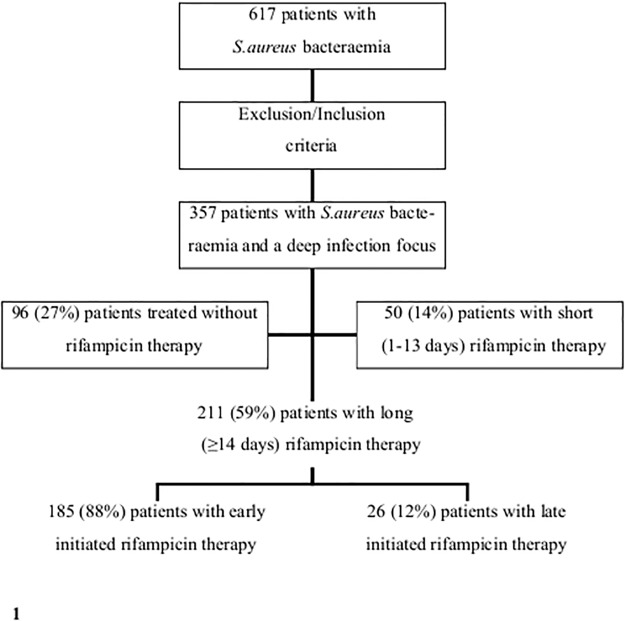
Retrospective, multicentre study in Finland including 357 SAB patients with a deep infection focus. Patients with alcoholism, liver disease or patients who died within 3 days were excluded. Patients were categorised according to duration of rifampicin therapy and according to whether rifampicin was initiated early (within 7 days) or late (7 days after) after the positive blood cultures. Primary end point was 90 days mortality.
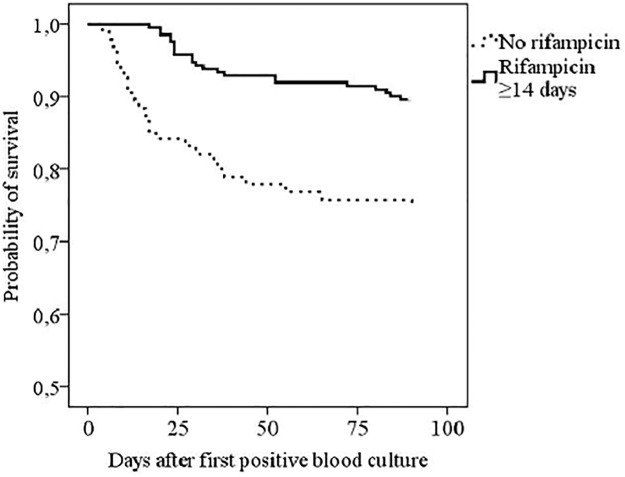
Twenty-seven percent of patients received no rifampicin therapy, 14% received rifampicin for 1-13 days whereas 59% received rifampicin ≥14 days. The 90 day mortality was; 26% for patients treated without rifampicin, 16% for rifampicin therapy of any length and 10% for early onset rifampicin therapy ≥14 days. Lack of rifampicin therapy increased (OR 1.89, p=0.026), rifampicin of any duration decreased (OR 0.53, p=0.026) and rifampicin therapy ≥14 days with early onset lowered the risk for a fatal outcome (OR 0.33, p<0.01) during 90 days follow-up.
Rifampicin adjunctive therapy for at least 14 days and initiated within 7 days of positive blood culture associated with improved outcome among SAB patients with a deep infection.
利福平已被用作伴有深部感染灶的金黄色葡萄球菌菌血症(SAB)的辅助治疗。然而,利福平治疗对预后影响的数据尚未确立,包括最佳起始时间点。我们研究了利福平治疗及其最佳起始时间对伴有深部感染的甲氧西林敏感金黄色葡萄球菌菌血症患者预后的影响。
在芬兰进行的一项回顾性多中心研究,纳入357例伴有深部感染灶的SAB患者。排除酗酒、肝病患者或在3天内死亡的患者。根据利福平治疗的持续时间以及利福平是在血培养阳性后早期(7天内)还是晚期(7天后)开始使用进行分类。主要终点是90天死亡率。
27%的患者未接受利福平治疗,14%的患者接受利福平治疗1 - 13天,而59%的患者接受利福平治疗≥14天。90天死亡率分别为:未接受利福平治疗的患者为26%,接受任何时长利福平治疗的患者为16%,早期开始且治疗≥14天的患者为10%。未使用利福平治疗会增加死亡风险(OR 1.89,p = 0.026),任何时长的利福平治疗会降低死亡风险(OR 0.53,p = 0.026),早期开始且治疗≥14天的利福平治疗在90天随访期间降低了致命结局的风险(OR 0.33,p < 0.01)。
对于伴有深部感染的SAB患者,利福平辅助治疗至少14天并在血培养阳性后7天内开始使用与改善预后相关。