Wichmann C, Moser T
Molecular Architecture of Synapses Group, Institute for Auditory Neuroscience and InnerEarLab, University Medical Center Göttingen, Göttingen, Germany,
Cell Tissue Res. 2015 Jul;361(1):95-114. doi: 10.1007/s00441-014-2102-7. Epub 2015 Jan 22.
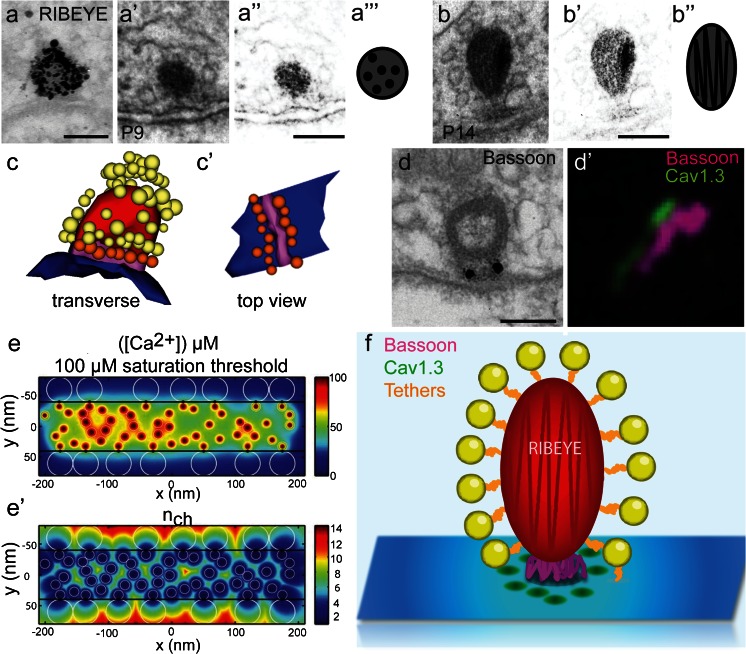
In the mammalian cochlea, sound is encoded at synapses between inner hair cells (IHCs) and type I spiral ganglion neurons (SGNs). Each SGN receives input from a single IHC ribbon-type active zone (AZ) and yet SGNs indefatigably spike up to hundreds of Hz to encode acoustic stimuli with submillisecond precision. Accumulating evidence indicates a highly specialized molecular composition and structure of the presynapse, adapted to suit these high functional demands. However, we are only beginning to understand key features such as stimulus-secretion coupling, exocytosis mechanisms, exo-endocytosis coupling, modes of endocytosis and vesicle reformation, as well as replenishment of the readily releasable pool. Relating structure and function has become an important avenue in addressing these points and has been applied to normal and genetically manipulated hair cell synapses. Here, we review some of the exciting new insights gained from recent studies of the molecular anatomy and physiology of IHC ribbon synapses.
在哺乳动物的耳蜗中,声音在内耳毛细胞(IHC)与I型螺旋神经节神经元(SGN)之间的突触处进行编码。每个SGN从单个IHC带状活性区(AZ)接收输入,然而SGN能够不知疲倦地以高达数百赫兹的频率放电,以亚毫秒级的精度编码声刺激。越来越多的证据表明突触前膜具有高度专业化的分子组成和结构,以适应这些高功能需求。然而,我们才刚刚开始了解诸如刺激-分泌偶联、胞吐机制、胞吐-胞吞偶联、内吞模式和囊泡重塑以及易释放池的补充等关键特征。将结构与功能联系起来已成为解决这些问题的重要途径,并已应用于正常和基因操纵的毛细胞突触。在这里,我们回顾了最近关于IHC带状突触分子解剖学和生理学研究中获得的一些令人兴奋的新见解。