Shen Zhong-Jian, Malter James S
Department of Pathology, University of Texas Southwestern Medical Center, Dallas, TX 75390-8548, USA.
Biomolecules. 2015 Apr 14;5(2):412-34. doi: 10.3390/biom5020412.
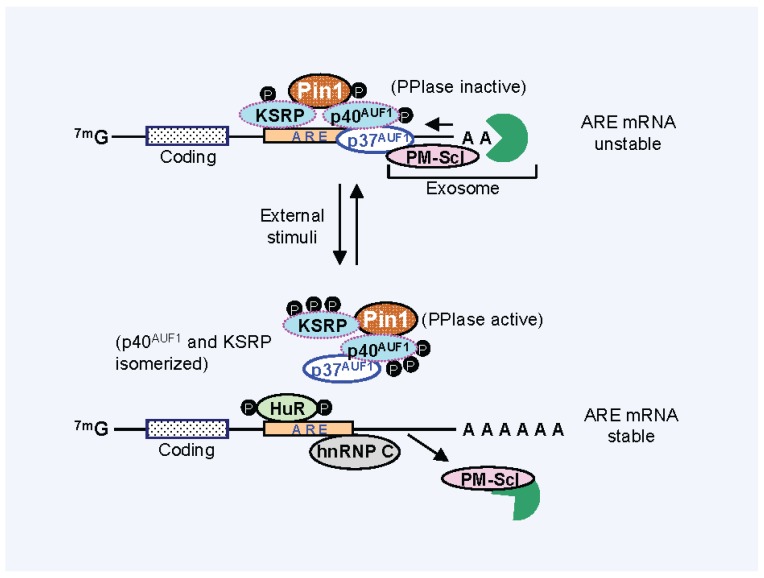
The accumulation of 3' untranslated region (3'-UTR), AU-rich element (ARE) containing mRNAs, are predominantly controlled at the post-transcriptional level. Regulation appears to rely on a variable and dynamic interaction between mRNA target and ARE-specific binding proteins (AUBPs). The AUBP-ARE mRNA recognition is directed by multiple intracellular signals that are predominantly targeted at the AUBPs. These include (but are unlikely limited to) methylation, acetylation, phosphorylation, ubiquitination and isomerization. These regulatory events ultimately affect ARE mRNA location, abundance, translation and stability. In this review, we describe recent advances in our understanding of phosphorylation and its impact on conformation of the AUBPs, interaction with ARE mRNAs and highlight the role of Pin1 mediated prolyl cis-trans isomerization in these biological process.
富含AU元件(ARE)的3'非翻译区(3'-UTR)mRNA的积累主要在转录后水平受到调控。这种调控似乎依赖于mRNA靶标与ARE特异性结合蛋白(AUBP)之间可变且动态的相互作用。AUBP与ARE mRNA的识别由多种主要作用于AUBP的细胞内信号引导。这些信号包括(但不限于)甲基化、乙酰化、磷酸化、泛素化和异构化。这些调控事件最终影响ARE mRNA的定位、丰度、翻译和稳定性。在本综述中,我们描述了我们对磷酸化及其对AUBP构象影响的最新认识进展,以及其与ARE mRNA相互作用,并强调了Pin1介导的脯氨酰顺反异构化在这些生物学过程中的作用。