Weng Ting Chia, Chan Ta Chien, Lin Hsien Tang, Chang Chia Kun Jasper, Wang Wen Wen, Li Zheng Rong Tiger, Cheng Hao-Yuan, Chu Yu-Roo, Chiu Allen Wen-Hsiang, Yen Muh-Yong, King Chwan-Chuen
Department of Medicine, College of Medicine, National Taiwan University (NTU), Taipei, Taiwan, Republic of China.
Research Center for Humanities and Social Sciences, Academia Sinica, Taipei, Taiwan, R.O.C.
PLoS One. 2015 Apr 15;10(4):e0122865. doi: 10.1371/journal.pone.0122865. eCollection 2015.
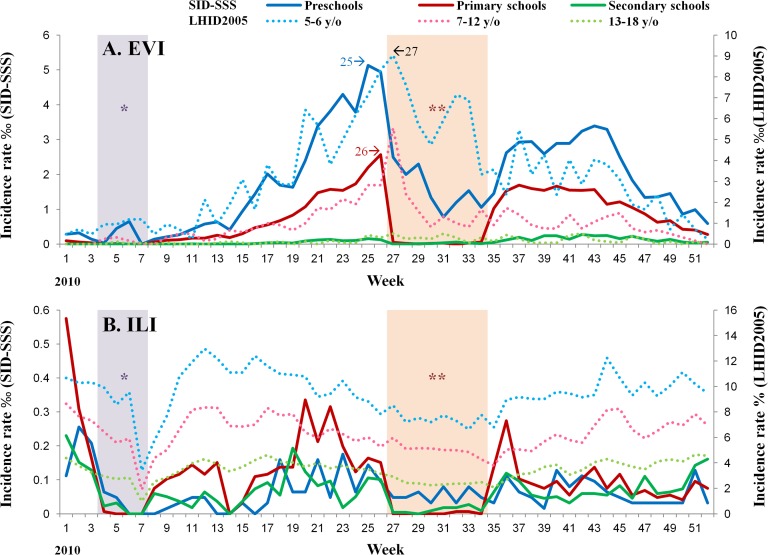
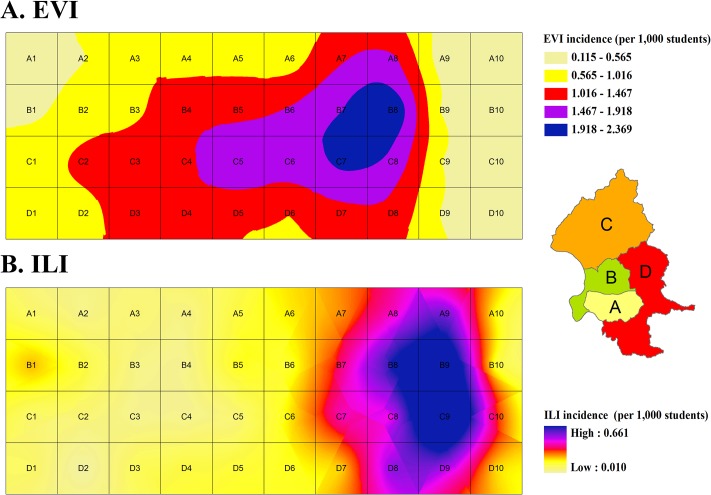
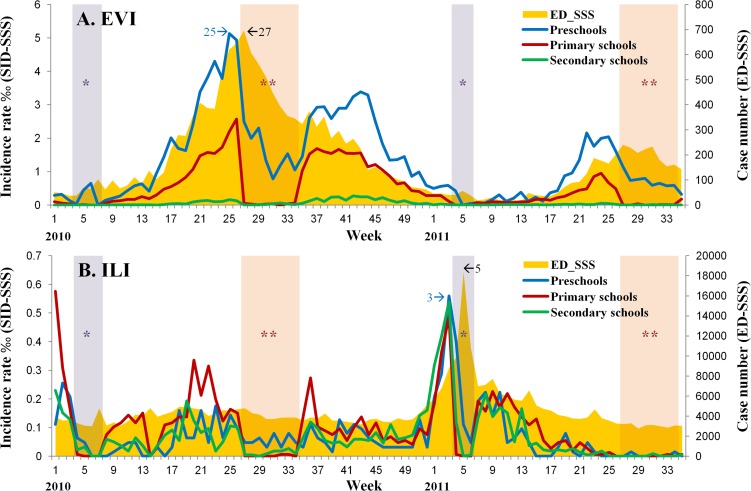
School children may transmit pathogens with cluster cases occurring on campuses and in families. In response to the 2009 influenza A (H1N1) pandemic, Taipei City Government officials developed a School-based Infectious Disease Syndromic Surveillance System (SID-SSS). Teachers and nurses from preschools to universities in all 12 districts within Taipei are required to daily report cases of symptomatic children or sick leave requests through the SID-SSS. The pre-diagnosis at schools is submitted firstly as common pediatric disease syndrome-groups and re-submitted after confirmation by physicians. We retrieved these data from January 2010 to August 2011 for spatio-temporal analysis and evaluated the temporal trends with cases obtained from both the Emergency Department-based Syndromic Surveillance System (ED-SSS) and the Longitudinal Health Insurance Database 2005 (LHID2005). Through the SID-SSS, enterovirus-like illness (EVI) and influenza-like illness (ILI) were the two most reported syndrome groups (77.6% and 15.8% among a total of 19,334 cases, respectively). The pre-diagnosis judgments made by school teachers and nurses showed high consistency with physicians' clinical diagnoses for EVI (97.8%) and ILI (98.9%). Most importantly, the SID-SSS had better timeliness with earlier peaks of EVI and ILI than those in the ED-SSS. Furthermore, both of the syndrome groups in these two surveillance systems had the best correlation reaching 0.98 and 0.95, respectively (p<0.01). Spatio-temporal analysis observed the patterns of EVI and ILI both diffuse from the northern suburban districts to central Taipei, with ILI spreading faster. This novel system can identify early suspected cases of two important pediatric infections occurring at schools, and clusters from schools/families. It was also cost-effective (95.5% of the operation cost reduced and 59.7% processing time saved). The timely surveillance of mild EVI and ILI cases integrated with spatial analysis may help public health decision-makers with where to target for enhancing surveillance and prevention measures to minimize severe cases.
学童可能会传播病原体,导致校园和家庭中出现聚集性病例。为应对2009年甲型H1N1流感大流行,台北市政府官员开发了一个基于学校的传染病症状监测系统(SID - SSS)。台北市12个行政区内从幼儿园到大学的教师和护士都被要求通过SID - SSS每日报告有症状儿童的病例或病假申请。学校的初步诊断首先作为常见儿科疾病综合征组提交,经医生确认后再次提交。我们检索了2010年1月至2011年8月的数据进行时空分析,并与基于急诊科的症状监测系统(ED - SSS)和2005年纵向健康保险数据库(LHID2005)中的病例一起评估时间趋势。通过SID - SSS,肠道病毒样疾病(EVI)和流感样疾病(ILI)是报告最多的两个综合征组(在总共19334例病例中分别占77.6%和15.8%)。学校教师和护士做出的初步诊断判断与医生对EVI(97.8%)和ILI(98.9%)的临床诊断具有高度一致性。最重要的是,SID - SSS的及时性更好,EVI和ILI的峰值出现时间比ED - SSS更早。此外,这两个监测系统中的这两个综合征组的相关性最好,分别达到0.98和0.95(p<0.01)。时空分析观察到EVI和ILI的模式都是从北郊地区向台北市中心扩散,ILI传播得更快。这个新系统可以识别学校中发生的两种重要儿科感染的早期疑似病例以及学校/家庭中的聚集性病例。它还具有成本效益(运营成本降低95.5%,处理时间节省59.7%)。对轻度EVI和ILI病例的及时监测与空间分析相结合,可能有助于公共卫生决策者确定加强监测和预防措施的目标地点,以尽量减少重症病例。