Zhang Rui-Ping, Xu Cheng, Liu Yin, Li Jian-Ding, Xie Jun
Department of Radiology, First Hospital, Shanxi Medical University, Taiyuan, Shanxi Province, China ; Molecular Imaging Program at Stanford, Stanford University, Stanford, CA, USA.
Department of Radiology, Shanxi Provincial People's Hospital, Taiyuan, Shanxi Province, China.
Neural Regen Res. 2015 Mar;10(3):404-11. doi: 10.4103/1673-5374.153688.
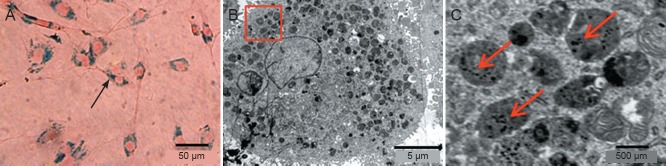
An important factor in improving functional recovery from spinal cord injury using stem cells is maximizing the number of transplanted cells at the lesion site. Here, we established a contusion model of spinal cord injury by dropping a weight onto the spinal cord at T7-8. Superparamagnetic iron oxide-labeled bone marrow mesenchymal stem cells were transplanted into the injured spinal cord via the subarachnoid space. An outer magnetic field was used to successfully guide the labeled cells to the lesion site. Prussian blue staining showed that more bone marrow mesenchymal stem cells reached the lesion site in these rats than in those without magnetic guidance or superparamagnetic iron oxide labeling, and immunofluorescence revealed a greater number of complete axons at the lesion site. Moreover, the Basso, Beattie and Bresnahan (BBB) locomotor rating scale scores were the highest in rats with superparamagnetic labeling and magnetic guidance. Our data confirm that superparamagnetic iron oxide nanoparticles effectively label bone marrow mesenchymal stem cells and impart sufficient magnetism to respond to the external magnetic field guides. More importantly, superparamagnetic iron oxide-labeled bone marrow mesenchymal stem cells can be dynamically and non-invasively tracked in vivo using magnetic resonance imaging. Superparamagnetic iron oxide labeling of bone marrow mesenchymal stem cells coupled with magnetic guidance offers a promising avenue for the clinical treatment of spinal cord injury.
利用干细胞改善脊髓损伤功能恢复的一个重要因素是使损伤部位移植细胞数量最大化。在此,我们通过在T7 - 8节段向脊髓上掉落重物建立了脊髓损伤的挫伤模型。将超顺磁性氧化铁标记的骨髓间充质干细胞经蛛网膜下腔移植到损伤的脊髓中。使用外部磁场成功地将标记细胞引导至损伤部位。普鲁士蓝染色显示,与未进行磁引导或超顺磁性氧化铁标记的大鼠相比,这些大鼠中有更多的骨髓间充质干细胞到达损伤部位,免疫荧光显示损伤部位有更多完整的轴突。此外,在具有超顺磁性标记和磁引导的大鼠中,Basso、Beattie和Bresnahan(BBB)运动评分量表得分最高。我们的数据证实,超顺磁性氧化铁纳米颗粒能有效标记骨髓间充质干细胞,并赋予足够的磁性以响应外部磁场引导。更重要的是,使用磁共振成像可以在体内动态、无创地追踪超顺磁性氧化铁标记的骨髓间充质干细胞。骨髓间充质干细胞的超顺磁性氧化铁标记与磁引导相结合为脊髓损伤的临床治疗提供了一条有前景的途径。