Wu Jing-Xian, Zhang Lu-Yu, Chen Yan-Lin, Yu Shan-Shan, Zhao Yong, Zhao Jing
Department of Pathology, Chongqing Medical University, Chongqing, China ; Institute of Neuroscience, Chongqing Medical University, Chongqing, China.
Molecular Medicine and Cancer Research Center, Chongqing Medical University, Chongqing, China.
Neural Regen Res. 2015 Mar;10(3):481-9. doi: 10.4103/1673-5374.153700.
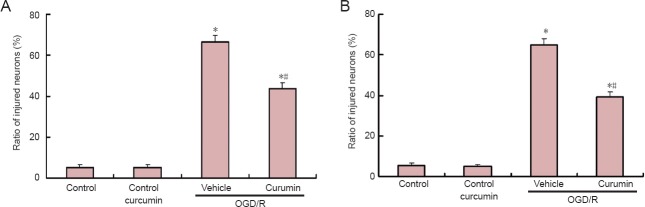
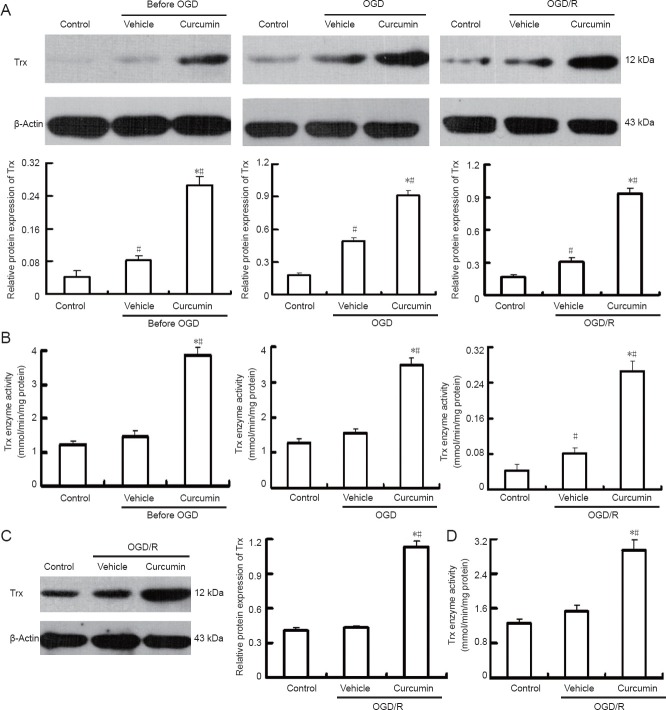
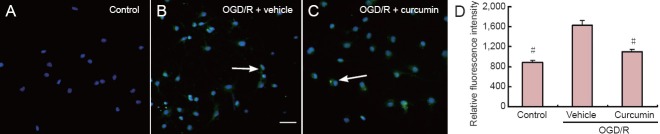
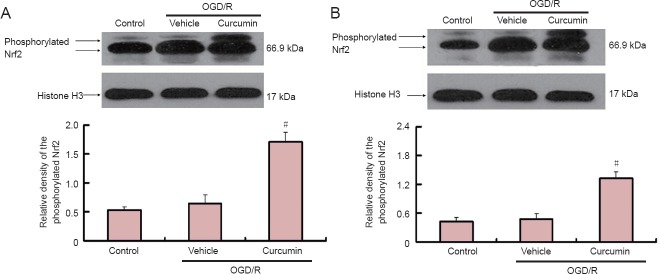
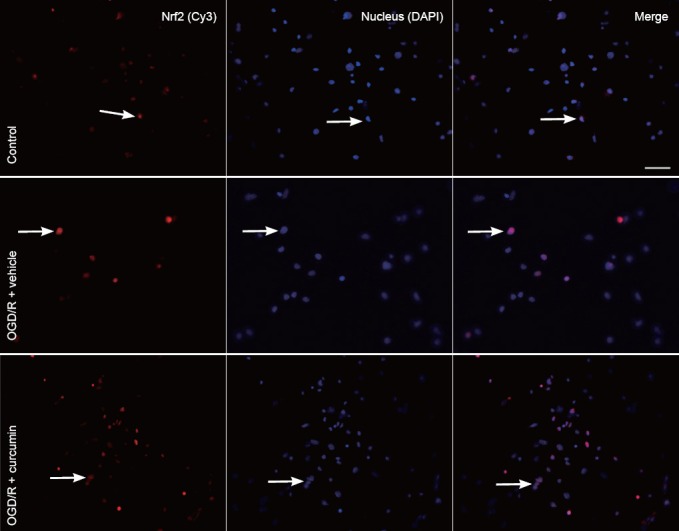
Recent studies have shown that induced expression of endogenous antioxidative enzymes thr-ough activation of the antioxidant response element/nuclear factor erythroid 2-related factor 2 (Nrf2) pathway may be a neuroprotective strategy. In this study, rat cerebral cortical neurons cultured in vitro were pretreated with 10 μM curcumin or post-treated with 5 μM curcumin, respectively before or after being subjected to oxygen-glucose deprivation and reoxygenation for 24 hours. Both pretreatment and post-treatment resulted in a significant decrease of cell injury as indicated by propidium iodide/Hoechst 33258 staining, a prominent increase of Nrf2 protein expression as indicated by western blot analysis, and a remarkable increase of protein expression and enzyme activity in whole cell lysates of thioredoxin before ischemia, after ischemia, and after reoxygenation. In addition, post-treatment with curcumin inhibited early DNA/RNA oxidation as indicated by immunocytochemistry and increased nuclear Nrf2 protein by inducing nuclear accumulation of Nrf2. These findings suggest that curcumin activates the expression of thioredoxin, an antioxidant protein in the Nrf2 pathway, and protects neurons from death caused by oxygen-glucose deprivation in an in vitro model of ischemia/reperfusion. We speculate that pharmacologic stimulation of antioxidant gene expression may be a promising approach to neuroprotection after cerebral ischemia.
最近的研究表明,通过激活抗氧化反应元件/核因子红细胞2相关因子2(Nrf2)途径诱导内源性抗氧化酶的表达可能是一种神经保护策略。在本研究中,体外培养的大鼠大脑皮质神经元在经历24小时氧糖剥夺和复氧之前或之后,分别用10μM姜黄素预处理或5μM姜黄素后处理。预处理和后处理均导致细胞损伤显著减少,这通过碘化丙啶/ Hoechst 33258染色得以表明;Nrf2蛋白表达显著增加,这通过蛋白质印迹分析得以表明;并且在缺血前、缺血后和复氧后,硫氧还蛋白全细胞裂解物中的蛋白质表达和酶活性显著增加。此外,姜黄素后处理抑制了早期DNA/RNA氧化,这通过免疫细胞化学得以表明,并且通过诱导Nrf2的核积累增加了核Nrf2蛋白。这些发现表明,姜黄素激活了硫氧还蛋白(Nrf2途径中的一种抗氧化蛋白)的表达,并在缺血/再灌注体外模型中保护神经元免受氧糖剥夺导致的死亡。我们推测,对抗氧化基因表达的药理学刺激可能是脑缺血后神经保护的一种有前景的方法。