Teng Shiyong, Joseph Mary Joseline, Yu Huizhi, Hu Chunlan, Li Xiaoshan, Hu Chunxiao
Department of Anesthesiology, First Hospital of Jilin University, Changchun, China.
Department of Laboratory Medicine, First Hospital of Jilin University, Changchun, China.
Ann Transl Med. 2022 Jul;10(14):807. doi: 10.21037/atm-22-3178.
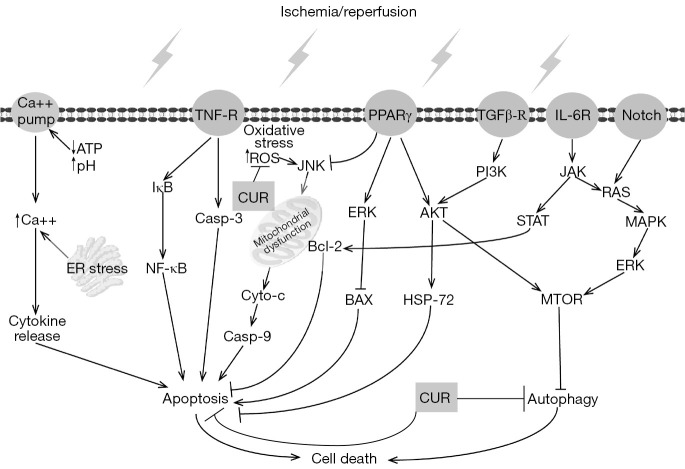
Ischemia-reperfusion (IR) injury is the cause of morbidity and mortality in a variety of diseases and surgical procedures including organ transplantation surgeries, acute coronary syndrome, strokes, and limb injuries. IR injury causes dysfunction of tissues and organs, and oxidative stress plays an important role in driving this process. Curcumin (CUR), a polyphenolic compound derived from turmeric, protects against IR injury by alleviating oxidative stress, reactive oxygen species (ROS) inflammation, apoptosis, and fibrosis. We review the protective effects of CUR against IR.
We searched PubMed, ScienceDirect, and Web of Science databases using the keywords: ischemic reperfusion, CUR and summarized the results.
The effects of CUR during IR have been reported for animal models and and the compound has been shown in various organs by suppression of oxidative stress, prevention of inflammation, inhibition of apoptosis and autophagy. CUR with nanocarriers showed many advantages than free CUR in the treatment of IR injury, such as improved bioavailability, sustained-release, better water solubility, better target organ accumulation, improved permeability across the blood-brain-barrier and more effective.
Nanotechnology offers significant improvements and promising strategies to improve drug delivery to IR-injured tissues and achieve the desired protective effects. Thus, it is necessary to promote further clinical trials to promote the clinical application of CUR with nanocarriers.
缺血再灌注(IR)损伤是包括器官移植手术、急性冠脉综合征、中风和肢体损伤在内的多种疾病及外科手术中发病和死亡的原因。IR损伤会导致组织和器官功能障碍,氧化应激在推动这一过程中起重要作用。姜黄素(CUR)是一种从姜黄中提取的多酚化合物,通过减轻氧化应激、活性氧(ROS)炎症、细胞凋亡和纤维化来预防IR损伤。我们综述了CUR对IR的保护作用。
我们使用关键词“缺血再灌注”“CUR”在PubMed、ScienceDirect和Web of Science数据库中进行搜索并总结结果。
已报道了CUR在IR过程中对动物模型的作用,并且该化合物在各个器官中均显示出通过抑制氧化应激、预防炎症、抑制细胞凋亡和自噬的作用。与游离CUR相比,纳米载体CUR在治疗IR损伤方面具有许多优势,如提高生物利用度、缓释、更好的水溶性、更好的靶器官蓄积、改善血脑屏障通透性以及更有效。
纳米技术为改善向IR损伤组织的药物递送并实现所需的保护作用提供了显著改进和有前景的策略。因此,有必要推动进一步的临床试验以促进纳米载体CUR的临床应用。